When the Storm IS the Sermon!
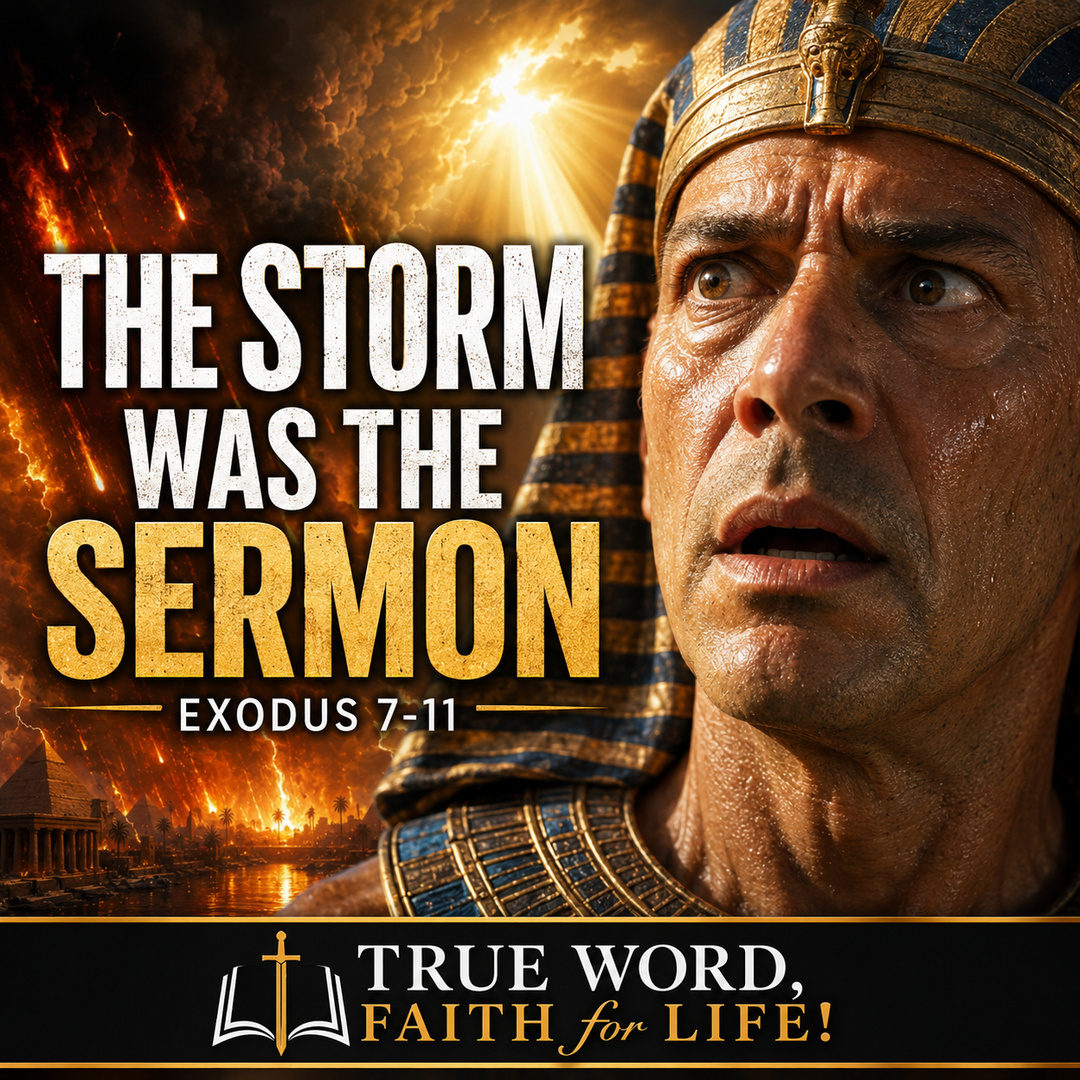
When the Storm Is the Sermon
A Reflection on Exodus 7 Through 11
I've spent the better part of five days living inside Pharaoh's refusals, and it hasn't been comfortable.
Not because the history is hard to follow. It isn't. Nine plagues, one increasingly stubborn king, a nation of slaves watching their captor unravel one catastrophe at a time. The history is straightforward. What isn't comfortable is how familiar the man at the center of it started to feel by about Wednesday.
I want to walk back through this week with you, not as a recap of five episodes, but as an honest look at what sitting inside these chapters for a week actually did to me, and maybe to you too.
A Fight Picked on Purpose
It starts in Exodus 7 with two old men. Moses is eighty. Aaron is eighty-three. God looks at them and says something almost startling: I have made you like God to Pharaoh. Not messengers. Not go-betweens. Like God to Pharaoh.
Aaron throws down his staff. It becomes a serpent. Pharaoh's magicians throw down theirs and match it, serpent for serpent, and for one breath it looks like a standoff. Then Aaron's serpent swallows theirs, and the entire outcome of the next nine chapters is already decided, even though nobody standing in that room could have known it yet.
I keep coming back to that image. God didn't out-argue Egypt's counterfeit power. He consumed it. There's a difference between winning a debate and ending one, and the staff swallowing the staffs is God ending one before it really starts.
Here's what struck me hardest working through this chapter: God picked this fight on purpose, with full knowledge of exactly how hard Pharaoh would resist. He wasn't hoping for an easy win. He was choosing a hard one, because His people were on the other side of it. I think about the things in my own life I've been managing instead of asking God to actually break. The parts of my story that feel too old, too embedded, too complicated for a direct confrontation. Exodus 7 doesn't let me keep believing that. God still picks fights He intends to win. He just doesn't always fight them on the timeline I'd prefer.
The Word That Cost Everything
Exodus 8 is where this got personal in a way I didn't expect.
Frogs come first, and for the first time in the whole sequence, Pharaoh bends. He calls for Moses and asks him to pray the frogs away. Moses hands him the easiest opening he'll get all week: name the hour, and I'll ask God to do it exactly then. Pharaoh's answer is one word.
Tomorrow.
I sat with that word longer than I expected to. Tomorrow sounds so reasonable. It sounds like patience, like wisdom, like someone taking their time to do things right. It isn't. It's a vote, cast quietly, to stay exactly where you are for one more night. Pharaoh didn't lose Egypt in one catastrophic decision. He lost it one tomorrow at a time, three plagues running, until there was nothing left to negotiate with. I don't think I'm alone in recognizing that pattern. I think most of us have a tomorrow sitting somewhere in our own lives right now, dressed up to look like prudence, that's actually just delay with better public relations.
Confessions With No Follow-Through
By Exodus 9, something even more uncomfortable starts happening. Pharaoh starts confessing.
Right in the middle of a hailstorm mixed with fire, the worst Egypt had ever seen, Pharaoh says the words: I have sinned. The LORD is righteous. I'm wrong. It sounds real, because in that moment, it probably was. Moses prays. The hail stops. And the instant the sky clears, Pharaoh hardens his heart again, as if the confession had never happened.
Scripture uses three different Hebrew words to track what's happening to Pharaoh's heart across this sequence, and they build on each other in a way that stopped me cold. Chazaq means to grow stubborn. Qashah means to grow harsh. And kabed means to grow heavy, sharing its root with kavod, the Hebrew word for glory. The weight that should have belonged to God's glory got rerouted, plague after plague, into the weight of one man refusing to bend, until the glory he was stealing turned into the very thing crushing him.
I've prayed Pharaoh's prayer. I'd guess you have too, even if you never used those exact words. Get me through this and I'll change everything, I promise. And then the storm passes, and the promise quietly leaves the room without anyone deciding it should. The only honest test of whether a confession was real is what it looks like on an ordinary Tuesday, with nothing on fire and nothing forcing your hand. Anybody can sound sincere with hail falling on their head. The Tuesday has no hail. The Tuesday only has whatever's actually true.
Chosen Blindness
Exodus 10 ends with darkness so thick the text says you could feel it. Three full days. Nobody could see anybody else, not even across the room. And in that same Egypt, under that same sky, Israel had light the entire time.
What got me about this chapter wasn't the darkness itself. It was how Pharaoh got there. Nobody wakes up one morning suddenly blind to God. It happens one declined warning at a time, one small refusal stacked on the last one, until the refusals stop even registering as refusals. By the time the actual darkness fell, Pharaoh had already been choosing it for chapters. The physical darkness was just catching up to a decision he'd already made nine times over.
There's real mercy hiding inside that hard truth, though. The light never moved. It was standing in Goshen the entire three days, in the same Egypt Pharaoh was groping through blind. Distance from the light has never once meant the light moved. It's always meant the choosing moved instead.
Mercy With a Clock On It
And then Exodus 11. One announcement left. Midnight, God said, out loud, in advance, on purpose. Every firstborn in Egypt. And a door in every Israelite home that would decide who woke up in the morning and who didn't.
Here's what I keep returning to. God didn't need to warn anyone. He already knew Pharaoh wouldn't yield. He told him anyway, with a specific hour attached, because the warning was never really for Pharaoh's benefit alone. It was for Israel, so they'd have time to actually prepare. And it's for every generation reading this since, so we'd understand something that's held true in every single one of these five chapters: God never sends judgment silently. He always sends word first, with enough time attached to actually do something about it.
The blood on the doorpost didn't stop midnight from coming. It changed what midnight meant when it arrived. That's still true. The hard providence still comes, the same hour, to everyone. What changes is what's already covering the door before it gets there.
What This Week Left Me With
I didn't expect a week in the plagues of Egypt to feel this personal. But laid out side by side, these five chapters trace something uncomfortably familiar: a heart moving from managed, to delayed, to falsely relieved, to blind, to finally out of time. I recognized more than one stage of that in myself this week, and I'd be surprised if you don't too.
Here's the mercy underneath all of it, though, and it's the reason this isn't just a hard week of history. Pharaoh had a door standing open longer than he deserved, all the way through Exodus 11. So do you. That door hasn't closed. The storm was never separate from the sermon. It was the sermon, delivered in mercy, with enough warning attached to actually change what happens next.
If any part of this week named something true in your own life, I'd encourage you not to let it pass by unanswered. Get the blood on your own door, today, while the offer is still standing in front of you.
If this teaching has been giving you solid ground to stand on, my book, True Word, Faith for LIFE!, goes deeper into these themes. You can find it at TrueWordFaithforLife.com.
Shalom, Dr. Shawn
---
True Word, Faith for LIFE! - The Book: https://www.truewordfaithforlife.com/store/true-word-faith-for-life-the-book/
Bible Rebinding: MooseWorks Bible Rebinding by Melissa: https://www.etsy.com/shop/MooseWorksBibles
STUDY GUIDE
Exodus 7 Through 11: The Plagues of Egypt
Days 60 Through 64 | True Word, Faith for LIFE!
How to Use This Guide
Each day below corresponds to one episode in this week's teaching. Every unit includes the scripture passage, a summary of the text, a word study drawing out key Hebrew terms, and discussion questions suited to personal reflection or small group use. Footnotes are numbered continuously through the guide. A full bibliography appears at the end.
DAY 60 | EXODUS 7 | "What Won't Let You Go?"
Scripture: Exodus 7:1-25
Summary
God commissions Moses, age eighty, and Aaron, age eighty-three, to confront Pharaoh, telling Moses plainly, "I have made you like God to Pharaoh" (Exodus 7:1).¹ Aaron's staff becomes a serpent and swallows the staffs of Pharaoh's magicians, a sign of dominance before a single plague has fallen. The first plague follows: the Nile turns to blood, the fish die, and the river Egypt depended on for life becomes undrinkable. Pharaoh's magicians replicate the sign, and Pharaoh's heart hardens.
Word Study
The plagues do not fall on Egypt randomly. Each one corresponds to a specific deity in the Egyptian pantheon. The Nile itself was venerated as the source of Egyptian life, associated with the gods Hapi, god of the Nile's annual flooding, and Khnum, guardian of its waters.² Turning the Nile to blood was not merely an ecological disaster; it was a direct confrontation with the god Egyptians credited for their nation's survival.
The Hebrew phrase describing Pharaoh's hardened heart here is chazaq lev (חָזַק לֵב), from the root chazaq, meaning to grow strong, firm, or stubborn.³ This is the first of three distinct Hebrew hardening terms that will appear across this week's chapters, each describing a different dimension of Pharaoh's deepening resistance.
Discussion Questions
1. What is the significance of God calling Moses "like God to Pharaoh"? How does this shape the confrontation that follows?
2. Aaron's serpent swallows the magicians' serpents before any plague falls. What does this sequencing suggest about the nature of the contest between God and Egypt's gods?
3. Is there a "Pharaoh" in your own life, something you have been managing rather than asking God to confront directly?
DAY 61 | EXODUS 8 | "What Are You Saying Tomorrow To?"
Scripture: Exodus 8:1-32
Summary
Three plagues fall in this chapter: frogs, gnats, and flies. Pharaoh bends for the first time when Moses offers to name the hour of relief, and Pharaoh answers, "Tomorrow" (Exodus 8:10). The frogs die and the pressure lifts, and Pharaoh's heart returns to its prior state. Gnats follow, and even Pharaoh's magicians cannot replicate this sign, telling him plainly, "This is the finger of God" (Exodus 8:19). With the plague of flies, God draws the first explicit distinction between Egypt and Goshen, where Israel lives untouched.
Word Study
Pharaoh's choice of "tomorrow" over the immediate relief Moses offers is one of the more theologically loaded details in the plague narrative. Nahum Sarna notes that the negotiation exchanges throughout the plague cycle function as a literary device demonstrating Pharaoh's repeated, deliberate choice against relief he could have had immediately, undercutting any later claim that he was not given a genuine opportunity to yield.⁴
The distinction drawn at Goshen in verses 22-23 is described using the Hebrew root pada (פָּדָה) in some later usages, though here the operative term is the simple establishing of a boundary: God states He will "put a division" (v. 23) between His people and Pharaoh's. This is the narrative's first concrete instance of the covenant distinction that will culminate in the Passover of Exodus 12.⁵
Discussion Questions
1. What does Pharaoh's answer of "tomorrow" reveal about the nature of delay as a form of resistance?
2. The magicians recognize God's power in the gnats but Pharaoh does not yield. What does this suggest about the relationship between recognizing truth and responding to it?
3. What is your version of "tomorrow," something you know to be true but have postponed acting on?
DAY 62 | EXODUS 9 | "What Are You Like the Morning After the Storm?"
Scripture: Exodus 9:1-35
Summary
Three more plagues escalate the confrontation: the death of Egypt's livestock, boils on man and beast, and a devastating hailstorm mixed with fire. For the first time, God instructs Moses to warn Egypt in advance of the hail's severity, offering safety to anyone who brings themselves and their animals under cover (Exodus 9:19). In the midst of the storm, Pharaoh confesses, "I have sinned this time. The LORD is righteous, and I and my people are wicked" (Exodus 9:27). The moment the hail stops, Pharaoh hardens his heart again.
Word Study
This chapter introduces the second and third of the three Hebrew hardening terms present across the plague narrative. Qashah (קָשָׁה), appearing in relation to Pharaoh's obstinance, carries the sense of growing harsh or severe.⁶ Kabed (כָּבֵד), used repeatedly of Pharaoh's heart throughout Exodus, means to grow heavy, and shares its consonantal root with kavod (כָּבוֹד), the Hebrew word for glory or weight of presence.⁷ Umberto Cassuto observes that this wordplay is unlikely to be accidental: the very term used for divine glory throughout the Torah is repurposed to describe the self-inflicted weight of Pharaoh's resistance.⁸
The tension between divine and human agency in the hardening formula, "the LORD hardened Pharaoh's heart" alongside "Pharaoh hardened his heart," has occupied commentators since antiquity. Brevard Childs notes that the text alternates deliberately between active and passive constructions, resisting a simple resolution in either direction.⁹
Discussion Questions
1. Pharaoh's confession in verse 27 sounds sincere. What distinguishes genuine repentance from relief-driven remorse?
2. God warns Egypt before the hail falls, extending mercy even to a nation outside His covenant. What does this suggest about the scope of God's warnings?
3. What does your spiritual life look like on an ordinary day, when no crisis is forcing your hand?
DAY 63 | EXODUS 10 | "How Close Can You Get to the Dark and Still Walk Away?"
Scripture: Exodus 10:1-29
Summary
Locusts strip Egypt of every remaining green plant. For the first time, Pharaoh's own officials confront him directly: "How long shall this man be a snare to us? ...Do you not yet understand that Egypt is ruined?" (Exodus 10:7). Pharaoh still will not fully yield, attempting to negotiate the terms of Israel's departure. Darkness follows, described as a darkness "which may be felt" (Exodus 10:21), lasting three days, while Israel retains light throughout.
Word Study
The darkness plague strikes at Ra, the sun god, considered the supreme deity of the Egyptian pantheon and the god with whom Pharaoh himself claimed a divine, filial relationship.¹⁰ James K. Hoffmeier situates this plague as the theological climax of the sequence's confrontation with Egyptian religion, arguing that a three-day eclipse of the sun god's domain would have been understood by Egyptians as a direct assault on Pharaoh's own claimed divinity.¹¹
The phrase "darkness which may be felt" (yamesh choshech, יָמֵשׁ חֹשֶׁךְ) uses a verb form suggesting a darkness with tangible, almost physical density, distinguishing it from ordinary night.¹² This is best read as total sensory deprivation rather than mere absence of light.
Discussion Questions
1. Pharaoh's own officials recognize the crisis before he does. What role do the people around us play in warning us before we're ready to hear it?
2. What is the difference between an inability to see and a refusal to see? How might one become the other over time?
3. Is there a warning you have declined more than once, until it stopped registering as a warning at all?
DAY 64 | EXODUS 11 | "Are You Ready Before Midnight Comes?"
Scripture: Exodus 11:1-10
Summary
God announces the tenth and final plague: the death of every firstborn in Egypt at midnight. Israel is instructed to ask their Egyptian neighbors for silver and gold, and the LORD moves the Egyptians' hearts to give willingly. Moses delivers the announcement to Pharaoh directly, including the promise that "not a dog shall growl" in any Israelite home, marking the clearest distinction yet between Egypt and Israel (Exodus 11:7). The chapter closes with the narrator's summary: "Pharaoh would not listen... that My wonders may be multiplied" (Exodus 11:9).
Word Study
The instruction for Israel to request silver and gold from their Egyptian neighbors (Exodus 11:2) has generated extensive scholarly discussion. Sarna reads this transaction as restitution rather than plunder, a compensation owed for generations of unpaid labor, made possible because God directly disposed the Egyptians favorably toward Israel (Exodus 11:3).¹³ This reading resolves the moral tension some readers bring to the passage: the text does not depict deception or theft, but a divinely arranged settlement of a genuine debt.
The phrase "not a dog shall growl" (v. 7) employs the Hebrew charats (חָרַץ), literally "to sharpen" or "to point," used idiomatically of a dog's growl or bark.¹⁴ The image functions as a merism, using an extreme case of expected disturbance, even the household dogs, to emphasize the totality of Israel's undisturbed peace amid Egypt's catastrophe.
Christian readers have long understood the Passover narrative beginning in this chapter as a type fulfilled in the death and resurrection of Yeshua. Paul makes this connection explicit: "For indeed Christ, our Passover, was sacrificed for us" (1 Corinthians 5:7).¹⁵ The blood applied to the doorposts, which does not prevent the visitation of judgment but determines its outcome for those under it, is widely read in Christian typological interpretation as prefiguring the atoning blood of the cross.¹⁶
Discussion Questions
1. How does understanding the silver and gold as restitution rather than plunder change your reading of this passage?
2. What is the significance of God announcing judgment in advance rather than executing it without warning?
3. What "midnight" are you currently facing, and are you prepared for it the way Israel prepared for theirs?
SYNTHESIS: THE WEEK AS A WHOLE
Read together, Exodus 7 through 11 trace a single, deliberate escalation. Three Hebrew terms for Pharaoh's hardening, chazaq, qashah, and kabed, appear across the sequence in an order that suggests deepening entrenchment rather than static repetition.¹⁷ Each plague targets a specific deity within Egypt's religious system, moving methodically up the hierarchy of the pantheon until it reaches Ra, the god with whom Pharaoh identified himself.¹⁸ And in every single instance, judgment is preceded by warning, extended not only to Israel but, in the case of the hail, to any Egyptian willing to heed it.¹⁹ The sequence culminates in Exodus 11 with the clearest statement yet of covenantal distinction, a distinction Christian typological reading has consistently connected to the atoning work of the cross.²⁰
NOTES
1. All scripture quotations are from the English Standard Version unless otherwise noted.
2. James K. Hoffmeier, Israel in Egypt: The Evidence for the Authenticity of the Exodus Tradition (New York: Oxford University Press, 1997), 146-49.
3. Ludwig Koehler and Walter Baumgartner, The Hebrew and Aramaic Lexicon of the Old Testament, trans. and ed. M. E. J. Richardson (Leiden: Brill, 2001), s.v. "חזק."
4. Nahum M. Sarna, Exploring Exodus: The Origins of Biblical Israel (New York: Schocken Books, 1996), 76-78.
5. Umberto Cassuto, A Commentary on the Book of Exodus, trans. Israel Abrahams (Jerusalem: Magnes Press, 1967), 105-7.
6. G. Johannes Botterweck, Helmer Ringgren, and Heinz-Josef Fabry, eds., Theological Dictionary of the Old Testament, vol. 13, trans. Douglas W. Stott (Grand Rapids: Eerdmans, 2004), s.v. "קָשָׁה."
7. Botterweck, Ringgren, and Fabry, Theological Dictionary of the Old Testament, vol. 7, s.v. "כָּבֵד."
8. Cassuto, A Commentary on the Book of Exodus, 114-16.
9. Brevard S. Childs, The Book of Exodus: A Critical, Theological Commentary (Philadelphia: Westminster Press, 1974), 170-75.
10. John D. Currid, Ancient Egypt and the Old Testament (Grand Rapids: Baker Academic, 1997), 105-9.
11. Hoffmeier, Israel in Egypt, 152-55.
12. Sarna, Exploring Exodus, 85-87.
13. Sarna, Exploring Exodus, 88-90.
14. Koehler and Baumgartner, Hebrew and Aramaic Lexicon, s.v. "חרץ."
15. 1 Corinthians 5:7, English Standard Version.
16. O. Palmer Robertson, The Christ of the Covenants (Phillipsburg, NJ: Presbyterian and Reformed, 1980), 165-70.
17. Botterweck, Ringgren, and Fabry, Theological Dictionary of the Old Testament, s.v. "חזק," "קָשָׁה," "כָּבֵד."
18. Currid, Ancient Egypt and the Old Testament, 98-109.
19. Sarna, Exploring Exodus, 76-87.
20. Robertson, The Christ of the Covenants, 165-70; 1 Corinthians 5:7.
BIBLIOGRAPHY
Botterweck, G. Johannes, Helmer Ringgren, and Heinz-Josef Fabry, eds. Theological Dictionary of the Old Testament. Translated by Douglas W. Stott. Grand Rapids: Eerdmans, 1974-2006.
Cassuto, Umberto. A Commentary on the Book of Exodus. Translated by Israel Abrahams. Jerusalem: Magnes Press, 1967.
Childs, Brevard S. The Book of Exodus: A Critical, Theological Commentary. Philadelphia: Westminster Press, 1974.
Currid, John D. Ancient Egypt and the Old Testament. Grand Rapids: Baker Academic, 1997.
Hoffmeier, James K. Israel in Egypt: The Evidence for the Authenticity of the Exodus Tradition. New York: Oxford University Press, 1997.
Koehler, Ludwig, and Walter Baumgartner. The Hebrew and Aramaic Lexicon of the Old Testament. Translated and edited by M. E. J. Richardson. Leiden: Brill, 2001.
Robertson, O. Palmer. The Christ of the Covenants. Phillipsburg, NJ: Presbyterian and Reformed, 1980.
Sarna, Nahum M. Exploring Exodus: The Origins of Biblical Israel. New York: Schocken Books, 1996.
The Holy Bible, English Standard Version. Wheaton, IL: Crossway, 2001.
© 2026 Dr. Shawn M. Greener. All Rights Reserved.

Author / Host / Theologian/Ret. SlamDancer
I am just a beggar who found Bread, helping other hungry beggars to find Him too. My life has certainly been complex and I and my halo has many dents. Heschel said; "Something Sacred hangs in the balance of every moment." I live like it. I teach like it.
As a person who survived a fatal 92 mph vs 51 mph head on crash, after dying and re-animating, and surviving several other brushes with death, my perspective is, let's say, unique. I haven't always been a theologian and I'm living REAL life, just like you... I have my hurts, habits and hangups too.
I've learned a few very important things along the way that I'm confident you'll find useful... butter for the Gluten free Bread so to speak.. Oh, you may chuckle or full on snort along the way, but you might also shed a few tears... Faith for LIFE... That's how it happens.

Why Can't You Make Yourself Change?