What If God Keeps His Word in the Hard Place?
What If God Keeps His Word in the Hard Place?
A Reflection on Exodus 2 through 6 | Days 55 through 59
Watch the full week on YouTube
What if God keeps His Word? Have you ever obeyed God and watched things get worse?
Not a little worse. Dramatically worse. The kind of worse that makes you wonder if you heard Him right in the first place.
That was the question sitting underneath everything we walked through this past week. Five days in Exodus, from a fugitive shepherd at a burning bush to a man standing in front of Pharaoh watching his obedience blow up in his face. And by the end of it, I think we found something more durable than comfort. We found covenant.
I want to walk back through it with you here, not as a recap, but as a chance to sit with it a little longer than a 20 minute episode allows.
It Started With Four Verbs
Exodus 2 ends with something easy to read past if you're moving quickly. Israel is groaning under slavery, and the text says God heard the groaning, God remembered the covenant, God saw the suffering, and God knew.
Four verbs. Heard. Remembered. Saw. Knew.
That's not a God watching from a distance, arms crossed, deciding whether to get involved. That's covenant attention turning into covenant action. The silence Israel had endured for so long wasn't absence. It was God gathering Himself toward movement.
I think a lot of us are living in that gap right now. The waiting feels like God has forgotten. But the text is clear: the groaning was heard before the deliverance ever started. Your silence isn't proof of His absence either.
A Burning Bush on a Workday
Then we got to Moses. Forty years removed from Egypt, doing the most ordinary thing a man can do, tending sheep on a hillside he'd probably walked a thousand times.
And the bush burned.
Here's what I want you to catch. Moses wasn't fasting. He wasn't seeking a vision. He was at work. And God didn't wait for him to find a holy place. God made the place holy by showing up in it.
That changes something for those of us waiting for a better season, a better platform, a quieter morning, before we expect God to speak. The bush burns where you already are. The only real question is whether you'll turn aside to look.
Moses did. And God called his name. Twice. Moses, Moses. Not an announcement. Contact. I see you specifically. I know you personally.
The Answer to "Who Am I?"
What followed in Exodus 4 might be the most relatable part of this whole story, because Moses did what every honest person does when God calls them to something bigger than they feel capable of. He objected. Three times.
They won't believe me. I can't speak well enough. Please send someone else.
And God never once answered the qualification question. Not once did He say "you are enough" or "you have what it takes." Every single time, His answer was a Person, not a credential. I will be with you. I will be with your mouth.
I want you to sit with that, because so many of us are stuck waiting to feel capable before we'll move. But capability was never the qualifying factor. Presence was. It still is.
There's an important distinction here too. God was patient with Moses' fear. Fear is honest. But when Moses kept refusing after every objection had already been answered, that's when we read that God's anger burned. There's a real difference between honest hesitation and persistent refusal after the answer's already been given.
What's In Your Hand
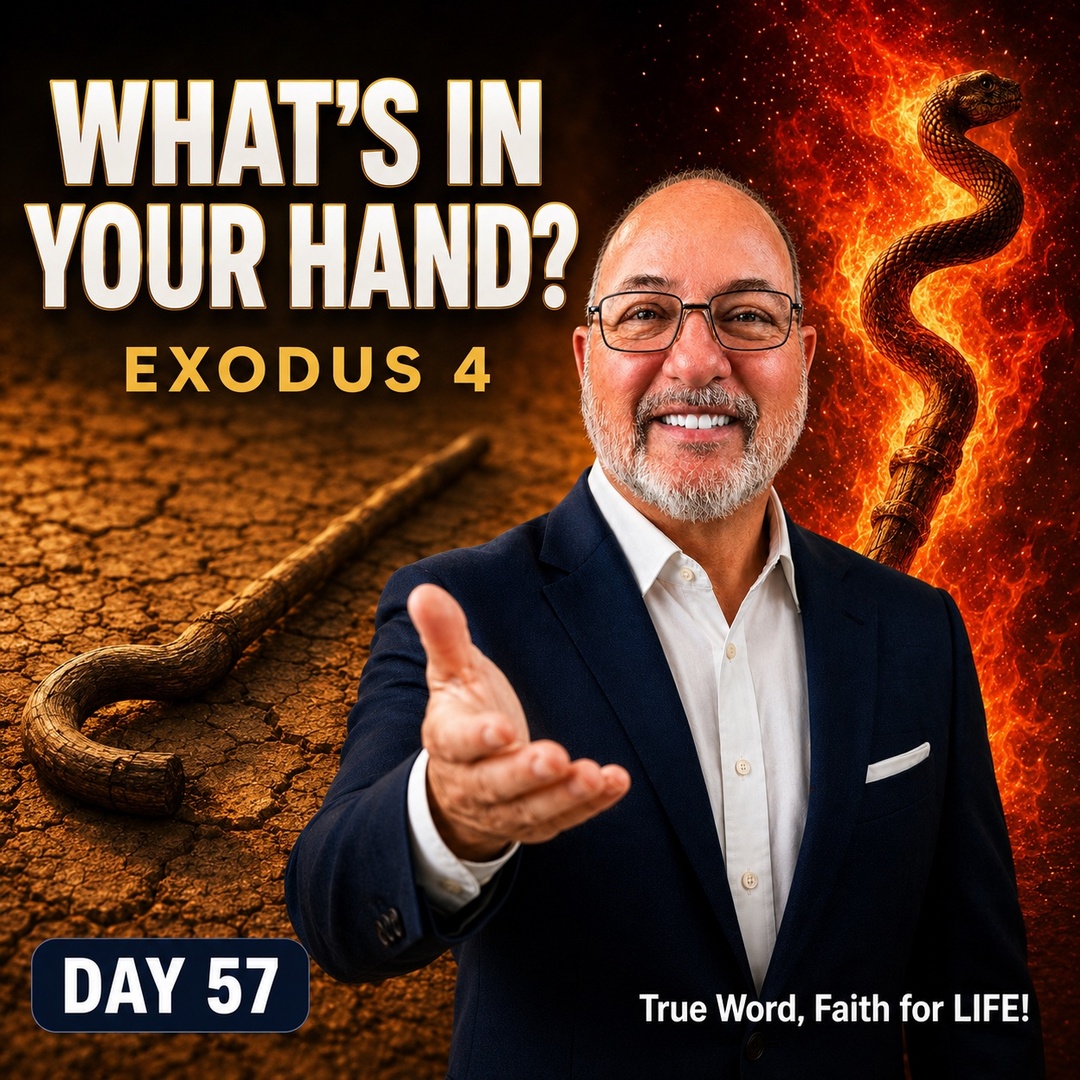
Then came one of the simplest and most practical moments in the entire Exodus narrative. God didn't hand Moses anything new. He asked about what Moses already had.
What is that in your hand?
A staff. The most ordinary object in a shepherd's daily life. Forty years of unremarkable use. And God said throw it down. Moses did. It became a serpent. Pick it up, God said. It became the staff of God.
Same object. Surrendered. Transformed.
I think about how much energy we spend wishing for a different gift, a different story, a different platform, when God is asking a much simpler question. What's already in your hand? The thing you've stopped noticing because it's so familiar. Offer it. Let Him decide what it becomes.
The Chapter Nobody Frames as a Success
And then we arrived at Exodus 5, which is, in my opinion, one of the most pastorally important chapters in the entire Torah, precisely because nobody wants to preach it.
Moses obeyed completely. He didn't add to the message or soften it. He went to Pharaoh and said exactly what God told him to say.
And everything got worse.
More bricks. No straw. The foremen beaten. And then, almost unbearably, the very people Moses came to deliver turned on him. You've made us stink in the sight of Pharaoh, they said. The LORD judge between you and us.
If you've ever obeyed God and watched the people you were trying to help blame you for their pain, you know exactly how heavy that moment is.
Here's what matters most about what Moses did next. He didn't go to the people with his complaint. He didn't organize a strategy session with Aaron. He took it straight to God.
Lord, why have You done evil to this people? Why did You send me?
That's raw. That's honest. And it's not faithlessness. It's a man who knew exactly where to take the hardest thing he was carrying.
Lament directed at God is prayer. Lament directed at people becomes discouragement. Moses chose the right direction for his pain.
If you're in your own version of Exodus 5 right now, hear this clearly: a hard beginning doesn't mean you misheard the call. Sometimes it means what God is doing is big enough to require the resistance. The bigger the opposition, the more undeniable the deliverance will be when it comes.
Seven Times, He Said I Will
Which brings us to the theological summit of the week. When God finally answers Moses' lament in Exodus 6, He doesn't offer an apology or a revised timeline. He offers something far weightier. A deeper revelation of who He is.
I appeared to your fathers as El Shaddai, God says. But by my name YHWH, I did not make myself fully known to them.
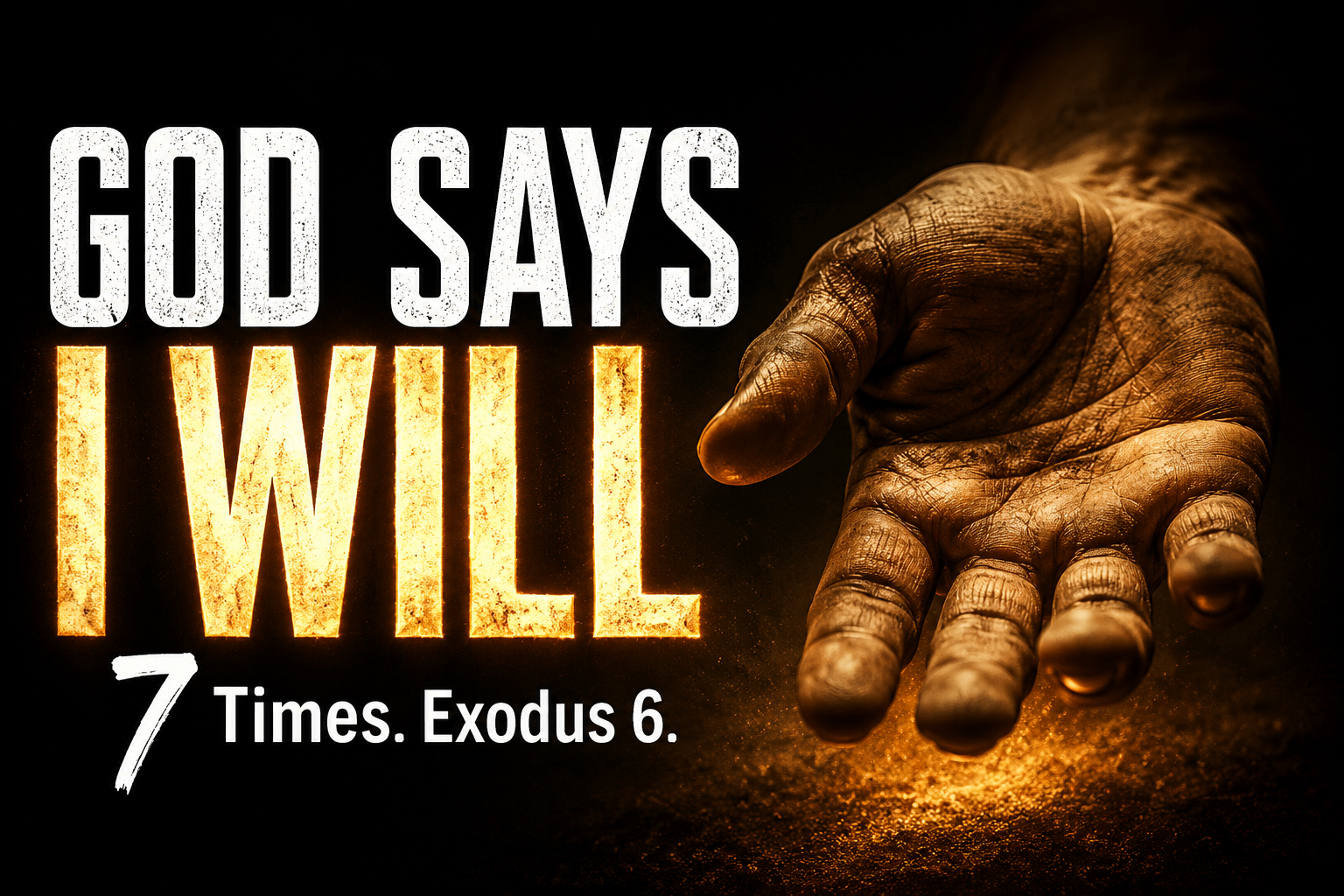
And then, seven times, the declaration: I will. I will bring you out. I will deliver you. I will redeem you. I will take you as my people. I will be your God. I will bring you into the land. I will give it to you.
Not seven hopes. Not seven plans. Seven covenant guarantees, the whole list framed front and back by the same four words: I am the LORD. His name is the guarantee behind every promise He makes.
And then something happened that I think gets overlooked too quickly. Moses brought the message back to the people, and they couldn't receive it. The text uses the Hebrew phrase kotzer ruach. Short of breath. Crushed. The slavery had gone on so long that even a promise this enormous couldn't get through to them.
God didn't revoke a single I will because of that. He kept working. The promise stayed in force for people who were too broken to hear it in the moment.
That might be the most tender truth in the entire week's teaching. What God has promised you doesn't depend on your ability to receive it on your worst day. It depends on His name. And His name doesn't change.
Where This All Points
Every thread of this week eventually leads to the same place. Moses drawn from the water as an infant to become a deliverer points forward to Yeshua, who went into the water of death itself and came out the other side in resurrection. The staff that became a serpent and then a staff again, life through apparent defeat, is a shadow of the cross. And the seven I wills of Exodus 6 have a body. His name is Yeshua.
He carried our bondage up a hill called Golgotha. His blood is the redemption price, paid once for all. He made a people who were not a people. He is Immanuel, God with us, for us, in us, forever.
And for everyone who is kotzer ruach right now, breathless and crushed and unable to hear the promise clearly, He came for you too. A bruised reed He will not break. A smoldering wick He will not snuff out.
So What Now?
If this week's teaching met you somewhere real, here's what I'd ask you to carry into the week ahead.
Turn aside long enough to notice where God might already be speaking in your ordinary Tuesday. Stop answering His call with a list of reasons you're not ready, and just say here I am. Name the ordinary thing in your hand that you haven't surrendered yet. If you're in a hard beginning, take the lament to God before you take it to anyone else. And pick one of the seven I wills as a covenant word to carry this week, not as a feeling, but as a fact that doesn't move no matter how you feel on a given day.
The hard place was never evidence that God left. It was the place He chose to be most fully known.
He's still speaking. The bush is still burning. And His name hasn't changed.
Shalom.
Dr. Shawn M. Greener is the founder of True Word, Faith for LIFE!, a chronological verse-by-verse Bible teaching ministry. Catch new episodes weekdays at 7:00 AM Eastern and the Sunday Summation at 6:30 PM Eastern. Learn more at TrueWordFaithforLife.com.
MOOSEWORKS BIBLE REBINDING
Your Bible carries prayers, tears, notes, promises, and memories. If it needs restoration or rebinding, I recommend Melissa of MooseWorks Bible for careful, beautiful work. My fifth MooseWorks Bible is being reBound right now! I will have pictures soon!



https://www.etsy.com/shop/MooseworksBibles
STUDY GUIDE | Days 55 through 59 | Exodus 2 through 6 True Word, Faith for LIFE! "What If God Keeps His Word in the Hard Place?"
For personal reflection, family discussion, or small group use.
https://www.youtube.com/live/ykCS1uQmaZM?si=2ylUWFWpwIfZfmZd
HOW TO USE THIS GUIDE
Work through one day at a time, ideally alongside that day's episode, or use the whole guide in a single sitting as a week-in-review. Each day includes the core passage, the central truth, and a few questions meant to be lived with, not rushed through. Read the question. Let it sit for a moment before you answer it.
DAY 55 | EXODUS 2 "What If God Sees You Even When You Can't See Him?"
THE PASSAGE: Exodus 2:23-25
THE CORE TRUTH: The text records four distinct divine actions: God heard Israel's groaning, God remembered His covenant, God saw their suffering, and God knew.[^1] The silence Israel endured was not absence. It was covenant attention turning toward covenant action.
QUESTIONS FOR REFLECTION:
- Is there a situation in your life right now that feels like silence from God? What would change if you believed He was actively gathering Himself toward movement rather than absent?
- The text uses four distinct verbs: heard, remembered, saw, knew. Which of those four feels most true to your current situation, and which feels hardest to believe right now?
- Where have you mistaken waiting for abandonment?
PRAYER FOCUS: Ask God to show you one piece of evidence this week that He has heard, remembered, seen, and known your situation, even in the waiting.
DAY 56 | EXODUS 3 "What If God Meets You in the Ordinary?"

THE PASSAGE: Exodus 3:1-12
THE CORE TRUTH: Moses encountered the divine presence while engaged in the ordinary labor of shepherding.[^2] God did not wait for Moses to locate a sacred space; rather, the LORD declared the ground holy by His own presence upon it.[^3] Attention is an act of faith. Turning aside is an act of obedience.
QUESTIONS FOR REFLECTION:
- What does your "ordinary workday" look like? Where is the hillside you walk past without expecting anything unusual?
- Have you been waiting for a better season, a quieter morning, or a more "spiritual" moment before you expect God to speak to you? What would it look like to turn aside right where you already are?
- God called Moses' name twice.[^4] Have you ever sensed God's specific, personal attention in a moment that surprised you? What happened?
PRAYER FOCUS: Ask God to open your eyes to one ordinary moment this week where He may already be speaking, and ask for the willingness to turn aside and look.
DAY 57 | EXODUS 4 "What's in Your Hand?"
THE PASSAGE: Exodus 4:1-17
THE CORE TRUTH: Moses raised three distinct objections to his commissioning, and in each instance God responded not with a credential but with a promise of presence.[^5] God did not equip Moses with a new instrument; instead, He directed Moses' attention to the ordinary shepherd's staff already in his possession, which became the means of divine demonstration once surrendered.[^6]
QUESTIONS FOR REFLECTION:
- Moses raised three objections: they won't believe me, I can't speak well enough, please send someone else.[^7] Which of these is closest to your own most common excuse?
- There's a difference between honest fear and persistent refusal after God has already answered the objection.[^8] Where in your life might you be repeating an objection past the point where He's already responded?
- What is the "staff" in your hand right now? The ordinary skill, story, or season of life you've stopped noticing because it's so familiar? What might it look like to throw it down and let God decide what it becomes?
PRAYER FOCUS: Name one ordinary thing in your hand and offer it to God this week, specifically and out loud.
DAY 58 | EXODUS 5 "What Do You Do When Obedience Makes Things Worse?"
THE PASSAGE: Exodus 5:1-23
THE CORE TRUTH: Moses obeyed the divine commission fully and without modification, and the immediate consequence was an intensification of Israel's suffering under Pharaoh's hardened policy.[^9] The Israelite foremen held Moses responsible for their increased burden,[^10] and Moses, in turn, brought his lament directly to God rather than to the people.[^11] Lament directed at God is prayer. Lament directed at people becomes discouragement.
QUESTIONS FOR REFLECTION:
- Have you ever obeyed God fully and watched the situation get harder rather than easier? How did you interpret that at the time?
- Where have you been taking your hardest complaints? To God directly, or to people, or to distraction? What's the difference it's made?
- Moses' prayer was raw and unfiltered.[^12] Do you give yourself permission to be that honest with God? Why or why not?
- A hard beginning doesn't necessarily mean you misheard the call. Is there a hard beginning in your life right now you've been tempted to read as evidence you got it wrong?
PRAYER FOCUS: If you're carrying a lament right now, write it out honestly, in your own words, and bring it directly to God before you bring it to anyone else this week.
DAY 59 | EXODUS 6 "When God Says I Will"
THE PASSAGE: Exodus 6:1-9
THE CORE TRUTH: God answered Moses' lament not with an apology or a revised timeline, but with a deeper revelation of the divine name and seven covenantal declarations, each anchored to the formula "I am the LORD."[^13] The patriarchs had known God as El Shaddai, but the fullness of the covenant name YHWH was unveiled to a generation in bondage and a leader in lament.[^14] When the message reached the people, they could not receive it on account of their crushed spirit, described in the Hebrew text as קֹצֶר רוּחַ (kotzer ruach), literally "shortness of breath" or "crushed spirit."[^15] God did not revoke a single declaration on account of their inability to receive it.
QUESTIONS FOR REFLECTION:
- Of the seven I wills,[^16] which one do you most need to receive as a covenant fact this week, not a feeling, but a fact that doesn't move regardless of how you feel on a given day?
- Have you ever been so crushed, so kotzer ruach, that even a true promise couldn't get through to you? What was that season like, and what brought you through it?
- What does it mean to you, practically, that the reliability of God's promises depends on His name and not on your ability to feel them right now?
- Where in your life right now do you need to remember that the revelation of God often deepens in the hard places, not in spite of them?
PRAYER FOCUS: Write down one of the seven I wills on a card or your phone. Carry it with you this week. Speak it out loud whenever the noise around you gets loud.
WEEK IN REVIEW | DISCUSSION QUESTIONS FOR GROUPS
If you're using this guide with a small group, family, or spouse, consider closing with these broader questions that pull the whole week together:
- Across Exodus 2 through 6, God heard, called, equipped, allowed hardship, and finally revealed Himself more deeply through the hardship. Which part of that pattern is hardest for you to trust, and which part comes most naturally?
- Moses went from a fugitive shepherd to a man standing face to face with Pharaoh in five chapters. What does his transformation teach you about how God prepares someone for a calling that feels too big?
- The phrase "God keeps His word in the hard place, not only after it" was central to this week. What is one hard place in your life right now where you need to believe that's true?
- If someone you love is in their own version of Exodus 5 right now, obeying and watching things get harder, what would you want to say to them based on this week's teaching?
A CLOSING WORD
The hard place was never evidence that God left. It's where He makes Himself most fully known. The bush is still burning. His name hasn't changed. And He's still saying I will.
NOTES
[^1]: Exodus 2:23-25 (New King James Version).
[^2]: Exodus 3:1.
[^3]: Exodus 3:5. See also Walter Brueggemann, "Exodus," in The New Interpreter's Bible, vol. 1 (Nashville: Abingdon Press, 1994), 711-12.
[^4]: Exodus 3:4. For the significance of the doubled name in Hebrew narrative convention, compare Genesis 22:11 (Abraham, Abraham) and Genesis 46:2 (Jacob, Jacob).
[^5]: Exodus 4:1, 10, 13. The threefold pattern of objection and divine response is treated extensively in Terence E. Fretheim, Exodus, Interpretation: A Bible Commentary for Teaching and Preaching (Louisville: John Knox Press, 1991), 63-71.
[^6]: Exodus 4:2-5.
[^7]: Exodus 4:1, 10, 13.
[^8]: Exodus 4:14. The text notes that "the anger of the LORD was kindled against Moses" only after the third objection, following two prior responses of patient accommodation.
[^9]: Exodus 5:6-9.
[^10]: Exodus 5:19-21.
[^11]: Exodus 5:22-23.
[^12]: Exodus 5:22-23 (New King James Version): "Lord, why have You brought trouble on this people? Why is it You have sent me? For since I came to Pharaoh to speak in Your name, he has done evil to this people, neither have You delivered Your people at all."
[^13]: Exodus 6:6-8. The sevenfold repetition of the first-person imperfect verb form, traditionally rendered "I will," is widely noted among commentators as a deliberate covenantal structuring device. See Nahum M. Sarna, Exploring Exodus: The Heritage of Biblical Israel (New York: Schocken Books, 1986), 61-64.
[^14]: Exodus 6:2-3. On the distinction between El Shaddai and the tetragrammaton YHWH in patriarchal versus Mosaic revelation, see Brevard S. Childs, The Book of Exodus: A Critical, Theological Commentary, Old Testament Library (Philadelphia: Westminster Press, 1974), 111-15.
[^15]: Exodus 6:9. The Hebrew phrase קֹצֶר רוּחַ (kotzer ruach) combines קֹצֶר (qotser, "shortness") with רוּחַ (ruach, "breath" or "spirit"), yielding the sense of being too crushed in spirit to receive or believe a word, even a true one. See Francis Brown, S. R. Driver, and Charles A. Briggs, A Hebrew and English Lexicon of the Old Testament (Oxford: Clarendon Press, 1906), s.v. "קֹצֶר."
[^16]: Exodus 6:6-8. The seven declarations are: (1) "I will bring you out," (2) "I will rid you out of their bondage," (3) "I will redeem you," (4) "I will take you as My people," (5) "I will be your God," (6) "I will bring you into the land," and (7) "I will give it to you for a heritage."
BIBLIOGRAPHY
Brown, Francis, S. R. Driver, and Charles A. Briggs. A Hebrew and English Lexicon of the Old Testament. Oxford: Clarendon Press, 1906.
Brueggemann, Walter. "Exodus." In The New Interpreter's Bible, vol. 1. Nashville: Abingdon Press, 1994.
Childs, Brevard S. The Book of Exodus: A Critical, Theological Commentary. Old Testament Library. Philadelphia: Westminster Press, 1974.
Fretheim, Terence E. Exodus. Interpretation: A Bible Commentary for Teaching and Preaching. Louisville: John Knox Press, 1991.
Sarna, Nahum M. Exploring Exodus: The Heritage of Biblical Israel. New York: Schocken Books, 1986.
The Holy Bible, New King James Version. Nashville: Thomas Nelson, 1982.
© 2026 Dr. Shawn M. Greener. All Rights Reserved. True Word, Faith for LIFE! | TrueWordFaithforLife.com

Author / Host / Theologian/Ret. SlamDancer
I am just a beggar who found Bread, helping other hungry beggars to find Him too. My life has certainly been complex and I and my halo has many dents. Heschel said; "Something Sacred hangs in the balance of every moment." I live like it. I teach like it.
As a person who survived a fatal 92 mph vs 51 mph head on crash, after dying and re-animating, and surviving several other brushes with death, my perspective is, let's say, unique. I haven't always been a theologian and I'm living REAL life, just like you... I have my hurts, habits and hangups too.
I've learned a few very important things along the way that I'm confident you'll find useful... butter for the Gluten free Bread so to speak.. Oh, you may chuckle or full on snort along the way, but you might also shed a few tears... Faith for LIFE... That's how it happens.

Stop Carrying What Isn't Yours