

 Apple Podcasts
 Spotify
 He Already Forgave YOU!
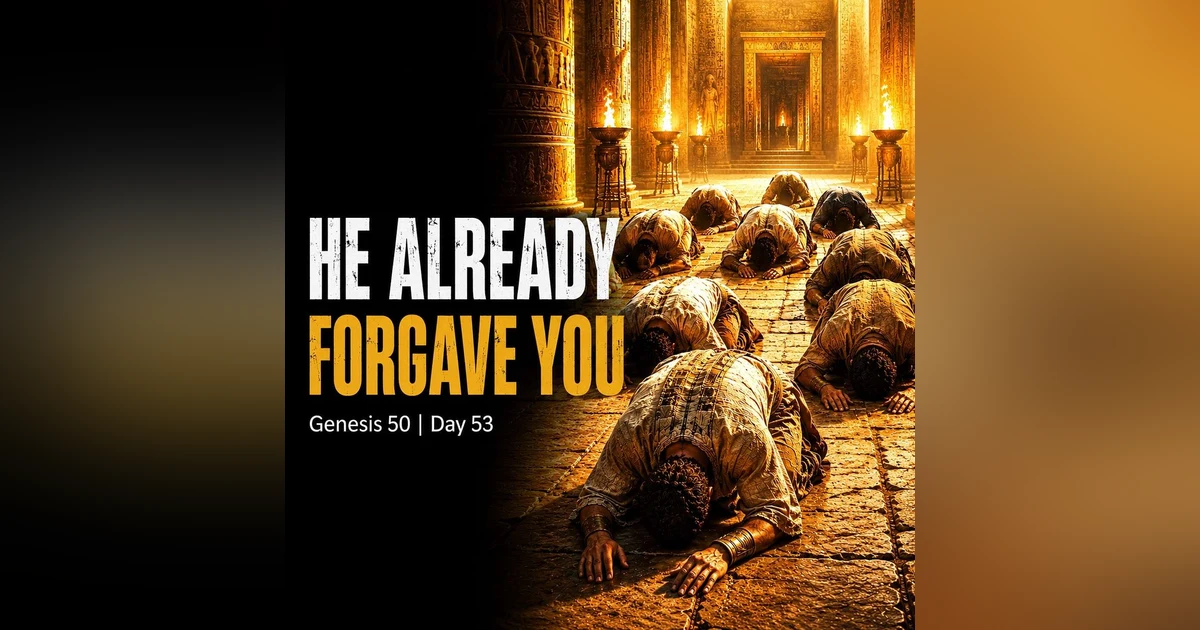

ARE YOU STILL TRYING TO PAY FOR WHAT'S FORGIVEN? | Genesis 50 | Day 53 You've heard the gospel. You've said the prayer. You know what the cross means. So, why are you still living like the hammer is coming? Genesis 50 closes the book of Genesis with grief, burial, fear, forgiveness, and one of the most powerful declarations in all of Scripture. Joseph has already forgiven his brothers. He fed them, housed them, wept over them. And the moment their father dies, they fall on their faces and off...
ARE YOU STILL TRYING TO PAY FOR WHAT'S FORGIVEN? | Genesis 50 | Day 53
You've heard the gospel. You've said the prayer. You know what the cross means. So, why are you still living like the hammer is coming?
Genesis 50 closes the book of Genesis with grief, burial, fear, forgiveness, and one of the most powerful declarations in all of Scripture. Joseph has already forgiven his brothers. He fed them, housed them, wept over them. And the moment their father dies, they fall on their faces and offer themselves as servants. Joseph weeps. Not from anger. From grief. Because there is a specific sorrow that comes when someone you love keeps paying for a debt you cancelled years ago.
Some of us do this with God every single day.
Today we work through the hashav of Genesis 50, the word that means God calculated redemption through the same events evil calculated for destruction. We meet pakod yifkod, the deathbed promise of Joseph that echoed across four hundred years of slavery and still landed. And we ask the question Joseph asked his terrified brothers: "Am I in the place of God?"
Whether you are in grief, guilt, or bitterness today, Genesis 50 has a word for you.
The coffin is not the ending. It never was.
What wound is Genesis 50 speaking to in your life today? Drop it in the comments. Let's go through this together.
Subscribe for verse-by-verse Bible teaching, live Monday through Friday at 7:00 AM Eastern and Sunday Summation at 6:30 PM Eastern.
https://TrueWordFaithforLife.com/contact
Get the book: True Word, Faith for LIFE! https://www.truewordfaithforlife.com/store/true-word-faith-for-life-the-book/
Bible Rebinding by Melissa at MooseWorks Bible Rebinding on Etsy: https://www.etsy.com/shop/MooseworksBibles
Music licensed through Audiio and Melodie.
#Genesis50 #BibleInAYear #TrueWordFaithForLife
© 2026 Dr. Shawn M. Greener. All Rights Reserved.
Send Dr. Shawn a Message. Please leave your contact information if you’d like a reply!
Thank you so much for listening! Please subscribe to the True Word, Faith for LIFE! YouTube channel, please click this link. Thank you again!
Shawn
https://www.youtube.com/channel/UCo1sLYz6J4FTUFwR5yjReMw
Good morning. Day fifty-three.
SPEAKER_00Are you still trying to pay for what's already been forgiven? Genesis fifty, you've already forgiven them. You said the words and you meant them. You moved toward them.
SPEAKER_01You kept moving toward them. And they're still tiptoeing around you. Still apologizing for things that you let go of years ago.
SPEAKER_00Still watching your face for the moment you finally stop pretending to be kind.
SPEAKER_01That's a specific kind of grief.
SPEAKER_00Not anger.
SPEAKER_01Grief. Because you've offered everything you have, and they still can't receive it. Genesis 50 is that story. Joseph has amazingly forgiven his brothers.
SPEAKER_00He told them to their faces. He wept so hard that the Egyptians heard him through the walls. He fed them, he housed them. He gave their children a future, and the moment their father dies, they send him a message that says, in effect, we know you've been waiting, we know who you really are. Please don't destroy us.
SPEAKER_01After everything, that is what guilt does to a person.
SPEAKER_00Guilt turns mercy into a delay. Guilt turns well, guilt guilt makes love look like a trap. Guilt makes you keep paying for what's already been forgiven. And some of us are doing this with God right now. We've heard the gospel. We know what the cross means. We've said the prayer. But deep down, in the place we don't talk about, we're still waiting for God to stop being patient and finally give us what we actually deserve. Genesis fifty has a word for that.
SPEAKER_01This will be the end of our Genesis journey. Shalom.
SPEAKER_00And welcome to True Word Faith for Life. I'm Dr. Sean. Today is day fifty-three, and we are in Genesis fifty. I need you to feel the weight of that before we go one word further. Genesis 50 is the last chapter of the first book of the Bible. Genesis began with the words, in the beginning, God. It began with light splitting darkness, with breath-filling dust, with a garden and a man and a woman and the voice of God walking in the cool of the day. And it ends with a coffin in Egypt. Let that land. The book that opened with creation closes with burial. The book that began with a garden ends with an embalming table. That's not a mistake. That's not a literary accident. Scripture telling us the truth. This world is broken. Death is real, and we are a long way from the garden. But Genesis 50 doesn't end in despair. It ends with a deathbed promise and a set of bones that refuse to stay silent. And a word that will echo across four hundred years of slavery. And still land on the other side. God will surely visit. And we've got the closing of a covenant story that has been building since chapter one. So let's go all in. Before we go all in, drop a that's me or a raised hand emoji in the chat if you've ever struggled to actually receive forgiveness from God or from another person. Because this chapter is for you. Joseph grieves Jacob. Faith doesn't make grief fake. Genesis 50 opens with Joseph falling on his father's face, weeping over him, kissing him. That isn't restrained, that isn't dignified public mourning. That's a son broken open over the body of his father. And I want you to notice what is not in this text. There's no qualifier. There's no, but Joseph trusted God, so he composed himself. There is no pivot to the silver lining. Joseph weeps. This is a man who has seen the faithfulness of God like almost no one in Scripture. He's watched the dreams come true. He's seen God take what was meant to destroy him and build something extraordinary right on through it. Yes, Joe. We do. Joe says, or asks, do we sometimes have to forgive ourselves before we can forgive others? Amen. True. We do. Joseph, I mean, he let's think about this. He has witnessed, experienced, grown through, lived through the faithfulness of God. Like no one else. He has watched his dreams come true. He's seen God take what was meant to destroy him and build something extraordinary right on through it. He knows how the story ends, and he still weeps. Faith doesn't make grief fake. The hope of resurrection doesn't require us to perform contentment we don't feel. The knowledge that God is sovereign doesn't demand that we be numb to loss. Yeshua stood at the tomb of Lazarus, his dear friend. Knowing full well what he was about to do. He knew what he was about to do, and yet he wept. John 11, 35, the shortest verse in the entire Bible. Two words. Yeshua wept. Jesus wept. And they're not small. They tell us that the Son of God didn't consider grief to be a failure of faith. He considered it the honest response of love to the reality of death. If you're grieving right now and you feel guilty about it, like you should be further along, like your faith should have made this easier, Joseph weeps. Yeshua weeps. You are allowed to weep. Even in mourning, the covenant people were visible. Joseph commands that Jacob be embalmed. The embalming takes forty days. The Egyptians mourn Jacob for seventy days. Seventy days of national mourning for a Hebrew shepherd from Canaan, a sojourner. A man who Pharaoh told to his face that his years had been few and evil, and now the empire weeps for him. That is El Shaddai, establishing the dignity of his servant in the eyes of the most powerful nation on earth. Then Joseph asks permission to go bury his father in Canaan. He doesn't approach Pharaoh directly. He sends word through Pharaoh's household first. That is court protocol, cultural wisdom, grief, and shrewdness walking together. And Pharaoh says yes. Not just yes, he says yes. And I'll send Egypt with you. Pharaoh's servants, Egypt's elders, chariots, horsemen, Joseph's household, his brothers, his father's household. It's a state funeral for a Hebrew patriarch. And it's moving through the land. And when the Canaanites watching from the threshing floor of Atad, when they see this procession, they say, This is a grievous morning to the Egyptians. And they name the place Abel Mejraim. Abel Mejraim. The morning of Egypt. God's people have always been most visible, not just in their victories, but in how they grieve, how they bury, how they keep covenant, even when it costs them something. The world's watching how covenant people handle loss, and they're watching now too. Jacob's bone said what his mouth already said. We are not done here. Say that with me slowly. The cave of Machbalah. Genesis 23. Abraham purchased this cave, the first piece of promised land in the covenant that the covenant family ever owned. The first legal deed in Canaan was a grave cave. Abraham and Sarah are buried there. Isaac and Rebekah, Leah, and now Jacob. In Genesis, burial is never just logistics. By the way, welcome to you all. Welcome, welcome, welcome. Thank you for joining. Now Jacob is buried there too. In Genesis, burial is never just logistics. It isn't. The patriarchs buried in Canaan are making a declaration. Everybody laid in that cave is saying, The promise still stands. God has not forgotten. We are coming back. Good morning. To bury a body in the promised land is to plant a seed in it. It is to say, this ground is still ours. God's word hasn't expired. We will rise here. Jacob's body in Machpalah is a mortgage on the future, and the family returns to Egypt and fear rises. Guilt turns mercy into a delay. With Jacob in the ground, the brothers still, well, they fall apart. They say to each other, What if Joseph has just been waiting? What if the only reason he kept us alive was because of our father? And now that our father is gone? What if the real Joseph shows up? Oh, sit in that for a minute, lean back in your chair. Joseph told them to their faces, in Genesis 45, I am Joseph, God, sent me here. You are not at fault. He wept so loudly that the Egyptians heard him weeping through the walls of the palace. He kissed every one of them. He settled them in the best land in Egypt. He has provided for their families through 17 years of living in his care, and they still think it's temporary. They think Jacob was the restraint. They think the kindness was performance. They think the real accounting has been running behind the scenes this whole time. And now the ledger's about to be opened. So they send Joseph a message. They say Jacob commanded him before he died to forgive his brothers. The text doesn't record Jacob saying this at all. Maybe he did. Maybe fear has made them build one more shield between themselves and the man they wronged. Either way, what the text shows us is this. They still don't trust the forgiveness that they've already received. They're still fighting battles when the war has already been won. And then they come and they fall before him and they say, We are your servants. And Joseph weeps. Why? Why does he weep? Because there's a specific grief that comes when someone you love keeps offering you payment for a debt you canceled years ago. When someone you've welcomed as family keeps insisting on treating themselves as your employee. When you have said you are forgiven, you are loved, you are mine. And they keep saying, I know, I know, but but what do I owe you? And here's where the text stops being about Joseph's brothers and it starts being about us. Some of us have said the prayer. We know what the cross means. We've been in the church for years. We can explain substitutionary atonement like it's nothing. And we still pray like we're trying to convince God to stay patient just a little bit longer. We still obey out of fear of what will happen if we don't. We still keep a running total of how bad we've been lately, half expecting God to call it in. We still treat Yeshua like a creditor we're managing instead of a savior who already said, It is accomplished. That isn't humility, that is unbelief. God grieves over it the same way Joseph wept. Because he's already said everything that needs to be said. He said it from a cross. He said it from an empty tomb. And we keep asking him to say it again because we still can't quite believe he meant us. You mean me? Drop a prayer hands or praying in the chat if you've ever been more comfortable serving God than trusting him.
SPEAKER_01Because this one is for all of us.
SPEAKER_00Bitterness begins the moment we climb into his chair. Joseph answers them. And what he says is one of the most important sentences in all of Scripture. Do not fear, for I am in the place of God. Am I instead of God? Am I his substance in this role? Hatahat Elohim Anoki. Am I instead of God? Am I his substitute in his role, in this role? Joseph doesn't deny what they did. He doesn't say, Well, I was nothing. No biggie. He doesn't rewrite history into something comfortable. He says, You meant evil against me. He names it evil, not a misunderstanding, not immaturity, evil. The wound was real. The years were real. The betrayal was real. And judgment belongs to God, not to Joseph. Now look at that question closely because the question is: for more than Joseph's brothers, am I in the place of God? Bitterness never announces itself that way. It doesn't walk in and say, hello, I'm here to take God's place in you. So it starts quietly. You replay the offense over and over and over. First, you just process it. You replay it just to process it, and then you do it again and again and again. Then you rehearse what you'd say if you ever had the chance. You keep the person under sentence in the back of your mind, a low-running verdict you carry everywhere. You decide you'll release them when justice has been served to your satisfaction, when they've suffered enough, when they've lost what you've lost, and without realizing it, you've climbed into the chair. You're sitting on the throne of final judgment. You've made yourself the moral center of another person's universe. You've assigned yourself a role that belongs only to God. And the weight of that chair is crushing you. Joseph refuses it. Not because the evil was small, the evil was not small. Joseph was thrown in a pit. He was sold. He was falsely accused. He was imprisoned. He was forgotten. He refuses the throne because the throne doesn't belong to him. Am I in the place of God? That question is the path of freedom. Not minimizing the evil, not pretending it was fine, not erasing the wound, releasing the throne that was never yours to hold. Same events, two intentions, one sovereign. Then Joseph says the sentence the entire book of Genesis has been building toward. You meant evil against me, but God meant it for good, to bring about that many people should be kept alive. The Hebrew word here, used for the word meant, used for both the brothers and for God, is hashav. Hashav. To think, to plan, to devise, to calculate, to intentionally reckon something toward an end. That isn't passive, that isn't accidental overlap. The brothers calculated evil against Joseph. God calculated redemption through those same events. Same events, two intentions, two reckonings. And there's no comparison between those two authorities. The word Hashav appears in one other place that we need to hear. And maybe you'll remember. Abraham believed God. And God reckoned it to him as righteousness. Genesis 15. God reckoned it to him as righteousness. Abraham believed God. Abraham believed God. And God reckoned it to him as righteousness. God reckons, God calculates truly. God sees the full ledger of a life, and his accounting isn't subject to revision. Now hear this clearly. Take a deep breath. Take a drink if you need to. This doesn't make evil good. The pit was evil. The false accusation was evil. The wasted years in prison were evil. Scripture never, never needs evil to be good in order for God to be sovereign. That is the Hebrew worldview. And it's far more honest than cheap positivity. Evil is evil, and God is sovereign over it in a way that no evil has ever outmaneuvered. And this is the moment in Genesis 50 where the text stops being a story about Joseph and starts being a shadow of the one it was always pointing toward. At the cross, human evil did its absolute worst. Caiaphas plotted. Judas calculated thirty pieces of silver. Rome executed, the crowd mocked, and the disciples ran. And God, without excusing a single second of it, brought the salvation of the world through what evil meant for death. Peter stands in Acts two and holds both realities in the same sentence. Yeshua was delivered by the predetermined plan and foreknowledge of God and a lawless man. Lawless men nailed him to a cross and killed him. Both are true. Simultaneously. Without contradiction. Human beings were responsible. God was sovereign. The cross is where evil met its sovereign and sovereign one. Joseph doesn't file legal forgiveness. He ministers to the wound. Then the text says something that would be easy to read past. Joseph comforted them and spoke kindly to them. That phrase spoke kindly in Hebrew, I want you to know, is veidabar alibom. Vedabar alibom. It literally means he spoke to their heart, not at them, not over them. To their heart. This is intimate healing language. The same phrase appears in Hosea 2. Where God says he will speak tenderly to Israel in the wilderness, as a husband who has gone into the desert after a wavered beloved, just to speak to her heart again. Joseph doesn't just file some sort of legal pardon and walk away. He stays. He ministers to the fear underneath the guilt. He speaks to the wound, not just the offense. And that is what mercy actually looks like. Now, I need to say something important here, and I need you to focus and hear it carefully wherever you are and whatever you're doing. I need you to hear this clearly. The text is not a command for every wounded person to restore full access to someone who has shown no repentance. Forgiveness and trust are not the same thing. Forgiveness releases vengeance to God. Trust is rebuilt over time. Through demonstrated repentance, accountability, safety, and wisdom. Joseph's situation had real repentance. Judah's transformation and back in Genesis 44, it proved it. Joseph also had structural authority that created a safe and ordered environment for this reconciliation. Don't use this story as a weapon against someone who was still in a dangerous situation. Don't dodge the command either. Followers of Yeshua are not permitted to build a life organized around permanent, permanent verdict holding. We forgive as we have been forgiven. Listen, I have asked for forgiveness from people and not been given it to this day for what I did and what I didn't do. Still, I haven't been forgiven. And they are Christians. Not because the wound wasn't real, because the throne doesn't belong to us. And because the God who spoke to our hearts is calling us to do the same. Joseph lived to 110 years, and in Egyptian culture, 110 years was the ideal, the measure of full, complete, flourishing life. The number that meant this person lived well, and God blessed them. And Joseph, the one sold into slavery, falsely accused, imprisoned, forgotten, lived to 110 years old. The man they tried to erase lived a complete life in the language of the very empire they sold him into. Before he dies, Joseph gathers his brothers and he speaks, I am about to die, but God will surely visit you and bring you up out of this land to the land he swore to Abraham, to Isaac, and to Jacob. And the Hebrew here is emphatic, it's not casual. God will surely visit you. God will surely attend to you. God will surely act on your behalf. The word Pachad means to attend to, to care for actively, to take decisive action on behalf of someone, and this isn't passive. This isn't God will eventually notice you. This is God will show up and he will move. And this phrase, Pachod Yefchod, becomes the watchword of Exodus. When Moses returns the to the Israelites in Egypt after four hundred years of silence, he uses this language. And the Israelites, when they hear it, they bow and they worship because they recognize it. They know this word. They were taught this word because Joseph said it on his deathbed. A dying man's last words planted a seed that flowed four hundred years later. Joseph's faith reached across centuries. Then he made them promise. He made them swear. He is placed in a coffin. And Genesis ends. But what about those bones? Moshe or Moses carries them out of Egypt when the Exodus comes. The whole nation of Israel carries them through forty years in the wilderness. And Joshua buries them at Shechem. In the territory of Joseph's descendants, in the land of the promise, Joseph's bones came home to his children's inheritance. God is that precise. God is that faithful. He doesn't lose track of a single promise. He doesn't lose track of a single set of bones. Listen, if you've been waiting a long time on something God has promised, drop I'm waiting in the chat. Joseph's bones. Joseph's bones waited four hundred years, but they came home. Genesis ends with a coffin, but the coffin isn't the ending. Genesis began with God speaking light into darkness, and it ends with a coffin in Egypt. How do these two things belong in the same story? Well, because the coffin isn't the ending. It's the promise in motion. Joseph's bones, they aren't silent in that box. They are preaching to every generation that carries them through the wilderness. God will visit. God will bring you up. Don't you dare settle here. This isn't your home. The whole Exodus is the coffin's sermon, and behind that rescue, a greater one was coming. The God who promised to visit his people in Egypt is the same covenant-keeping God who, in the fullness of time, visited us in Yeshua. He walked into the worst that human evil could do. He was laid in a tomb. And he came out on the other side. The coffin is never the last word when the God of Covenant is still speaking. Oh, for sure, Genesis is finished. Exodus begins, and God is still visiting his people. Now I have a word for you at the end of Genesis. Many, many messages I received. You are taking far too long. The math doesn't add up. You will never be finished in a year. Why are you belaboring Genesis? That's like telling a contractor, listen, breeze through the foundation of the home. Don't worry about the foundation of the big building that'll have a hundred stories. Just quickly. Do it quickly. Genesis is our foundation. And there are so many beautiful lessons to be learned that if we don't learn those lessons well and completely, we will never understand what is to come. Now, before we cross into the place where you're living right now, I want us to stop here just for a moment. We started Genesis with, in the beginning, God. We've walked with Adam, with Noah in the rain, and Abraham under the stars, believing a promise that looked impossible. We were with Isaac on the mountain. We were with Jacob at the fort of Jabuck, walking with a limp. He earned from wrestling God face to face. We were with Joseph in the pit, in the prison, in the palace, and through all of it, one thing hasn't changed. God keeps covenant. God keeps covenant across floods, across famines, across betrayals, deathbeds, dark nights of the soul, and years of silence. He is El Shaddai, the God whose sufficiency is greater than every barren place. He is Haro'e, the shepherd who does not lose his sheep. He is Goel, the redeemer who stops, and he steps into the wreckage. He is the one whose covenant cannot be broken by the worst things that human beings can do. Genesis is finished. Exodus is coming. And the God who said, I will be with you, is the same God who will say, I will bring you up out of Egypt. He has not gone quiet. He is still speaking. He is still visiting, and we are still following. So where does Genesis 50 find you today? Where does Genesis 50 find you? This chapter doesn't meet all of us in the same place, but it meets all of us somewhere. Maybe you're in grief. You love God and you're you're still weeping. You know the theology of resurrection and you st you still cry yourself to sleep. You're not failing. You're not weak. You're a person who loves someone. And love has a cost. When loss comes, bring that grief to the God, who stood at the tomb and he wept. He's not waiting for you to feel better before he draws near. He draws near now, in the middle of it. Faith doesn't make grief fake. Let it be real. Maybe you're in guilt. You've said the prayer, you know what the cross means, but you're still acting like a servant when the father of this house has already put a robe on your shoulders. You're still trying to manage God, still keeping the ledger, still half-waiting for the real accounting to begin. Today's word isn't complicated. Stop. Yeshua's blood is enough. Not almost enough. Not enough for some people, other people, enough for you. Today, come just as you are. Receive what's already been given. Stop offering servanthood to the one who has called you family. And maybe you're in bitterness. You're still sitting in that chair carrying the verdict, running the mental rehearsal of what you'd say if you had the chance. Today, Joseph asks you the question directly: Am I in the place of God? Are you? Release the throne. Not because they deserve it, not because the wound wasn't real, but because that chair will crush you and it was never yours to sit in in the first place. One step. That's all. One step today. If you're in grief, bring one honest sorrow to God out loud today, not edited, not managed for appearance, just honest. Tell him what it actually feels like. He can handle it. If you're in guilt, say this out loud right now, before we go any further. Yeshua's blood is enough. I receive forgiveness. I am not a servant working off a dead. I am a child who's been welcomed home. Say it. Then act like it for the rest of today. Pray as a child, not as someone in collections. If you're in bitterness, pray this. Father, judgment belongs to you, not to me. I release this verdict. I step down from this throne. This person's debt is yours to settle, not mine. Then take one concrete step. End the mental rehearsal. Call a qualified and highly reputable counselor if the wound is deep enough to need one. Write the letter you may never send. Just get it out of your body. Stop monitoring what they're doing in their life. What they're doing in their life doesn't matter. Doesn't concern you any longer. One place, one step. That's how freedom begins. I have for you today a challenge and a choice. Here's the challenge. Will you let evil write the ending? Will you let evil write the ending? Joseph didn't. His brothers calculated evil. God calculated redemption through the same events. The sin was real, the wound was real. And God's reckoning was greater. At the cross, the world calculated death for Yeshua. God brought salvation through what evil meant for destruction. Evil met its sovereign and it lost. Joseph's brother spent 17 years living in forgiveness they didn't fully trust. Don't spend the next 17 years of your life if you have 17 years remaining doing the same thing. So choose. Receive forgiveness. Stop paying for what's already been settled. Stop offering. Offering servanthood to the one who has already called you his child. Release vengeance. Come down from the throne. It doesn't belong to you, it never did. Trust Providence, the same God who turned a pit into a platform, a prison into a palace, and a coffin into a sermon. He is not finished with your story. Carry hope forward, because God will surely visit his people. He said it to Joseph's brothers through a dying man's last breath. He said it to Israel through 400 years of silence and then a burning bush. He said it to the world through an empty tomb, and he is saying it to you today. Pakhodefkod, God will surely visit. Prayer isn't asking for an easy journey, it's asking for a strong back. Let's pray. Father, in the name of Yeshua, thank you that evil doesn't get the final word. Thank you that you are not surprised by what has been done to us or by what we have done. Thank you that your reckoning is more powerful than any every human calculation for harm. Heal our grief, the kind we've been afraid to show you, the kind we've been carrying alone. Meet us in it. Free us from the guilt that keeps refusing your forgiveness. Let us hear today, not as doctrine, but as life. Yeshua's blood is enough. Deliver us from the bitterness that has been sitting in your chair. Give us the courage to step down. Give us the grace to release what we were never meant to carry. Teach us to tell the truth about evil and to trust your power to redeem it. Make us people who carry hope forward, people who believe, even in Egypt, even with the coffin in the room. Even in the silence between the promise and the fulfillment, that Pachodif God, you will surely visit us in the name of Yeshua. The one who entered the tomb and refused to remain there. Amen.
unknownGlory to God.
SPEAKER_00Now, if you've never surrendered your life to Yeshua, to Jesus, maybe today is the day you stop waiting for the hammer. Maybe today is the day you stop pretending. The God who turned Joseph's pit into a platform. Who turned a cross into salvation of the world. That's the very same God who is reaching toward you right now, not to collect what you owe, not to review your record before deciding whether he will save you. No. You. He's reaching toward you to welcome you home. And if that's you, I want you to pray with me. Don't delay. Don't wait a second longer. Yeshua, I believe you are the Son of God. I believe you died for my sin and you rose again. I turned from my sin and my self-rule. Forgive me, cleanse me, make me new. I receive your mercy, not as a servant trying to earn it, but as a child coming home. Teach me to follow you. Amen. If you prayed that prayer today, welcome to the family of God. You're not a servant. You're not on probation. You are in the family. You don't have to figure out your next step alone. Reach out to me at true wordfaithforlife.com slash contact. I'll personally connect with you. I'll help you take your next step. If you gave your life to Yeshua today, or maybe you still have questions, which I understand. Maybe they're questions you're not sure you're allowed to ask. That door is open. Take advantage of it. If this episode, if it reached you today, share it with someone who needs to hear what evil meant for harm. God can redeem for life. Maybe they're stuck in guilt. Maybe they're still paying for what has already been forgiven. Maybe they're still fighting battles that and the war's already been won. Maybe they're gripping a verdict they need to release. Maybe they just need to know that the coffin is not the ending. Send the link today. Now, I'm gonna say it first in Hebrew, then I'm gonna tell you what I'm saying. May Adonai lift up his face toward you and give you shalom. Until tomorrow, Friday. You do not want to miss Friday. You do not want to miss this episode. Until then, 7 a.m. Eastern Standard Time, live. Shalom Bishem Yeshua, Veshalom Alechim, which means peace in the name of Yeshua, and peace be upon you all. Thank you for joining me today.