Why Do We Break What God Is Building?

Why Do We Break What God Is Building?
Why do people who know God still force, fear, lie, and break what He’s building? Genesis 16 to 21 is brutally honest, painfully modern, and full of hope. If you’ve ever repeated a pattern you thought was dead, this is for you. Watch the powerful episode and Subscribe HERE!
Promise pressure doesn’t just reveal what we want. It reveals what still owns us.
There are moments in the Bible that feel less like ancient history and more like someone has quietly opened the door to your private life.
Genesis 16 through 21 is one of those moments.
This part of Abraham and Sarah’s story does not flatter anybody. It does not sanitize pain. It does not pretend that people who know God always respond to pressure in holy ways. It tells the truth. It tells the truth about waiting. It tells the truth about fear. It tells the truth about compromise. And it tells the truth about God.
That is why these chapters matter so much for modern listeners.
A lot of people today are not asking academic questions first. They are asking survival questions. Why do I keep going back to the same fear? Why do I keep sabotaging what matters most? Why do I keep forcing things God never told me to force? Why do I still feel pressure after all God has already shown me?
Genesis 16 through 21 answers those questions by walking us through one covenant household under strain.
In the Ancient Near Eastern world, this strain was not abstract. Barrenness was not simply a private sorrow. It carried social shame, household instability, questions of inheritance, and real uncertainty about the future. Offspring meant continuity. Household meant survival. Name meant legacy. Land meant security. So when God promised Abraham descendants, He was not handing out vague religious comfort. He was speaking directly into the deepest ache and highest pressure point in Abraham and Sarah’s lived world.
That is what makes this section of the Bible so powerful. The details belong to their world, but the pressure belongs to ours too.
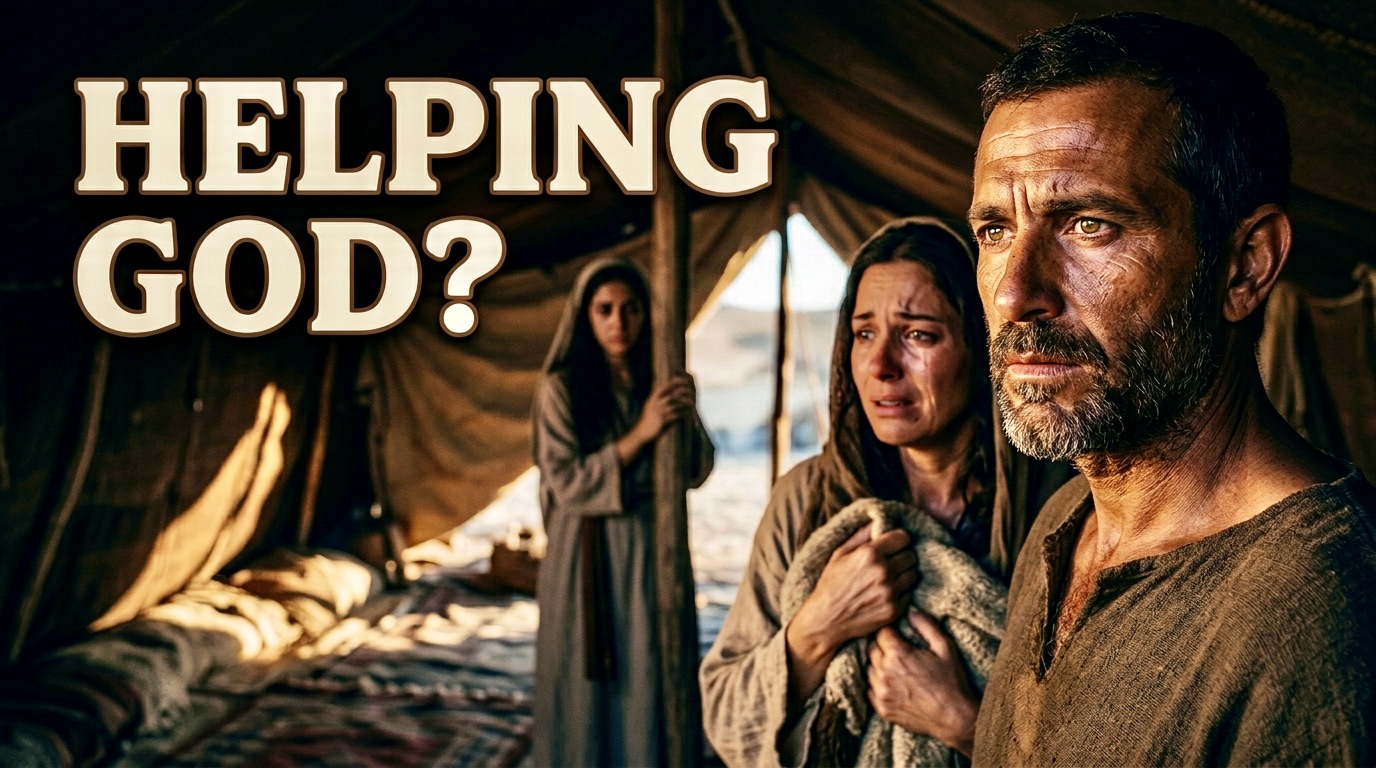
Genesis 16 shows what happens when people try to solve covenant pressure with human strategy. Sarai reaches for a culturally available answer. Hagar is used. Abram agrees. The household fractures. Pain multiplies. Jealousy erupts. The family does not become stronger by taking control. It starts bleeding.
That still happens every day.
People get tired of waiting and start forcing. They force relationships. They force business outcomes. They force ministry moves. They force timing. They force emotional closure. They force doors open. Then they are stunned when what they built under pressure starts wounding people later.
The Bible is painfully honest here. Disobedience does not become wisdom because it was born in distress.
But Genesis 16 also gives us one of the most tender revelations in the whole Bible.
God sees Hagar.
That line lands with force when you understand the world she lived in. A servant woman in that culture had little leverage, little dignity, and very little protection. Yet the God of heaven meets her in the wilderness. He sees her affliction. He speaks into her pain. And Hagar names Him as the God who sees.
That means no wounded person is invisible to God, even when the wound was caused by the failures of somebody else.
Genesis 17 turns from pressure to identity. God does not begin by telling Abraham what Abraham wants to hear. He begins with who He is. “I am God Almighty; walk before me, and be blameless.” That matters. Before God addresses the promise, He anchors Abraham in the character of the Promiser.
Then comes the name change.
Abram becomes Abraham.
Sarai becomes Sarah.
In the Hebraic world, names are not decorative. They speak role, identity, and calling. God is not just relabeling them. He is declaring covenant destiny before visible fulfillment arrives. That is how God works so often. He forms identity before He unveils outcome.
That is hard for modern people, because we usually want visible results first. We want change without surrender. We want blessing without reshaping. We want fulfillment without formation. But God does not merely hand people futures. He forms people who can carry them.
Genesis 18 takes us into Sarah’s laughter, and this may be one of the most emotionally honest moments in the Abraham narrative. Sarah does not laugh because she is lighthearted. She laughs because disappointment has worn grooves into her soul. Her laughter is armor.
A lot of people know that laugh.
It is the laugh that says, “Don’t get my hopes up.”
It is the laugh that says, “I have prayed too long to be naive now.”
It is the laugh that says, “I would rather sound cynical than get crushed one more time.”
And into that place comes one of the sharpest questions in the Bible: “Is anything too hard for the Lord?”
Notice what that question does. It does not deny pain. It does not deny delay. It does not deny the long ache of waiting. It asks whether any of those things have made God weak. And the answer is no.
That same chapter also gives us Abraham interceding for Sodom, where he learns something essential about the moral character of God. The Judge of all the earth will do what is just. God is patient, but He is not morally confused. He is merciful, but He is not indifferent. He listens, but He does not redefine holiness to fit corruption.
That truth explodes in Genesis 19.
Sodom is not presented as merely a city with private vice. It is a culture in open revolt against restraint, holiness, and created order. Violence is normalized. Shame is gone. What should horrify is ordinary. Lot, standing too close to corruption, becomes a warning inside the warning. He hesitates when he should flee. Why? Because compromise weakens reflexes.
That is not just ancient history. That is a living word for the modern world. People can live so near poison that numbness starts feeling like peace. But numbness is not peace. It is what happens when conscience has been dulled by proximity to compromise.
Then Genesis 20 lands with a painful kind of honesty.
Abraham lies again.
Again.After the promises.
After the altars.
After the covenant.
After the encounters.
He falls back into an old fear and an old survival pattern.
If we are honest, that chapter hurts because it feels so familiar. We want Abraham to be beyond this by now. We want him healed. We want him stable. We want him finished with that old reflex. But the Bible refuses to flatter us. Real growth is often uneven. People do make progress and still stumble. People do trust God and still feel old fears surge back under pressure.
That does not excuse Abraham. But it does explain why this text reaches modern people so deeply.
Many of us know what it is to repeat something we thought God had already healed.
And yet Genesis 20 is also full of mercy.
Abraham is unsteady. God is not.
Abraham wobbles. God restrains. Abraham repeats an old failure. God still keeps covenant.
That is not permission to sin. It is proof that God’s faithfulness is deeper than our instability.
Then Genesis 21 opens like sunrise.
Isaac is born.
And the point is enormous in its simplicity.
God did exactly what He said. At the time He intended. In the way He intended.
Not through Sarai’s forcing.
Not through Abraham’s fear.
Not through wounded laughter.
Not through compromise. God kept His word.
That is the deep thread tying the whole week together.
Everything around the promise shook.
The household shook.
The emotions shook.
The waiting shook.
The culture shook.
The patriarch shook.
But the word of God did not shake.
That is not small comfort for modern believers. That is oxygen.
Some readers live in Genesis 16 right now. They are about to force something under pressure.
Some live in Genesis 17. God is working on identity while they demand visible proof.
Some live in Genesis 18. Their disappointment has become sarcasm, distance, or self protection.
Some live in Genesis 19. They have lived near compromise long enough that numbness feels normal.
Some live in Genesis 20. They are ashamed because an old fear has risen again.
Some are desperate for Genesis 21. They need to know God still remembers.
The beauty of this section is not that it gives us polished heroes. It does not.
The beauty is that it gives us a holy God who still sees, still speaks, still warns, still restrains, still remembers, and still fulfills.
So the question is not whether pressure is real.
It is...
The question is what pressure is making you do.
Are you forcing?
Are you laughing at hope?
Are you living too close to corruption?
Are you repeating an old fear and calling it wisdom?
Or are you finally ready to bring the whole thing back under the God who keeps His word?
The Bible does not just diagnose the wound. It calls you out of it.
And that is the hope!
You do not have to be owned by the pattern pressure exposed.
You do not have to become your fear.
You do not have to keep bleeding under the same old reflex.
God’s promises are not fragile.
And neither is His mercy toward those who return.
Which part of Genesis 16 through 21 hit you hardest? Hagar in the wilderness, Abraham’s new name, Sarah’s laughter, Sodom’s warning, Abraham’s repeated fear, or Isaac’s birth?

© 2026 Dr. Shawn M. Greener. All Rights Reserved.
True Word, Faith for LIFE!
The Bible Rebinder I Mentioned on the Podcast
This is one of the three Bibles Melissa of MooseWorks Bible restored for me, beautifully rebound with a rugged new cover and exceptional attention to detail.

A Bible is more than a book. It is often a treasury of prayers, notes, promises, memories, and the record of a life spent seeking God.

If you have a treasured Bible that deserves to be preserved with excellence, I am honored to recommend Melissa of MooseWorks Bible.

Her work is marked by beautiful craftsmanship, thoughtful detail, and genuine kindness. She does not simply repair Bibles. She helps preserve the story they carry.
Visit MooseWorks Bible today:
Click HERE for MooseWorks Bible ReBinding on ETSY
© 2026 Dr. Shawn M. Greener. All Rights Reserved.
True Word, Faith for LIFE!
STUDY GUIDE
Why Do We Break What God Is Building?
Summary
Genesis 16 through 21 is one of the most searching and pastorally relevant units in the Abraham narrative. It brings together the themes of barrenness, promise, identity, covenant sign, wounded laughter, intercession, judgment, repeated fear, and fulfillment.
In each chapter, the text reveals what pressure exposes in the human heart.
Sarai and Abram force a solution.
Hagar suffers in the fallout.
Abram and Sarai are renamed before the promise is visible. Sarah laughs under the weight of long disappointment. Sodom becomes a model of social and moral disorder. Abraham repeats an old fear in Genesis 20.
Then, at last, Isaac is born in Genesis 21. The sequence is not random. It is a sustained theological revelation showing that human instability cannot cancel divine covenant faithfulness.
These chapters matter deeply because they do not present polished saints but real people, under real pressure, in a real world. They also reveal a God who still sees, still speaks, still judges, still restrains, still remembers, and still fulfills His word.1
Key Terms
Barrenness: In the Ancient Near Eastern world, barrenness carried not only personal pain but also questions of continuity, inheritance, social standing, and household survival.2
Covenant: A binding relational commitment marked by loyalty, obligation, and promise. In Genesis 17 the covenant is reaffirmed with a visible sign, showing that Abraham’s whole future stands under God’s claim.3
Name and Identity: In the Hebraic world, names often communicate meaning, role, identity, and destiny. Abram’s and Sarai’s renaming signals covenant transformation before visible fulfillment appears.4
Holiness and Judgment: Genesis 18 and 19 show that God’s patience does not mean moral confusion. The Judge of all the earth does what is just.5
Fear and Survival Patterns: Genesis 20 reveals how old fears can reappear even in a person who has genuinely encountered God. This does not justify compromise, but it does show the realism of biblical anthropology.6
Context and Exegesis
Genesis 16 must be read against the background of Ancient Near Eastern household structures and customary attempts to secure an heir through secondary women within the household. Such practices were culturally intelligible, but the narrative exposes that what is culturally normal is not necessarily covenantally faithful. Sarai’s action is understandable in social terms but devastating in covenant terms. The chapter shows how quickly promise pressure can become human manipulation. Hagar, the servant woman, bears the cost of decisions made by the powerful. Yet the theological shock of the chapter is that God meets her in the wilderness and reveals Himself as the One who sees. This is not a side note. It is a theological declaration that the God of covenant is also the God who sees the afflicted.7
Genesis 17 shifts the narrative toward identity and covenant sign. God identifies Himself as El Shaddai and calls Abram to walk before Him blamelessly. The text places divine character before human desire. Abram’s name becomes Abraham, and Sarai becomes Sarah. The renaming signals more than a cosmetic change. It speaks covenant destiny over them before the promise is visible. Circumcision, as the covenant sign, is placed in the sphere of generative future and continuation. The sign marks belonging, obligation, and divine claim over Abraham’s line. Abraham’s laughter at this point reflects the collision between divine promise and visible impossibility.8
Genesis 18 develops both intimacy and confrontation. The visitors announce that Sarah will have a son, and Sarah laughs. Her laughter should not be trivialized. The narrative presents it as the reaction of a heart worn by delay and disappointment. God’s question, “Is anything too hard for the Lord?” functions as a theological center point. The issue is not whether the promise is humanly impossible. It is. The issue is whether anything that is impossible for humans lies outside the power of God. The second half of the chapter moves to Abraham’s intercession for Sodom and reveals the moral consistency of God’s justice.9
Genesis 19 must be read as social and covenant judgment, not merely as a record of isolated vice. The city is portrayed as deeply disordered, violent, and hostile to restraint and holiness. Lot’s presence at the gate suggests embeddedness in the city’s life, yet his hesitation in the face of judgment reveals how compromise dulls reflexes. One of the enduring pastoral insights of the chapter is that prolonged proximity to corruption breeds numbness. The text warns against mistaking numbness for peace or adjustment for maturity.10
Genesis 20 returns to Abraham’s old fear. In a foreign political environment, he misrepresents Sarah to protect himself. The narrative acknowledges real vulnerability in the Ancient Near Eastern setting, where kings wielded immense personal power, but it does not justify Abraham’s action. Fear may feel rational and still lead to sin. That is one reason the chapter is so pastorally potent. It shows that spiritual growth is real but uneven. Abraham’s failure is serious, but God’s restraint and covenant faithfulness are stronger still.11
Genesis 21 brings the promised birth of Isaac. The theological point is straightforward and decisive. God keeps His word. The child comes at the appointed time, by divine faithfulness, not by human forcing. This birth answers not only biological impossibility but also the cumulative failures, laughter, fear, and delay of the preceding chapters. The promise survives human weakness because it rests on God.12
Primary Text Comparison
Genesis 16 to 21 may be summarized as one unified movement. The ESV consistently emphasizes the narrative clarity of the account, while the Complete Jewish Study Bible often helps modern readers hear the Hebraic texture of covenant language and naming patterns more distinctly. In teaching these chapters together, the strongest interpretive emphasis should remain on the covenant faithfulness of God and the moral exposure of the human heart under pressure.13
Discussion Questions
- Why does Genesis 16 show that culturally acceptable solutions can still violate covenant faithfulness?
- What does Hagar’s wilderness encounter reveal about the character of God?
- Why is identity before fulfillment such a major theme in Genesis 17?
- What kind of laughter does Sarah represent in Genesis 18, and how does it relate to modern disappointment?
- How does Genesis 19 portray cultural collapse and moral numbness?
- Why is Abraham’s repeated fear in Genesis 20 so pastorally important for modern believers?
- What does Isaac’s birth in Genesis 21 teach about the relationship between divine promise and human weakness?
- Which chapter in this section most directly exposes your own pressures, fears, or reflexes?
Practical Application
This section of Genesis teaches that pressure does not create holiness or sin out of nowhere. It reveals what has been hiding in the heart. When people are delayed, disappointed, frightened, or ashamed, they often reach for control, compromise, image management, or numbness. The answer is not denial but surrender. Genesis 16 warns against forcing outcomes God has not authorized. Genesis 17 reminds us that God forms identity before He grants visible fulfillment. Genesis 18 confronts wounded laughter and asks whether delay has made us think God is weak. Genesis 19 warns against living so close to corruption that conscience becomes dull. Genesis 20 shows that repeated fear is real, but it also shows that God’s covenant faithfulness is deeper than our uneven growth. Genesis 21 calls us back to the bedrock truth that God keeps His word.
For modern believers, this means pressure must be brought to God instead of converted into control. It means fear must be named honestly rather than baptized as wisdom. It means compromise must be treated as dangerous, not ordinary. And it means hope must be grounded not in visible ease but in the character of the God who remembers and fulfills. The pastoral force of these chapters is this: you do not have to become the pattern pressure exposed. The same God who saw Hagar, renamed Abraham, confronted Sarah, judged Sodom, restrained Abimelech, and gave Isaac still sees, still speaks, and still keeps His word.14
Footnotes - Gordon J. Wenham, Genesis 16–50, Word Biblical Commentary 2 (Dallas: Word Books, 1994), 1–18.
- K. A. Kitchen, On the Reliability of the Old Testament (Grand Rapids: Eerdmans, 2003), 316–19.
- John H. Walton, Genesis, NIV Application Commentary (Grand Rapids: Zondervan, 2001), 442–49.
- Victor P. Hamilton, The Book of Genesis, Chapters 1–17, New International Commentary on the Old Testament (Grand Rapids: Eerdmans, 1990), 468–73.
- Christopher J. H. Wright, Old Testament Ethics for the People of God (Downers Grove, IL: InterVarsity Press, 2004), 187–91.
- Bruce K. Waltke, Genesis: A Commentary (Grand Rapids: Zondervan, 2001), 286–91.
- Wenham, Genesis 16–50, 6–16.
- Walton, Genesis, 442–49; Hamilton, The Book of Genesis, Chapters 1–17, 468–73.
- Bruce K. Waltke with Cathi J. Fredricks, Genesis: A Commentary (Grand Rapids: Zondervan, 2001), 274–82.
- Christopher J. H. Wright, Old Testament Ethics for the People of God, 187–91; John H. Walton, Genesis, 470–77.
- Wenham, Genesis 16–50, 67–73.
- Victor P. Hamilton, The Book of Genesis, Chapters 18–50, New International Commentary on the Old Testament (Grand Rapids: Eerdmans, 1995), 73–82.
- David H. Stern, Complete Jewish Study Bible (Peabody, MA: Hendrickson Bibles, 2016), notes on Genesis 16–21.
- Michael S. Heiser, The Unseen Realm (Bellingham, WA: Lexham Press, 2015), 115–20; Skip Moen, “Thinking Hebraically about Covenant and Identity,” lecture notes and thematic teaching, accessed conceptually through the Hebraic worldview tradition reflected in his work.
Bibliography
Hamilton, Victor P. The Book of Genesis, Chapters 1–17. New International Commentary on the Old Testament. Grand Rapids: Eerdmans, 1990.
Hamilton, Victor P. The Book of Genesis, Chapters 18–50. New International Commentary on the Old Testament. Grand Rapids: Eerdmans, 1995.
Heiser, Michael S. The Unseen Realm. Bellingham, WA: Lexham Press, 2015.
Kitchen, K. A. On the Reliability of the Old Testament. Grand Rapids: Eerdmans, 2003.
Stern, David H. Complete Jewish Study Bible. Peabody, MA: Hendrickson Bibles, 2016.
Walton, John H. Genesis. NIV Application Commentary. Grand Rapids: Zondervan, 2001.
Waltke, Bruce K. Genesis: A Commentary. Grand Rapids: Zondervan, 2001.
Wenham, Gordon J. Genesis 16–50. Word Biblical Commentary 2. Dallas: Word Books, 1994.
Wright, Christopher J. H. Old Testament Ethics for the People of God. Downers Grove, IL: InterVarsity Press, 2004. Shalom b’Shem Yeshua.
© 2026 Dr. Shawn M. Greener. All Rights Reserved.
True Word, Faith for LIFE!
#BibleTeaching #Genesis #TrueWordFaithForLIFE
Shalom b’Shem Yeshua.

Author / Host / Theologian/Ret. SlamDancer
I am just a beggar who found Bread, helping other hungry beggars to find Him too. My life has certainly been complex and I and my halo has many dents. Heschel said; "Something Sacred hangs in the balance of every moment." I live like it. I teach like it.
As a person who survived a fatal 92 mph vs 51 mph head on crash, after dying and re-animating, and surviving several other brushes with death, my perspective is, let's say, unique. I haven't always been a theologian and I'm living REAL life, just like you... I have my hurts, habits and hangups too.
I've learned a few very important things along the way that I'm confident you'll find useful... butter for the Gluten free Bread so to speak.. Oh, you may chuckle or full on snort along the way, but you might also shed a few tears... Faith for LIFE... That's how it happens.
