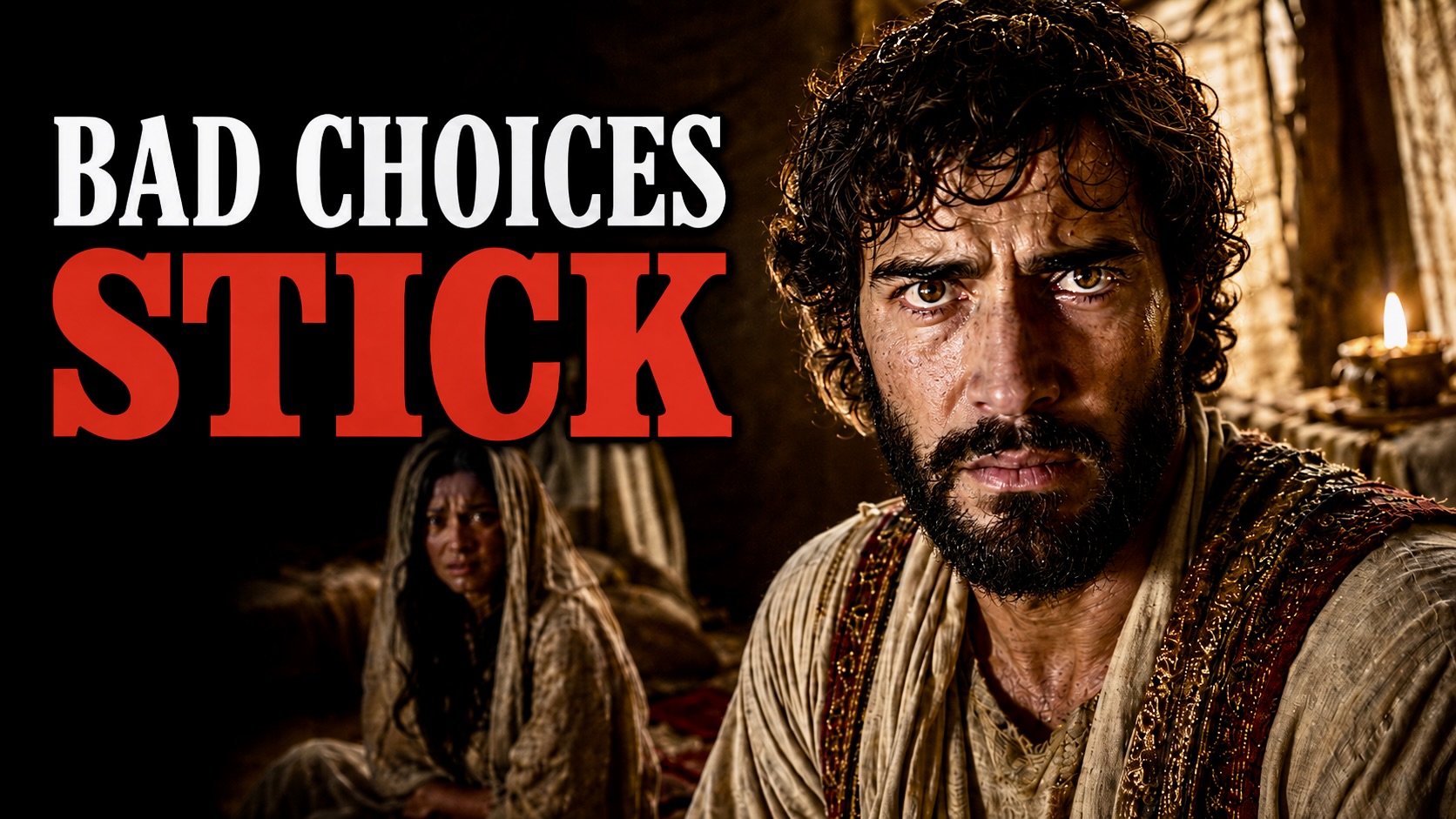
WHY DO BAD CHOICES STICK?
BLOG POST
Watch on True Word Faith for LIFE with Dr. Shawn
WHY DO BAD CHOICES STICK?
Why do Bad Choices Stick? That question is not merely about regret. It is about formation. It is about the strange and painful way one decision can follow us into the next room, the next relationship, the next season, and sometimes the next generation.
Anchor Line:
God does not waste consequences. He uses them to expose what still needs surrender.
There are choices we make in a moment that do not stay in that moment.
We make them under pressure.
We make them in fear.
We make them when appetite is loud and wisdom is quiet.
We make them when we are tired, angry, lonely, resentful, or convinced that God is taking too long.
Then the moment passes.
But the consequence does not.
That is why Genesis 27 to Genesis 30 is so unsettling. It is not merely ancient family drama. It is a mirror. Isaac, Rebekah, Jacob, Esau, Laban, Leah, and Rachel are not polished religious figurines placed on a stained glass shelf. They are covenant people with fear, favoritism, manipulation, appetite, longing, envy, and grief in the house.
That is one reason the Bible is so trustworthy. It does not sanitize its own people.
It tells the truth.
And the truth is this. Bad choices stick because they form us. They shape the patterns we carry. They teach our appetites to expect a vote. They train fear to speak first. They give wounds a strategy. They create consequences that follow us until God, in His mercy, holds up the mirror.
In Genesis 27, Isaac is old. His eyes are dim. He prepares to bless Esau. In the Ancient Near Eastern world, a father’s blessing was not a casual sentimental prayer. It carried inheritance, household authority, family direction, and covenantal future. Spoken words carried weight. They were not treated as disposable sound. They helped establish destiny within the family line.1
Rebekah overhears Isaac. She knows what God had said before the boys were born. The older would serve the younger. Jacob, not Esau, was tied to the covenant line. But Rebekah does what many of us do. She believes the promise, but she does not trust the process.
That is where the mirror gets close.
How often do we say we trust God, then grab the steering wheel?
We pray, then panic.
We believe, then scheme.
We claim faith, then manage people, pressure outcomes, hide truth, soften facts, and call it wisdom.
Rebekah is not an atheist. She is a covenant woman acting as though God needs help.
That is dangerous.
The moment we think God needs our deception to fulfill His promise, we have already stepped out of covenant trust.
Jacob then enters the story, and his first concern is not righteousness. His first concern is exposure. He does not first say, "This would be wrong." He says, in effect, "What if I get caught?"
That is the difference between conviction and calculation.
Conviction asks, "Is this right before God?"
Calculation asks, "Can I get away with it?"
That is not just Jacob. That is us.
When the heart is bent, the mind becomes a lawyer. We argue ourselves into compromise. We rename disobedience as strategy. We rename appetite as need. We rename fear as caution. We rename manipulation as leadership. We rename impatience as discernment.
Then we are no longer asking whether we are faithful.
We are only asking whether we will suffer consequences.
But God's world is moral. We may dodge exposure for a season, but we do not dodge formation. What we practice forms us. What we hide shapes us. What we excuse trains us. What we feed grows teeth.
Jacob gets the blessing, but he does not get peace.
He gets the words, but he loses the house.
He gets the outcome, but he has to run.
That is the cost of grasping.
Esau's part in the story is no less serious. His cry after losing the blessing is devastating. He weeps bitterly. He wants the blessing, but earlier he despised the birthright. He traded covenant weight for immediate appetite. He treated his firstborn place as disposable, then later wanted the emotional benefit of what he once treated as worthless.2
That is a warning for modern life.
There are moments when appetite speaks louder than inheritance.
Appetite says, "I need this now."
Covenant says, "Remember who you are."
Appetite says, "One bowl will not matter."
Covenant says, "One choice can reveal what you value."
Appetite says, "I am tired. I deserve this."
Covenant says, "Do not sell tomorrow because your stomach is loud today."
Spiritual carelessness rarely looks catastrophic at first. It looks ordinary. It sounds reasonable. It says, "I am tired." It says, "I am lonely." It says, "I am stressed." It says, "God understands."
And yes, God understands.
But understanding is not permission.
Mercy is not approval.
Grace is not God pretending our choices do not matter.
Grace is God meeting us in truth so we can be made whole.
Genesis then takes us into the shattered home. Everybody in that tent loses something. Isaac loses the illusion that he can override God's direction through personal preference. Rebekah loses her son. Jacob loses home. Esau loses the blessing. The family loses peace.
That is how sin works. It rarely stays with the person who chose it.
Modern Western culture often says, "It is my life. It is my choice. It is nobody else's business."
That is not the Hebraic worldview.
In the world of the Bible, identity is communal, covenantal, and generational. Your choices do not float in isolation. They echo through households. They shape children. They alter marriages. They change trust. They weaken witness. They teach patterns. They build culture.3
You do not just choose for you.
You choose into a web of relationships.
Then Jacob runs. He is guilty, afraid, displaced, and sleeping on the ground with a stone near his head. And there, in the wilderness, God comes to him.
Not because Jacob earned it.
Not because Jacob has become noble overnight.
Not because Jacob finally has his life together.
God comes because covenant rests on God's faithfulness before it ever rests on Jacob's maturity.
At Bethel, Jacob sees a stairway, ramp, or connection point between heaven and earth. Angels ascend and descend. The LORD stands there and repeats the covenant promise. Land. Seed. Blessing. Presence. Protection. Return.4
God does not excuse Jacob's deception.
But God does not abandon Jacob to it.
That is mercy.
Some people think grace means God says, "It does not matter."
No.
Grace means God says, "It matters more than you know, and I am still not leaving you in it."
Jacob is between what he broke and what God is building. He is between regret and restoration. He is between old patterns and new obedience. He is between who he has been and who God is forming.
Many of us know that place.
We are not home anymore.
We are not at the destination yet.
Guilty behind us.
Uncertain before us.
Stone under us.
Heaven above us.
And sometimes the wilderness is where the noise finally gets quiet enough for us to hear God say, "I am still here."
Then Jacob arrives at a well. In Genesis, wells are never just scenery. Wells are life. Water means survival, flocks, hospitality, household future, and contested blessing. Abraham's servant found Rebekah at a well. Isaac's servants contended over wells. Jacob meets Rachel at a well. The Bible keeps bringing us back to water because life depends on what we draw from.5
That question remains alive.
What are you drawing from?
Fear?
Appetite?
Approval?
Control?
Anger?
Old wounds?
Religious performance?
Or the living God?
Jacob sees Rachel. He moves the stone. It is dramatic and emotional. It looks like the beginning of a beautiful romance. But Genesis will not let romance cover formation.
Jacob has arrived at Laban's house.
And Laban is the mirror Jacob did not ask for.
Jacob does not just meet Laban.
Jacob meets himself in another man's clothing.
The deceiver meets a master manipulator. The man who used disguise in the dark is fooled in the dark. The man who took advantage of his father's blindness wakes up unable to believe what has happened to him.
This is not karma.
This is formation.
The Bible is not teaching an impersonal cosmic payback system. It is showing the moral governance of a personal God who forms His covenant people through truth, exposure, pressure, and mercy.
Some lessons cannot be learned through information alone. They must be learned through exposure. You can know lying is wrong and still not understand what it does to a soul until someone lies to you. You can know manipulation is wrong and still not feel its violence until someone uses you. You can know favoritism hurts and still not repent until you watch a household fracture under it.
God's goal is not to humiliate Jacob.
God's goal is to transform him.
Genesis 29 is brutal. Jacob works seven years for Rachel. Then comes the feast. In that world, marriage was not merely private romance. It involved family alliance, economic arrangement, covenantal responsibility, household expansion, and social obligation. The veil, the feast, the nighttime transfer, and the father's authority created the setting where Laban could weaponize custom against Jacob.6
Morning comes.
And behold, it was Leah.
That line lands like a hammer.
Morning exposes what darkness concealed.
Jacob confronts Laban. Laban answers, "It is not so done in our country, to give the younger before the firstborn."7
The younger before the firstborn.
Do you hear the sting?
Jacob's whole life has been tangled in younger and older. He took the place of the older. He received what belonged to the firstborn. Now Laban turns the language back on him.
God's Word does not shout where a whisper will do.
Jacob is being confronted by his own story.
Then we meet Leah and Rachel in their pain.
Leah is not loved like Rachel.
Rachel is loved, but barren.
Leah is fruitful, but aching.
Rachel is cherished, but desperate.
Comparison turns both women's pain into rivalry.
Leah is given away by her father in a scheme. She becomes part of a household where she is compared, measured, and emotionally diminished. The Bible says the LORD saw that Leah was hated, or unloved, and He opened her womb.8
Do not miss that.
God saw Leah.
She names her children from that ache.
Reuben says, "The LORD has looked upon my affliction."
Simeon says, "The LORD has heard that I am hated."
Levi says, "Now this time my husband will be attached to me."
Judah says, "This time I will praise the LORD."9
That progression matters.
Leah moves from trying to be seen by Jacob to knowing she has been seen by God. She moves from aching for attachment to praise. And Judah comes from Leah. The line of kings comes through Leah. Ultimately, Messiah comes from Judah.
The overlooked woman is not overlooked in the purposes of God.
The one who feels second place is carrying royal destiny.
Leah teaches us that being overlooked by people is not the same as being unseen by God.
Rachel teaches us that being loved by people does not remove every ache.
And both women teach us that comparison can make a blessed life feel barren.
That is the poison of comparison. It turns another person's blessing into your accusation. It makes you unable to enjoy what God has given because you are obsessed with what He gave someone else.
But in a covenant worldview, blessing is not a limited commodity God runs out of.
God is not poor.
God is not panicked.
God is not rationing mercy because heaven is low on supply.
So why do bad choices stick?
Because they are never merely events. They become patterns. They shape desire. They train fear. They echo through relationships. They reveal what still rules us.
But here is the mercy.
God does not waste consequences.
When God lets the mirror show us what is really there, we should not curse the mirror.
We should repent.
When God lets the bill come due, we should not only ask Him to remove the bill.
We should ask Him what we kept buying.
When God lets a pattern repeat, we should not only rebuke the situation.
We should ask what the pattern is revealing.
Shame says, "Hide."
Conviction says, "Come into the light."
Shame says, "You are what you did."
Conviction says, "You did wrong, but God is calling you to be made new."
That is where the gospel meets us.
Yeshua does not come to decorate the old life.
He comes to make us new.
Your past may explain some things, but it does not have to own everything.
Your wounds may have shaped you, but they do not have to rule you.
Your consequences may be real, but they do not have to be final.
Jacob's choices caught up with him.
But God caught Jacob too.
And if you will stop running, He can catch you too.
Question for your heart:
Where have your choices been catching up with you, and what would repentance look like today?
Footnotes for Blog Post
1. Gordon J. Wenham, Genesis 16 to 50, Word Biblical Commentary 2 (Dallas: Word Books, 1994), 207 to 212; Victor P. Hamilton, The Book of Genesis: Chapters 18 to 50, New International Commentary on the Old Testament (Grand Rapids: Eerdmans, 1995), 213 to 220.
2. Genesis 25:29 to 34; Genesis 27:34 to 38. See Robert Alter, The Hebrew Bible: A Translation with Commentary, vol. 1, The Five Books of Moses (New York: W. W. Norton, 2019), 146 to 154.
3. John H. Walton, Ancient Near Eastern Thought and the Old Testament: Introducing the Conceptual World of the Hebrew Bible, 2nd ed. (Grand Rapids: Baker Academic, 2018), 103 to 125.
4. Genesis 28:10 to 22. See Tremper Longman III and John H. Walton, The Lost World of the Flood: Mythology, Theology, and the Deluge Debate (Downers Grove, IL: IVP Academic, 2018), 27 to 38, for broader ANE conceptual background on sacred space and cosmic geography; see also Michael S. Heiser, The Unseen Realm: Recovering the Supernatural Worldview of the Bible (Bellingham, WA: Lexham Press, 2015), 98 to 107.
5. Nahum M. Sarna, Genesis, JPS Torah Commentary (Philadelphia: Jewish Publication Society, 1989), 199 to 203.
6. K. A. Mathews, Genesis 11:27 to 50:26, New American Commentary 1B (Nashville: Broadman and Holman, 2005), 462 to 471.
7. Genesis 29:26, ESV.
8. Genesis 29:31.
9. Genesis 29:32 to 35.
© 2026 Dr. Shawn M. Greener. All Rights Reserved.
True Word, Faith for LIFE!
The Bible Rebinder I Mentioned on the Podcast
This is one of the three Bibles Melissa of MooseWorks Bible restored for me, beautifully rebound with a rugged new cover and exceptional attention to detail.

A Bible is more than a book. It is often a treasury of prayers, notes, promises, memories, and the record of a life spent seeking God.

If you have a treasured Bible that deserves to be preserved with excellence, I am honored to recommend Melissa of MooseWorks Bible.

Her work is marked by beautiful craftsmanship, thoughtful detail, and genuine kindness. She does not simply repair Bibles. She helps preserve the story they carry.
Visit MooseWorks Bible today:
CLICK HERE FOR MOOSEWORKS ON ETSY

© 2026 Dr. Shawn M. Greener. All Rights Reserved.
True Word, Faith for LIFE!
STUDY GUIDE
WHY DO BAD CHOICES STICK?
Genesis 27 to Genesis 30
Through the Bible in a Year: Walking the Story of God
Summary
Genesis 27 to Genesis 30 is one of the most emotionally honest sections in the patriarchal narratives. It shows covenant people making painful choices, suffering real consequences, and still being pursued by the faithful God of Abraham and Isaac. Isaac tries to bless Esau despite God's earlier word concerning Jacob. Rebekah manipulates events to protect what she believes to be the covenant outcome. Jacob deceives his father and receives the blessing, but the consequence is exile. Esau, who had earlier despised his birthright, weeps bitterly when the blessing is gone. The family fractures.
Then Jacob runs. At Bethel, God meets him in the wilderness and repeats the covenant promise. Jacob has sinned, but he is not abandoned. God does not excuse deception, but He does continue His covenant purpose. Jacob then arrives at Laban's house, where the deceiver is deceived. He works for Rachel, but wakes to Leah. Laban's deception becomes a mirror in which Jacob sees the kind of world his own choices have helped create. The story then shifts to Leah and Rachel, whose pain reveals the deep wounds of comparison, longing, infertility, lovelessness, and household rivalry.
The central lesson is not that God rewards deception. He does not. The lesson is that God is faithful even when His covenant people are immature, wounded, sinful, and unfinished. Bad choices stick because they form us, follow us, and echo through relationships. Yet God can use consequences as mercy. Exposure can become grace when it leads to repentance.
Key Bible Passages
Genesis 27:1 to 45:
Jacob deceives Isaac, Rebekah manipulates the outcome, Esau loses the blessing, and the household fractures.
Genesis 28:10 to 22:
Jacob encounters God at Bethel and receives the reaffirmed covenant promise.
Genesis 29:1 to 30:
Jacob meets Rachel, serves Laban, and is deceived into marrying Leah.
Genesis 29:31 to 35:
God sees Leah's affliction and opens her womb.
Genesis 30:1 to 24:
Rachel and Leah struggle through barrenness, fertility, rivalry, and longing.
Key Hebrew and Conceptual Terms
Berakah, Blessing:
The Hebrew term berakah refers to blessing, but in Genesis 27 the blessing is not sentimental language. It carries covenantal, familial, and inheritance significance. Isaac's spoken blessing functions within a patriarchal household world where words, authority, and family destiny are deeply connected.1
Bekorah, Birthright:
The birthright involves firstborn status, family inheritance, and household responsibility. Esau's earlier willingness to trade his birthright reveals spiritual carelessness. His later grief over the blessing must be read in light of his earlier contempt for covenant privilege.2
Mirmah, Deceit:
Jacob's story is marked by deception. The Hebrew Bible often uses narrative reversal to expose moral patterns. Jacob deceives his father in the darkened world of Isaac's blindness, then he is deceived in the darkness of Laban's wedding scheme.3
Chesed, Covenant Loyalty:
Although the term chesed is not the central vocabulary of every verse in this unit, the concept of covenant loyalty stands behind God's faithfulness to His promises. Jacob's failures do not nullify God's covenant fidelity. God's covenant faithfulness remains the foundation of the story.4
Sane, Hated or Unloved:
Genesis says Leah was "hated," often understood in context as unloved or less loved in comparison with Rachel. The language is emotionally severe, showing Leah's vulnerable position in the household and God's compassionate attention to her affliction.5
ANE and Hebraic Context
The Ancient Near Eastern background is essential for understanding this section of Genesis. These stories are not modern individualistic tales about personal preference. They are household narratives set in a world of clan identity, patriarchal authority, inheritance, marriage alliances, fertility concerns, and generational covenant.
In Genesis 27, Isaac's blessing carries legal, social, and covenantal weight. A father's spoken words could shape inheritance and household future. This is why the deception matters so deeply. Jacob does not merely trick his father out of a kind prayer. He participates in a fraudulent transfer of family destiny. Rebekah's manipulation, while tied to her knowledge of God's earlier word, still reflects a failure to trust God's process.6
In Genesis 28, Jacob's Bethel encounter must be understood as sacred space. Jacob is between home and destination, between guilt and promise. The stairway or ramp between heaven and earth signals divine presence and access. God confirms the Abrahamic promise to Jacob, not because Jacob is morally impressive, but because God's covenant faithfulness is greater than Jacob's immaturity.7
In Genesis 29, marriage must not be reduced to modern romance. Marriage involved household alliances, economic arrangements, labor, fertility, and family obligation. Laban controls the household and uses custom to justify deception. The nighttime feast, the veil, and paternal authority create the setting in which Jacob can be deceived. When Laban says it is not done to give the younger before the firstborn, his words strike directly at Jacob's own story.8
Leah and Rachel must also be read within their cultural world. Fertility, sons, household status, and marital affection carried enormous social and emotional weight. Leah's child naming reveals her ache for love and recognition. Rachel's barrenness reveals the anguish of longing while living in comparison. Both women are wounded by a household system shaped by rivalry and manipulation, yet God sees and works within their pain.9
Theological Themes
1. God does not waste consequences.
Consequences are not always punishment in the simplistic sense. Sometimes they are exposure. Sometimes they are formation. Sometimes God lets a person experience the fruit of their own pattern so they can finally see what their choices are doing.
Jacob's deception does not vanish after he receives the blessing. It follows him into exile. Later, in Laban's house, Jacob experiences deception from the other side. The point is not impersonal karma. It is moral formation under the governance of God.
2. Faith must not become manipulation.
Rebekah knows God's word, but she acts as though God's promise depends on her scheme. This is one of the most dangerous forms of religious dysfunction. It believes the right outcome, but uses unrighteous means to secure it.
This remains deeply relevant. Believers can use pressure, fear, exaggeration, emotional control, and hidden agendas while telling themselves they are protecting God's will. Genesis warns us that God does not need deception to fulfill covenant.
3. Appetite can reveal what we value.
Esau's story is not merely about hunger. It is about spiritual carelessness. He treats his birthright as disposable, then later grieves the blessing. Appetite often makes small choices feel harmless, but those choices can reveal what we truly value.
4. God meets people in the wilderness.
Jacob does not encounter God at Bethel because he has earned a spiritual reward. He encounters God because God is faithful. The wilderness becomes the place of revelation. This is hope for anyone between regret and restoration.
5. God sees the overlooked.
Leah is unloved, but God sees her. Her son Judah becomes the line of kings and ultimately the line of Messiah. Genesis teaches that human ranking does not determine divine purpose. The person overlooked in the household may be central in the redemptive plan of God.
6. Comparison can make blessing feel barren.
Leah has children but longs for love. Rachel has love but longs for children. Each woman is tempted to see the other as possessing the missing piece of her life. Comparison turns another person's blessing into an accusation against God. Covenant trust calls us to receive our portion, surrender our ache, and trust God's wisdom.
ESV and CJSB Comparison
Genesis 29:31
ESV:
"When the LORD saw that Leah was hated, he opened her womb, but Rachel was barren."
CJSB:
"ADONAI saw that Le'ah was unloved, so he made her fertile, while Rachel remained childless."
The ESV preserves the sharp literal force of "hated," while the CJSB captures the relational sense of being unloved. Both help us feel the pain of Leah's condition. This is not a sterile fertility note. It is a statement about God's compassion toward a woman diminished in her own household.
Genesis 28:15
ESV:
"Behold, I am with you and will keep you wherever you go, and will bring you back to this land."
CJSB:
"Look, I am with you. I will guard you wherever you go, and I will bring you back into this land."
The ESV's "keep you" and the CJSB's "guard you" both emphasize divine protection. Jacob is leaving home because of sin and family fracture, but God promises presence and return. This is covenant mercy.
Genesis 29:25
ESV:
"And in the morning, behold, it was Leah!"
CJSB:
"In the morning Ya'akov saw that he was with Le'ah."
The ESV preserves the shock of the Hebrew narrative with "behold." The CJSB makes the discovery plain. Either way, morning exposes what darkness concealed.
Discussion Questions
1. Where do you see the difference between conviction and calculation in Jacob's response to Rebekah's plan?
2. Why is it dangerous to believe God's promise while using manipulation to bring it about?
3. What does Esau's treatment of the birthright reveal about appetite and spiritual carelessness?
4. How does the Hebraic view of family and covenant challenge the modern idea that personal choices are purely private?
5. What does Jacob's Bethel encounter teach us about God's faithfulness to immature and guilty people?
6. Why is Laban such a powerful mirror for Jacob?
7. How does Leah's story challenge the way people measure value, desirability, and usefulness?
8. How does Rachel's pain show that being loved by people does not remove every ache?
9. Where has comparison made a blessed area of your life feel barren?
10. What is one real act of repentance that would move this teaching from information to transformation?
Practical Application
1. Name the pattern.
Ask honestly, "Where have my choices been catching up with me?" Do not begin by blaming another person. Begin by asking what God may be exposing in you.
2. Stop spiritualizing manipulation.
Do not call pressure wisdom. Do not call exaggeration discernment. Do not call control leadership. If the method does not reflect God's character, it does not honor God's promise.
3. Identify the appetite.
Esau's bowl of stew represents the pressure of immediate desire. Ask, "What short term relief am I tempted to trade for long term covenant faithfulness?"
4. Let the mirror do its work.
When God uses consequences to expose a pattern, do not curse the mirror. Repent. Consequences can become mercy when they lead to truth.
5. Refuse comparison.
Leah and Rachel show how comparison can poison real blessings. Practice gratitude without denying pain. Bring both to God.
6. Take one concrete step.
Repentance must become embodied. Make the call. Tell the truth. Apologize. Set the boundary. Close the browser. Delete the contact. Confess the pattern. Choose obedience under the kingship of Yeshua.
Closing Reflection
Bad choices stick because they do not merely happen outside us. They shape what is happening inside us.
But the gospel is greater than the pattern.
Jacob's choices caught up with him.
But God caught Jacob too.
And if you will stop running, He can catch you too.
Footnotes for Study Guide
1. Gordon J. Wenham, Genesis 16 to 50, Word Biblical Commentary 2 (Dallas: Word Books, 1994), 207 to 212.
2. Victor P. Hamilton, The Book of Genesis: Chapters 18 to 50, New International Commentary on the Old Testament (Grand Rapids: Eerdmans, 1995), 178 to 184, 213 to 220.
3. Robert Alter, The Art of Biblical Narrative, rev. ed. (New York: Basic Books, 2011), 88 to 113; Robert Alter, The Hebrew Bible: A Translation with Commentary, vol. 1, The Five Books of Moses (New York: W. W. Norton, 2019), 146 to 162.
4. Walter Brueggemann, Genesis, Interpretation (Atlanta: John Knox Press, 1982), 236 to 247.
5. Nahum M. Sarna, Genesis, JPS Torah Commentary (Philadelphia: Jewish Publication Society, 1989), 202 to 205.
6. John H. Walton, Ancient Near Eastern Thought and the Old Testament: Introducing the Conceptual World of the Hebrew Bible, 2nd ed. (Grand Rapids: Baker Academic, 2018), 103 to 125.
7. Michael S. Heiser, The Unseen Realm: Recovering the Supernatural Worldview of the Bible (Bellingham, WA: Lexham Press, 2015), 98 to 107; John H. Walton, Genesis, NIV Application Commentary (Grand Rapids: Zondervan, 2001), 573 to 585.
8. K. A. Mathews, Genesis 11:27 to 50:26, New American Commentary 1B (Nashville: Broadman and Holman, 2005), 462 to 471.
9. David H. Stern, ed., Complete Jewish Study Bible (Peabody, MA: Hendrickson Publishers, 2016), notes on Genesis 27 to 30.
Bibliography
Alter, Robert. The Art of Biblical Narrative. Revised edition. New York: Basic Books, 2011.
Alter, Robert. The Hebrew Bible: A Translation with Commentary. Vol. 1, The Five Books of Moses. New York: W. W. Norton, 2019.
Brueggemann, Walter. Genesis. Interpretation. Atlanta: John Knox Press, 1982.
Hamilton, Victor P. The Book of Genesis: Chapters 18 to 50. New International Commentary on the Old Testament. Grand Rapids: Eerdmans, 1995.
Heiser, Michael S. The Unseen Realm: Recovering the Supernatural Worldview of the Bible. Bellingham, WA: Lexham Press, 2015.
Mathews, K. A. Genesis 11:27 to 50:26. New American Commentary 1B. Nashville: Broadman and Holman, 2005.
Sarna, Nahum M. Genesis. JPS Torah Commentary. Philadelphia: Jewish Publication Society, 1989.
Stern, David H., ed. Complete Jewish Study Bible. Peabody, MA: Hendrickson Publishers, 2016.
Walton, John H. Ancient Near Eastern Thought and the Old Testament: Introducing the Conceptual World of the Hebrew Bible. 2nd edition. Grand Rapids: Baker Academic, 2018.
Walton, John H. Genesis. NIV Application Commentary. Grand Rapids: Zondervan, 2001.
Wenham, Gordon J. Genesis 16 to 50. Word Biblical Commentary 2. Dallas: Word Books, 1994.
© 2026 Dr. Shawn M. Greener. All Rights Reserved.
True Word, Faith for LIFE!

Author / Host / Theologian/Ret. SlamDancer
I am just a beggar who found Bread, helping other hungry beggars to find Him too. My life has certainly been complex and I and my halo has many dents. Heschel said; "Something Sacred hangs in the balance of every moment." I live like it. I teach like it.
As a person who survived a fatal 92 mph vs 51 mph head on crash, after dying and re-animating, and surviving several other brushes with death, my perspective is, let's say, unique. I haven't always been a theologian and I'm living REAL life, just like you... I have my hurts, habits and hangups too.
I've learned a few very important things along the way that I'm confident you'll find useful... butter for the Gluten free Bread so to speak.. Oh, you may chuckle or full on snort along the way, but you might also shed a few tears... Faith for LIFE... That's how it happens.

Stop Carrying What Isn't Yours