Useful Until Used
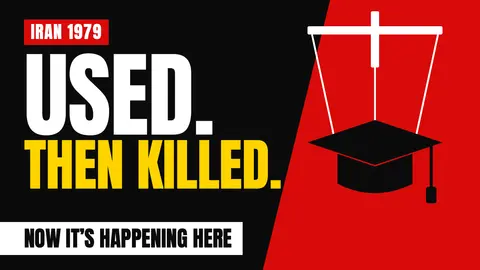
Useful Until Used: The 1979 Playbook and the War Inside the West
By Dr. Shawn M. Greener | TrueWordFaithforLife.com
Last Wednesday, November 4th, the Islamic Republic of Iran threw itself a party. It throws this party every year, and it gives the day an official name: Students' Day, paired with the "National Day of Fighting Global Arrogance."[^1] The occasion is the anniversary of the day in 1979 when students stormed the American embassy in Tehran and held Americans hostage for 444 days.[^2] This year the crowds carried posters of the new Supreme Leader, Mojtaba Khamenei, holding a rifle.[^2]
The day before the party, in Isfahan, the regime hanged two young men, Amirhossein Maleki and Amirhossein Ebrahimi, for their part in January's protests.[^3] Maleki was twenty years old.[^4] Rights groups documented torture, forced confessions, and gross violations of due process in their case.[^3]
Put those two days side by side. On Wednesday, the regime throws a party for students. On Tuesday, its hangman goes to work on them.
That isn't a contradiction. That's the Islamic Republic. The regime loves students who are useful. It imprisons the ones who aren't. And when it's finished with them, it hangs them.
It has operated this way from the first months of its existence. The people it's borrowing in the West today don't know that story. So here it is.
The Islamists did not take Iran by themselves. They borrowed the students, the intellectuals, the socialists, and the communists. They used them to seize power. Then they destroyed them.
The Plan Was in Print in 1970
Start with the truth about the Shah, because the truth makes the rest of the story hit harder. His Iran had real grievances: a secret police, SAVAK, that tortured political prisoners; a censored press; a 1975 decree folding the country into a single legal party; and an oil boom that enriched a few and left millions behind.[^5]
Those grievances are exactly why the coalition against him was so wide. It included the liberal nationalists of the National Front, Mehdi Bazargan's moderate Freedom Movement, the Islamic-Marxist Mojahedin-e Khalq (MEK), the Marxist Fedaian guerrillas, the pro-Soviet Tudeh Party, students, writers, lawyers, bazaar merchants, and the clergy.[^5]
Almost every faction believed it would end up in charge. The liberals expected the cleric to bless the revolution and step aside. The left believed history was on its side and that an old religious man was a temporary figurehead.
They had no excuse for being wrong, because the plan was in print.
In early 1970, in Najaf, Ayatollah Ruhollah Khomeini delivered the lectures later published as Islamic Government.[^6] In them he laid out velayat-e faqih, the guardianship of the jurist. The doctrine is simple. A senior Islamic jurist rules. Not the people. Not a parliament that can overrule him. The jurist.
Then came Paris. From October 1978, Khomeini operated from Neauphle-le-Château outside Paris, giving a stream of interviews to the world press about freedom and independence while his cassette sermons were smuggled into Iran's mosques.[^5] What he didn't campaign on in Paris was the guardianship of the jurist.
He told his own movement the plan in 1970. He told the world a different story in 1978. Islamists are patient. They'll wait nine years to tell you the truth.
Who Holds the Organization
Khomeini returned to Tehran on February 1, 1979, and the Shah's last government collapsed ten days later.[^5] The coalition had won. Now the real contest began, and it turned on one question: who holds the organization?
The partners held the slogans, the newspapers, the campuses, and the crowds. The Islamists built the machinery: revolutionary committees in the neighborhoods, revolutionary courts, the Islamic Republican Party running through the mosque network, and, on May 5, 1979, a separate armed force loyal to the revolution and to Khomeini himself. The Islamic Revolutionary Guard Corps.[^5]
Remember that name. It's the thread that runs from 1979 to this morning's news.
That same year, a cleric-dominated assembly wrote the guardianship of the jurist into Iran's constitution.[^5] The doctrine Khomeini never campaigned on in Paris became the law of the land.
Then came November 4, 1979. Students calling themselves the Followers of the Imam's Line seized the American embassy. Prime Minister Bazargan, the revolution's moderate face, couldn't end it and resigned two days later.[^5] Documents seized in the embassy were then used to brand rivals as American agents; Bazargan's deputy, Abbas Amir-Entezam, was arrested on espionage charges and became the longest-held political prisoner in the Islamic Republic's history.[^5]
The students who climbed that wall thought they were striking at America. They were clearing the field for the clerics.
The Order of the Gallows
Now watch the order.
First, the liberals. In August 1979 the regime closed the major daily Ayandegan and a wave of other publications. Bazargan's government fell that November.[^5] The left cheered.
Second, the universities. In the spring of 1980, loyalist gangs stormed campuses and drove out leftist groups. In June the regime launched its Cultural Revolution and shut the universities for three years. Thousands of students and professors were purged.[^5] The people who supplied the revolution's vocabulary were locked out of their own classrooms by the government they helped create.
Third, the president. Abolhassan Bani-Sadr, a member of Khomeini's Paris circle and Iran's first elected president, was impeached in June 1981 and fled the country. Sadegh Ghotbzadeh, Khomeini's spokesman in Paris, was executed in 1982.[^5] The face of the revolution in Paris was shot by the revolution in Tehran.
Fourth, the Mojahedin. When the MEK broke with the regime in June 1981, it was answered with firing squads. Thousands were executed in 1981 and 1982.[^5]
Fifth, the communists. The Tudeh Party backed Khomeini at every step. It endorsed the hostage crisis and applauded the purges of everyone else. In 1983 the regime arrested its leaders, paraded party chief Nureddin Kianouri on state television confessing to treason and espionage, and banned the party.[^7] Loyalty didn't save them. It only put them at the back of the line.
Sixth, the prisons. In the summer of 1988, on Khomeini's order, "death commissions" interrogated political prisoners for minutes at a time about their loyalty and their faith, then sent many to the gallows. Amnesty International documented the mass killings and the regime's decades-long concealment of the graves.[^8] Leftists were asked whether they prayed. Their answers decided whether they lived.[^7]
One of the men on Tehran's death commission was a young prosecutor named Ebrahim Raisi.[^9] In 2021, the Islamic Republic made him its president.
Every partner who helped bury the last one was next in line. That isn't a regime losing control of its revolution. That's a regime executing its plan. On schedule. In order.
The Playbook in Five Moves
Strip away the names and dates, and you get a playbook:
- Hide the end goal. Publish the real plan to your own people. Show the world a friendlier face.
- Borrow the partner's language. Speak of the oppressed, of justice, of anti-imperialism.
- Borrow the partner's bodies. Let students and activists fill the streets and take the risks.
- Keep the organization, the money, and the guns for yourself. Let the partners have the microphones.
- Purge on schedule. When a partner's usefulness is spent, eliminate it, and use the next partner to help.
The IRGC was born inside that playbook. It has never run any other one. And it's running it in our countries now.
The Playbook Comes West
This isn't opinion. On June 10, 2026, twenty-two nations, including the United States, the United Kingdom, France, Germany, Canada, and Australia, issued a joint statement condemning "lethal plotting and other malign actions" in Europe, North America, and Australia by the IRGC's intelligence organization, the Quds Force, and Iran's Ministry of Intelligence.[^10] They named the targets: Iranian dissidents, journalists, and Jewish and Israeli communities. They called out Iran's use of criminal networks to do the work.[^11]
Move one: hide. For decades, the Islamic Center of Hamburg presented itself as a religious and cultural institution. In July 2024, Germany banned it as an Islamist extremist organization and a propaganda center for the Iranian regime.[^12] This year a new brand appeared: Harakat Ashab al-Yamin al-Islamiya, HAYI, claiming attacks on Jewish and Israeli targets across Europe. In May, the U.S. Justice Department indicted Mohammad Baqer Saad Dawood Al-Saadi, a dual Iranian-Iraqi national, in connection with nearly twenty attacks and attempted attacks, including attempts to hit a synagogue in New York. Prosecutors call HAYI what it is: a front for Kata'ib Hezbollah and other U.S.-designated terrorist organizations, and they say Al-Saadi also ran its media.[^13]
A new name. A new brand. The same machine behind it.
Move two: borrow the language. In July 2024, Director of National Intelligence Avril Haines stated that actors tied to Iran's government had posed as activists online to encourage protests over the Gaza war and had even provided financial support to protesters. She added that many Americans involved may not have known they were interacting with a foreign government.[^14]
Some heard that and said the protesters were innocent. They missed the point. The students of 1979 weren't agents either. They were useful. The partner never has to be on the payroll. The partner only has to be pointed in a direction. Sincerity is the fuel. The IRGC holds the steering wheel.
Move three: borrow the bodies. In 1979 the borrowed bodies were students. Today they're criminals too. Australia's intelligence service concluded the IRGC directed the 2024 arson attacks on a Sydney kosher restaurant and Melbourne's Adass Israel synagogue through layers of intermediaries, and Australia expelled Iran's ambassador.[^15] In Britain, MI5 has tracked at least twenty potentially lethal Iran-backed plots since January 2022.[^16] In the United States, prosecutors charged IRGC asset Farhad Shakeri with recruiting criminal contacts from American prisons for surveillance and assassination plots, including against Donald Trump and journalist Masih Alinejad.[^17]
And the HAYI operative? Prosecutors say that when he went looking for someone to hit the New York synagogue, he believed he was hiring a Mexican cartel member. He was talking to an undercover agent.[^18]
The regime isn't sending its own sons to do this. It's renting ours.
Move four: keep the organization. Every one of these operations runs back to the command structures the twenty-two nations named. The activist gets the slogan. The criminal gets the cash. Tehran keeps the direction, the money, and the plan.
Move five: the purge. If you're a young activist in the West carrying a slogan Tehran would approve, you don't have to guess what the regime thinks of you. Watch what it does to people exactly like you.
Protests broke out across Iran in late December 2025. On January 8 and 9, 2026, under an internet blackout, security forces opened fire. Amnesty International called January 2026 the deadliest period of repression in decades of its research.[^19] The regime's own official count admitted 3,117 dead.[^19] Rights groups have documented thousands more.[^20] Since then, the regime has hanged protester after protester, including the twenty-year-old in Isfahan the day before its Students' Day party.[^3]
The regime that encourages your protest in New York shoots protesters in Tehran. The regime that celebrates the students of 1979 hangs the students of 2026.
You are not the regime's ally. You are its inventory. Ask the Tudeh.
The Plan to Break It
The West has finally named the enemy. The U.S. designated the IRGC a Foreign Terrorist Organization in 2019.[^21] Canada listed it in 2024.[^22] On January 29, 2026, after the massacre, the European Union added it to its terrorist list.[^23] In July, Britain moved under its new National Security (State Threats) Act 2026 to ban the IRGC, making support punishable by up to fourteen years in prison.[^24]
That's progress. But a designation is a sign on the door. It isn't a lock. Here's the lock:
- Enforce the designations. Prosecute material support. Freeze assets. Remove IRGC-linked individuals. Publish an annual enforcement report. If the number is zero, the designation is theater.
- Close the fronts. Germany showed the model with Hamburg. Any institution taking direction from the Supreme Leader's office or the IRGC should be closed and its assets seized. This isn't about any faith. It's about a foreign government wearing the costume of one.
- Hunt the cutouts and protect the targets. Prosecute state-hired crime as terrorism. Build a standing task force across the U.S., Britain, Europe, Canada, and Australia that follows the money up to the handler. Fund real protection for Jewish communities, Iranian dissidents, and journalists.
- Cut the money. Enforce sanctions on the shadow fleet, its insurers, ports, and buyers. Pay whistleblowers. Chase the crypto. An IRGC without money is a slogan without an army.
- Make influence register. Enforce the Foreign Agents Registration Act and university foreign-funding disclosure, with penalties that hurt.
- End the hostage trade. Belgium convicted Iranian diplomat Assadollah Assadi in 2021 for plotting to bomb an opposition rally near Paris; he was swapped home in 2023.[^25] Sweden convicted Hamid Nouri in 2022 for crimes tied to the 1988 massacre; he was swapped home in 2024.[^26] Every swap prices the next kidnapping. Convicted agents of the Iranian state should serve their sentences. Every one of them.
- Arm the truth. Teach 1979 on every campus repeating the regime's vocabulary. Teach the Tudeh. Teach the death commissions. Fund the tools that break the blackout, and document every crime by name for the courts.
None of it requires a single new war. All of it requires will.
The Warning Nobody Gave Them
The enemy isn't the Iranian people. They're the regime's first victims and its final answer. The enemy isn't Muslims. This regime has killed more Muslims than anyone. The enemy is an organization: an ideology with an army, a doctrine with a secret police, a revolutionary guard that has spent forty-seven years using people and burying them.
This year, that system lost its Supreme Leader, Ali Khamenei, in the U.S.-Israeli strikes of February 28. In March, the clerics handed his office to his son, Mojtaba.[^27] A revolution that overthrew a hereditary king now has a hereditary Supreme Leader. Everything the students of 1979 marched against, the regime became.
They changed the face. They didn't change the playbook.
The students of 1979 never got the warning. Nobody warned the liberals. Nobody warned the professors. Nobody warned the Mojahedin. Nobody warned the Tudeh, until their leader was on television confessing.
The students of this generation have now been warned. In this playbook, you're useful until you're used. Then they bury you.
Don't be used. Tell the story. Break the machine. And stand with the Iranian people until they are free.
Notes
[^1]: "Iran's Students' Day rallies resound with defiance," Tehran Times, November 4, 2026. [^2]: "Photos: Iran marks US Embassy takeover with rallies against America, Israel," Al Jazeera (AFP, AP, Reuters), November 4, 2026. [^3]: Lizzie Porter, "Two young men executed in Iran over January protests," The National, November 3, 2026 (citing Hengaw and Iran Human Rights). [^4]: Farnoosh Faraji, "Iranian protester was put through a mock hanging before his execution, source says," Iran International, November 3, 2026. [^5]: Ervand Abrahamian, A History of Modern Iran (Cambridge University Press, 2008), chapters 5 and 6. Standard account of the coalition, the 1979 transition, the IRGC's founding, the constitution, the hostage crisis, the press closures, the Cultural Revolution, and the purges of Bani-Sadr, Ghotbzadeh, the MEK, and Amir-Entezam. [^6]: Ruhollah Khomeini, Islamic Government, in Islam and Revolution: Writings and Declarations of Imam Khomeini, trans. Hamid Algar (Mizan Press, 1981). [^7]: Ervand Abrahamian, Tortured Confessions: Prisons and Public Recantations in Modern Iran (University of California Press, 1999). Covers the Tudeh arrests, Kianouri's televised confession, and the 1988 interrogations of leftist prisoners. [^8]: Amnesty International, Blood-Soaked Secrets: Why Iran's 1988 Prison Massacres Are Ongoing Crimes Against Humanity (December 2018). [^9]: Amnesty International, Blood-Soaked Secrets (2018); Human Rights Watch statements on Ebrahim Raisi's role in the 1988 Tehran commission (2021). [^10]: "Joint statement on Iranian State Threats and HAYI-claimed attacks," Norwegian Ministry of Foreign Affairs (one of 22 signatories), June 10, 2026. Also published by the UK Government (GOV.UK) and the U.S. Department of State. [^11]: "22 Countries Warn Iran: 'Immediately Stop Attacks and Extraterritorial Operations,'" IranWire, June 11, 2026. [^12]: German Federal Ministry of the Interior, ban order on the Islamic Center Hamburg (IZH), July 24, 2024. [^13]: U.S. Attorney's Office, Southern District of New York, "Dual Iranian-Iraqi National Indicted For Providing Material Support To Terrorist Organizations," press release, May 2026. https://www.justice.gov/usao-sdny/pr/dual-iranian-iraqi-national-indicted-providing-material-support-terrorist ; see also DarkOwl, "The Attack Was the Message: The DOJ Indictment and the Operational Model Behind HAYI," June 9, 2026. [^14]: Office of the Director of National Intelligence, "Statement from the Director of National Intelligence Avril Haines on Iranian Influence Efforts," July 9, 2024. [^15]: Australian Security Intelligence Organisation, Director-General Mike Burgess, public statement on IRGC direction of antisemitic attacks, and Prime Minister Anthony Albanese's announcement expelling Iran's ambassador, August 26, 2025. [^16]: Ken McCallum, Director General of MI5, annual threat update, October 8, 2024. [^17]: U.S. Department of Justice, "Charges Announced in Connection with Iranian Plot to Assassinate Former President Donald J. Trump and Other Targets," November 8, 2024. [^18]: "Iraqi militant leader directed and urged attacks on Americans and Jews over Iran war, feds say," Egypt Independent (CNN), May 2026. [^19]: Amnesty International, "What happened at the protests in Iran?" January 28, 2026. [^20]: "Iran says 3,117 killed in protests, activists fear 'far higher' toll," Al-Monitor (AFP), January 21, 2026; "First official death toll of recent Iran protests 3,117, state TV says," Times of Israel (AP), January 21, 2026. [^21]: U.S. Department of State, Designation of the Islamic Revolutionary Guard Corps as a Foreign Terrorist Organization, April 8, 2019. [^22]: Public Safety Canada, listing of the IRGC as a terrorist entity under the Criminal Code, June 19, 2024. [^23]: "EU designates Iran's Revolutionary Guards a terrorist organisation in policy shift," Express Tribune (Reuters), January 29, 2026. [^24]: Campaign Against Antisemitism, "UK Government proscribes the Islamic Revolutionary Guard Corps," July 13, 2026; "UK unveils plan to ban Iran Revolutionary Guards," Arab News (AFP), July 13, 2026. [^25]: Antwerp Criminal Court judgment against Assadollah Assadi, February 4, 2021; Belgian-Iranian prisoner exchange, May 26, 2023 (widely reported by Reuters and AP). [^26]: Stockholm District Court judgment against Hamid Nouri, July 14, 2022; Swedish-Iranian prisoner exchange, June 15, 2024 (widely reported by Reuters and AP). [^27]: "Iran names Mojtaba Khamenei as new supreme leader after father's killing," Al Jazeera, March 8, 2026; "Mojtaba Khamenei named Iran's new supreme leader," Washington Times, March 8, 2026.
Bibliography
Books and Reports
- Abrahamian, Ervand. A History of Modern Iran. Cambridge: Cambridge University Press, 2008.
- Abrahamian, Ervand. Tortured Confessions: Prisons and Public Recantations in Modern Iran. Berkeley: University of California Press, 1999.
- Amnesty International. Blood-Soaked Secrets: Why Iran's 1988 Prison Massacres Are Ongoing Crimes Against Humanity. London: Amnesty International, December 2018.
- Khomeini, Ruhollah. Islam and Revolution: Writings and Declarations of Imam Khomeini. Translated by Hamid Algar. Berkeley: Mizan Press, 1981.
Government Documents
- Australian Security Intelligence Organisation and Office of the Prime Minister of Australia. Statements on IRGC-directed attacks and expulsion of Iran's ambassador. August 26, 2025.
- Federal Ministry of the Interior (Germany). Ban order on the Islamic Center Hamburg. July 24, 2024.
- MI5. Director General Ken McCallum, annual threat update. October 8, 2024.
- Norwegian Ministry of Foreign Affairs. "Joint statement on Iranian State Threats and HAYI-claimed attacks." June 10, 2026.
- Office of the Director of National Intelligence. Statement by DNI Avril Haines on Iranian influence efforts. July 9, 2024.
- Public Safety Canada. Listing of the IRGC as a terrorist entity. June 19, 2024.
- U.S. Attorney's Office, Southern District of New York. "Dual Iranian-Iraqi National Indicted For Providing Material Support To Terrorist Organizations." May 2026.
- U.S. Department of Justice. Charges against Farhad Shakeri and co-defendants. November 8, 2024.
- U.S. Department of State. FTO designation of the IRGC. April 8, 2019.
News and Analysis
- Al Jazeera. "Iran names Mojtaba Khamenei as new supreme leader after father's killing." March 8, 2026.
- Al Jazeera. "Photos: Iran marks US Embassy takeover with rallies against America, Israel." November 4, 2026.
- Al-Monitor (AFP). "Iran says 3,117 killed in protests, activists fear 'far higher' toll." January 21, 2026.
- Amnesty International. "What happened at the protests in Iran?" January 28, 2026.
- Arab News (AFP). "UK unveils plan to ban Iran Revolutionary Guards." July 13, 2026.
- Campaign Against Antisemitism. "UK Government proscribes the Islamic Revolutionary Guard Corps." July 13, 2026.
- DarkOwl. "The Attack Was the Message: The DOJ Indictment and the Operational Model Behind HAYI." June 9, 2026.
- Egypt Independent (CNN). "Iraqi militant leader directed and urged attacks on Americans and Jews over Iran war, feds say." May 2026.
- Express Tribune (Reuters). "EU designates Iran's Revolutionary Guards a terrorist organisation in policy shift." January 29, 2026.
- Faraji, Farnoosh. "Iranian protester was put through a mock hanging before his execution, source says." Iran International, November 3, 2026.
- IranWire. "22 Countries Warn Iran: 'Immediately Stop Attacks and Extraterritorial Operations.'" June 11, 2026.
- Porter, Lizzie. "Two young men executed in Iran over January protests." The National, November 3, 2026.
- Tehran Times. "Iran's Students' Day rallies resound with defiance." November 4, 2026.
- Times of Israel (AP). "First official death toll of recent Iran protests 3,117, state TV says." January 21, 2026.
- Washington Times. "Mojtaba Khamenei named Iran's new supreme leader." March 8, 2026.
© 2026 Dr. Shawn M. Greener. All Rights Reserved.

Author / Host / Theologian/Ret. SlamDancer
I am just a beggar who found Bread, helping other hungry beggars to find Him too. My life has certainly been complex and I and my halo has many dents. Heschel said; "Something Sacred hangs in the balance of every moment." I live like it. I teach like it.
As a person who survived a fatal 92 mph vs 51 mph head on crash, after dying and re-animating, and surviving several other brushes with death, my perspective is, let's say, unique. I haven't always been a theologian and I'm living REAL life, just like you... I have my hurts, habits and hangups too.
I've learned a few very important things along the way that I'm confident you'll find useful... butter for the Gluten free Bread so to speak.. Oh, you may chuckle or full on snort along the way, but you might also shed a few tears... Faith for LIFE... That's how it happens.