

 Apple Podcasts
 Spotify
 DAY 25: Are You Forcing What God Promised?
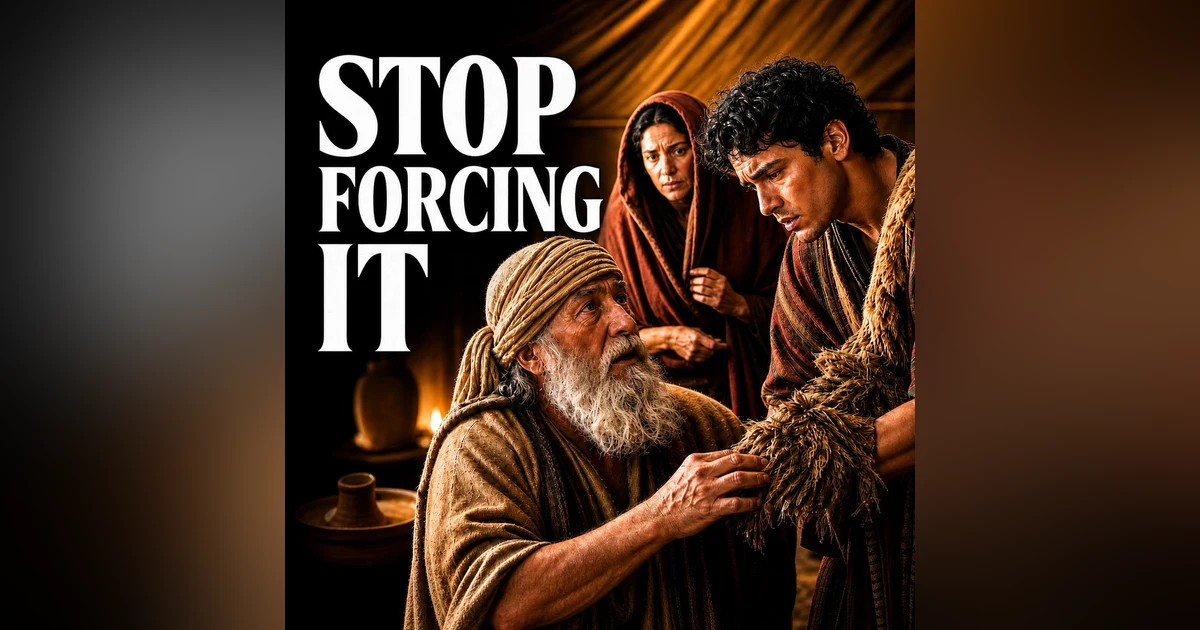
DAY 25: Are You Forcing What God Promised? What if your problem isn’t that God hasn’t spoken, but that fear has convinced you to force what He already promised? What if God’s promise is real, but your fear is still trying to force the outcome? Genesis 27 is one of the most uncomfortable family scenes in the Bible. Isaac is blind. Rebekah is scheming. Jacob is pretending. Esau is about to be displaced. And somehow, God’s covenant purpose still moves forward through a house full of favoritism, ...
Key Takeaways
- Fear can cause us to force outcomes that God has already promised, rather than trusting His plan.
- God's covenant purpose can move forward even through flawed and manipulative family dynamics, as seen in Genesis 27.
- Manipulation and deception are never holy, even when used in an attempt to secure a divine promise.
- God's timing and blessing are safest when we allow Him to work without our panicked interference or schemes.
- Understanding the Hebraic and Ancient Near Eastern context reveals the dangers of using spiritual language to justify human ambition.
DAY 25: Are You Forcing What God Promised?
What if your problem isn’t that God hasn’t spoken, but that fear has convinced you to force what He already promised?
What if God’s promise is real, but your fear is still trying to force the outcome?
Genesis 27 is one of the most uncomfortable family scenes in the Bible. Isaac is blind. Rebekah is scheming. Jacob is pretending. Esau is about to be displaced. And somehow, God’s covenant purpose still moves forward through a house full of favoritism, appetite, secrecy, fear, and manipulation.
In Day 25 of Through the Bible in a Year: Walking the Story of God, Dr. Shawn M. Greener walks through Genesis 27:1 to 29 and exposes one of the hardest truths in the life of faith: God can move through broken people, but that never makes manipulation holy.
This episode speaks directly to real people living in real pressure. People who are tempted to control outcomes. People who are tired of family dysfunction. People who know what it feels like when conversations become strategies, rooms become stages, and truth gets buried under fear.
Genesis 27 reminds us that God’s promise does not need our deception. God’s timing does not need our panic. God’s blessing is safest when our hands are clean.
From a Hebraic and Ancient Near Eastern perspective, this passage is not just about a stolen blessing. It is about covenant, spoken authority, family fracture, spiritual dissonance, and the danger of using holy language to baptize human schemes.
Tell me in the comments: Where are you tempted to force an outcome instead of trusting God’s timing and method?
More resources:
https://www.truewordfaithforlife.com
The Bible Rebinder I Mentioned on the Podcast
This is one of the three Bibles Melissa of MooseWorks Bible restored for me, beautifully rebound with a rugged new cover and exceptional attention to detail.
A Bible is more than a book. It is often a treasury of prayers, notes, promises, memories, and the record of a life spent seeking God.
If you have a treasured Bible that deserves to be preserved with excellence, I am honored to recommend Melissa of MooseWorks Bible.
Her work is marked by beautiful craftsmanship, thoughtful detail, and genuine kindness. She does not simply repair Bibles. She helps preserve the story they carry.
Visit MooseWorks Bible today:
Click HERE to contact MooseWorks Bibles
https://www.etsy.com/shop/MooseworksBibles
© 2026 Dr. Shawn M. Greener. All Rights Reserved.
True Word, Faith for LIFE!
Send Dr. Shawn a Message. Please leave your contact information if you’d like a reply!
Thank you so much for listening! Please subscribe to the True Word, Faith for LIFE! YouTube channel, please click this link. Thank you again!
Shawn
https://www.youtube.com/channel/UCo1sLYz6J4FTUFwR5yjReMw
Frequently Asked Questions
What is the main theme of DAY 25: Are You Forcing What God Promised?
This episode explores how fear can lead us to try and force God's promises instead of trusting His timing and methods, using the story of Jacob and Esau in Genesis 27 as an example.
How does Genesis 27 illustrate the theme of forcing God's promises?
Genesis 27 shows a family riddled with favoritism and fear, where Jacob and Rebekah manipulate events to secure a promised blessing, demonstrating how deception is not holy even when pursuing divine promises.
Can God use broken people to fulfill His promises?
Yes, God can and does move His purposes forward through broken people, but this does not make their broken or manipulative actions holy.
What is the danger of trying to force God's promises?
The danger lies in using deception, panic, or manipulation to control outcomes, which can lead to family fracture and a misuse of spiritual language to baptize human schemes.
Good morning. Are you ready? Are you all in? Are you all in? This one gets deep. Broken families. Maybe you can identify. Why does the blessing come through a scene this broken? This broken. Why is Isaac blind? Why is Rebecca scheming? And why is Jacob pretending to be Esau? Why does one of the most important covenant moments in Genesis feel like a family disaster? I'll tell you why. That's why I'm here. It's the whole reason I showed up. Because the Bible doesn't flatter the chosen family. It doesn't. It tells the truth. It shows the promise. Not through some fluffy, I don't know, everything's perfect world. It shows us promise moving through real people with real wounds. You and me. You and me. Real appetites, real fears, real favoritism, and real manipulation. Real. You can like it or you don't, but it's real. And that matters because some of us still think God only works through clean stories, perfect stories. All buttoned up stories. Oh, no, that's what he does. Yeah, that's all. That's all he does is work through that. Those people come along and boom. Genesis says no. God's promise can move through a broken house. Don't miss this so early. Don't miss this. That doesn't make the brokenness holy. God can and often does keep his word through human mess without approving of the mess. Alright, we ask questions. I don't know. You want to answer them? You can. If you don't have to, I don't. It doesn't matter. Where are you tempted? Come on, ain't no point in me asking this question if you're not going to answer it. Where are you tempted to manipulate because you're afraid God won't handle what he already promised? You say, Well, I don't know that I can trust God to handle that. I don't think I can. Oh, you don't say it as bold and as brash as all that. Happens in here. Happens in here. That question happens here and here. Where are you tempted to manipulate because you're afraid God won't handle what he's already promised? Welcome back to Through the Bible in a year, walking the story of God. I'm Sean. Today we come to Genesis 27, 1 to 29. Wow, we're covering a lot of verses. This episode is brought to you by my book, True Word, Faith for Life. True Word, Faith for Life. You can find it at True WordFaithforLife.com. True WordFaithforLife.com. And uh in this store. It's gonna it's gonna take you deeper into what it means to live as a true follower of the way. Not a perfect follower of the way, a true follower of the way. A true one. Ain't nobody say nothing about being a perfect one. A true one. So Genesis 21. I'm sorry, 27. It opens with Isaac all old. His eyes are dim. That detail matters. Don't skip over that. His physical sight is failing. That's what it means. His eyes are dim. He's losing his vision. But the story also invites us to ask about his spiritual perception because Isaac calls Esau, his older son, and tells him to take his weapons and go hunt game. Prepare delicious food and bring it so Isaac may bless him before he dies. I want you to remember what God had already spoken before the twins were born. The older shall serve the younger. Look, the oracle wasn't unclear. God had already announced, He had already announced that the covenant direction would not follow ordinary human expectation, yet Isaac moves to bless Esau. Why? Why, why'd that happen? The text already, it already told us that Isaac loved Esau because he ate of his game. That's not some flattering detail. Isaac's appetite is tethered to his preference. Food, favoritism, and family. Food, favoritism, and family to destiny. They're now dangerously tangled. And when appetite starts steering the house, discernment gets blurry fast. Oof da. The ancient Near East. In this world of the ancient Near Eastern world, that that was a different world. A father's blessing wasn't just some sort of sentimental speech he did at dinner time or some special event. It carried legal, familial, covenantal, and prophetic weight. Words mattered. You don't think your words matter, the things you say that come out of your mouth, and not for nothing, the things you don't say. For the married folk out there, if one spouse is always complimenting the other and the other's not complimenting the one that's complimenting them so much, the unsaid words matter. They hear them. For those of you out there where your children wince every time you speak. So this moment is massive. Isaac isn't merely saying something kind over Esau. He's attempting to confer family destiny, and that destiny has already been addressed by the Word of God. That's the tension here. Isaac has affection for Esau, probably a likable guy. He's a tough guy. Look, men, I'll say this to you. And I don't know what women like. Clearly, I don't know. I'm not an expert on that, except I've talked to I don't know how many couples in my counseling chairs. Women don't love a feminine man who they can manipulate and push around. They want somebody has some thoughts of their own, some strength, somebody that can protect them. They'll say, you know, I like a man that'll cry. Not when the burglar's coming through the door. Not when the crazy person is wielding a machete. It's no wonder. It's no wonder Isaac had affection for Esau. He got the protein. He brought home the food. He provided. Yeah, okay. Isaac has an appetite for uh Esau's game. Isaac has cultural expectation on his side. But God has already spoken this other word. So when human preference collides with divine revelation, somebody has to bow. Then Rebecca's listening. Man. This is another painful detail. Breaks my heart. Breaks my heart for Isaac, breaks my heart for Rebecca, breaks my heart for all of history. It's another yet another painful family detail. And I don't know what your family is like, but I can tell you. I don't come from a perfect family. I'm not perfect. I haven't been perfect within my family, and my family's not perfect. The house isn't operating in open trust. People are listening from corners of the tents. From just outside the flap. If you've ever been camping, you know what that means. Planning in shadows, managing outcomes through secrecy. Don't run around with a bunch of secrets in your family. Don't do it. Don't do it. Bring it out into the open. Talk about the stuff. Maybe painful you look in my family, we didn't talk about anything. Nothing. There was no pain avoided. There's no benefit to it. This is what happens when truthfulness breaks down in a family. By the way, I don't throw shade on my dad or my mom. My dad made bad choices. My mom did the best she could. She did the best she could. In very difficult circumstances. So what happens when truthfulness breaks down in a family? Conversations aren't conversations, they're strategies. Rooms become stages. People stop speaking plainly and start working around one another. You know what I mean. Some of you know exactly what that feels like. You grew up in it. You grew up in a house, maybe, where nobody said the real thing directly. I did. Everybody hinted, nobody hinted. Everybody maneuvered, oh, they showed that in my family. Everybody watched tone, timing, mood, and opportunity. Well, maybe not. Maybe that was the way it is in your family. That's the way it was with Isaac, Rebecca, Esau, and Jacob. And that's exhausting. It's not covenant health. Rebecca hears Isaac's plan and moves quickly. Now we need to be careful here. Rebecca remembers the word God spoke, and she knows Jacob is the son connected to the covenant direction. Her concern isn't completely wrong. That's the way it often is with us, but her method is wrong. And that's the way it often is with us. Maybe our heart's not in the wrong place, but our way we go about it is wrong. I see all of you answering up what you went through as a child and your families. Your families then, your families now. A few of you. Look, her method, her method was wrong. This is where many people deceive themselves. They think a right concern sanctifies a wrong method. It doesn't. You can care. Look, you can. You can care about the right outcome and still sin in the way that you pursue it. You can say, but I'm protecting my child while manipulating everybody in your house. You can say, I am preserving the ministry while hiding the truth. You can say, well, I'm keeping the peace while building the room on secrecy. Right concern, wrong method. God sees both. And I'm not throwing rocks at you. I'm not. I don't, you know, look, after counseling, I don't know how many families, husbands and wives, and individuals. We're all a jacked-up lot. We are all a jacked up lot. We try to remember. We try to remember. Amen. To be continued 25. By the way, excellent, excellent YouTube channel. Very interesting. Um says, I don't ever remember seeing my parents showing affection in front of me. I did, I did see my dad show affection to my mom. I did. But there was certainly no working stuff out, figuring stuff out. So I feel you, bro. Right concern, wrong method, and God sees both. Rebecca tells Jacob to bring two young goats so she can prepare food for Isaac. Jacob immediately sees the problem. Esau is hairy, Jacob is smooth. If Isaac touches him, now that's what I'm saying. He was, for all intents and purposes, blind. He was legally blind and he didn't have his glasses. Something happened to him. He was out there. I don't know. He lost him. If Isaac touches him, he may think Jacob is mocking him. Then Jacob says, he will bring a curse on himself and not a blessing. Right? Notice what Jacob fears here. He doesn't say, Mother, this is wrong. He was a he was grown. He was a grown daggum man. You can tell your parents when something is wrong. We didn't in my family, because if you did, you got your lips smacked off. You do it with respect. He doesn't say we should try. He doesn't say we should trust the word of God that has already been spoken. He doesn't, he doesn't say deception is not the way, Ma. He fears getting caught. Sometimes kids kids children scheme with one or the other parent to triangulate. It's a tough position to put your kids in, but when they're grown people, you both are wrong. See, that's a mirror for the human heart. Many people are more afraid of exposure than of evil. More afraid of consequences than corruption. More afraid of being found out than being false. He's not. It's okay. Jacob at this point is still the heel grabber. He's still the grasper. Remember, in the womb. He's climbing onto that heel. Jacob had ambition. He's still the man trying to secure through cunning what God has already spoken by promise. He already had it, but he was afraid, fear. Rebecca was fearful. Rebecca says, Let your curse be on me, my son. Ooh. Only obey my voice. Ouch! That sentence is heavy. She takes responsibility. She also intensifies the pressure. Only obey my voice. That's dangerous language when the voice being obeyed is leading someone into deception. Oh man, come on. A parent's voice is powerful. A mother's voice is powerful. Ask me how I know. A father's voice is powerful. Ask me how I know. A leader's voice is powerful. Ask me how I know. And I know you know the same thing, but no human voice has the right to overrule righteousness. Honor doesn't mean participating in sin. Loyalty doesn't mean obeying manipulation. There are moments when the faithfulness to God requires refusing even the familiar voice that says, just do what I say. Even that voice that hugs you and kisses you goodnight. Even that voice that hugs and kisses you in the morning, even that voice which pats you on the head or hugs you around the neck and says, Hey, it's gonna be all right. Sometimes that voice is wrong. Just do what I say. Then Rebecca takes Esau's best garments and puts them on Jacob. She covers his hands and his neck with goatskins. Ouch! What in the world? That's theater, that's costume, that's false identity wrapped around a covenant son. I want to remind you, he already had the blessing from God. Sometimes that little embellishing lie, you already had the job. You already had the promotion. You already had your mate's affection. But that little embellishing lie. False identity wrapped around a covenant son. Jacob enters his father's presence, wearing his brother's smell, his brother's clothing, his brother's texture, and his mother's plan. That image should disturb us. Because deception often requires us to wear what isn't ours: a false voice, a false story, a false confidence, a false holiness, a false version of ourselves. The longer you wear what is false, the more it trains you to live divided. Jacob goes to Isaac and says, My father. Where are you, my son? Heartbreaking. Heartbreaking. That question sits all over the whole scene. Who are you? Who are you, my son? Who are you? Jacob answers, I'm Esau, your firstborn. Direct lie. Not a misunderstanding, not a gray area, a lie. And Jacob says he has done as Isaac told him another flat out lie. It's how they go. They just snowball. Isaac asks how he found the game so quickly. Jacob says, Well, because the Lord your God granted Me successful. Oh, let's pull the Lord into it. How many times do we do it? Come on. Somebody out there, how many times have you done it? Now the deception becomes even worse. Jacob brings God's name into the lie. And that should make us tremble. It's bad enough to deceive, isn't it? It's worse to put holy language on deception. People still do this. In the modern world, people do it all the time. God told me, the Lord gave me a word. Will I have peace about this? The Lord opened the door. This is favored. The Lord showing favor on me. Sometimes that is true, by the way. But sometimes people are using spiritual language to baptize a scheme. Genesis 27 says, Do not drag God's name into your manipulation. And Isaac is suspicious here. He says, Come near that I may feel you, my son, and know whether you are really my son Esau or not. Hmm. Boy, that's heartbreaking. Is that not heartbreaking? The man is near death. He's blind, and he has to feel of his son. He can't trust Rebekah. He thought he could trust Jacob. He put all of his trust in Jacob. That's my boy that does the right thing. Oh, I love Esau. He's a hunter. He brings in the food. He's strong. He's tough. But I thought I could trust Jacob. And Jacob comes near, and Isaac touches him and says, The voice is Jacob's voice, but the hands are the hands of Esau. It's heartbreaking. Put yourself in his shoes. He's near the end of his amazing life. Not perfect life, amazing life. The voice doesn't match the hand. Something is off. Something's not integrated. And that's what deception does. It creates dissonance. The sound doesn't match the substance. The presentation doesn't match the truth. The image doesn't match the identity, but the disguise is enough to move the moment forward. Blindness, appetite, favoritism, and deception all converge, not usually from one thing, but from a convergence of unaddressed things. Isaac asks once more. Are you really my son Esau? Jacob says, I am. And Isaac eats. Don't miss how central food is in this family story. Esau sold the birthright over food. Food. Red lentil stew. Isaac moves to bless Esau around food. Rebecca and Jacob use food as part of the deception. It'll feed you and it'll kill you. Food will feed you, nourish you, and food will kill you. Genesis is showing us that appetite can become spiritually dangerous when it rules the house. Look, appetite can often be sexual. That's a super dangerous one. Make you do stuff that will wreck you. Appetite isn't always sexual. Appetite is whatever desire gets permission to lead. The appetite for food, the appetite for control. The appetite for comfort. The appetite for being right. Oh, how many how many of us are out there addicted to being right? Thank you, Alex. Thank you all. How wonderful you all are. And in chat, it's just lovely. I love how kind you are to one another. The appetite for being right. Ask me how I know. The appetite for a preferred outcome. When appetite leads, discernment fades. And Isaac asked Jacob to come near and kiss him. Oh man, come on. He smells Esau's garments and he blesses him. The smell convinces him what the voice could not. Then Isaac speaks the blessing. Dew of heaven, fatness of the earth, grain and wine, people serving, nations bowing, lordship over brothers, those who curse heartbreaking. Those who curse him are now cursed. Those who bless him, blessed. This blessing carries echoes of Abraham's promise. I want you to hear it again. Dew of heaven, fatness of the earth, grain and wine, people serving, nations bowing, lordship over brothers, those who curse him, cursed. Those who bless him, blessed. This blessing carries the echoes of that very promise that Abraham had. The covenant story is moving forward, but it moves through a terrible mess. That's the tension at this part. God's purpose stands. God, look, God's purpose stands. Absolutely. We can't interrupt it. But human deception. Human deception. Oh, there's my sweet brother. Oh, how I love my brother Wes. Montbon. That's what he is. He is one of the most precious human beings. He and my sweet Lily. Oh, how I love them. That's one of my brothers right there. Thank you for tuning in. Thank you all for tuning in. What a blessing. Look, human deception still wounds. God had chosen Jacob. Jacob still lied. Right? He still lied. God's word prevails. Rebecca's still manipulated. The blessing moves forward. The house is still damaged. Don't confuse God's sovereignty with God's approval of sin. This passage forces us to hold two truths at once. First, God is faithful to his covenant promise. Don't miss that. Say it out loud to yourself. Say it out loud to yourself. God is faithful to his covenant promise. He's still faithful to his covenant promise. Say it out loud. Did you say it? Second, human manipulation creates real damage. Say that out loud. Human manipulation creates real damage. A lot of bad theology comes from us refusing to acknowledge the separation between those two. A lot of bad theology comes from refusing to hold both. Some people say, well, God used it, so it must have been fine. No. No. God used the cross too, and that wasn't fine. And the people who betrayed and murdered Yeshua were still guilty. Those people that murdered Jesus were still guilty, yet he used the cross. And that cross was disgusting. That the King of Kings and the Lord of Lords, the only perfect man to ever walk the earth, hung on a tree, just about naked, tortured to death. No. They were still guilty. Yet God's ability to redeem evil doesn't make evil righteous. And other people say if people sin, God's purpose must be ruined. No. Also, no. Hashtag no. Human sin is real, but it's not stronger than God's covenant faithfulness. Genesis 27 stands right in that tension. God isn't defeated by the mess, and the mess isn't excused by God's faithfulness. You see, some people will stay in that mess and they'll say, Well, the Lord works in a mess. The Lord works in a mess. Well, the Lord works in a mess. Mess. The Lord works. But they don't clean their mess up. It's incumbent upon me every day to work on cleaning my mess up. Mess is an excuse by God's faithfulness. Not in you, not in me. Some of you need this because you also came from a broken house. Maybe you're living in a broken house right now. Maybe there was favoritism, there wasn't mine. Maybe there was manipulation, there wasn't mine. Maybe one child was preferred. Oh, there definitely wasn't mine. Maybe one parent used one child against each other, against another. Maybe everything happened through secrecy. Maybe people lied and then they called it wisdom. Maybe people controlled and then they called it love. Well, I love you was never said in my house. Ever. Never heard it until I was about to go on something when I was serving. Um anyway. And what what we were about to do was extraordinarily dangerous. So I called home. When I hung up, there was never any I love you's with my parents. But this particular time I thought, well, I'm not coming home. There's a high chance I'm not coming home. So they gave us time to call our family. And I called. And I said, I love you at the end of the phone call. And after about 30 seconds, what came back to me was, Well, we we love you too. I grasped onto that and put it right in here. I said, Okay, let's go do this. Genesis doesn't pretend covenant families are automatically healthy, they're not. But Genesis also doesn't say broken family systems get the final word. God can work. He can. He can work through wreckage without calling wreckage holy. He can redeem what people damaged, he can carry forward what sin tried to corrupt. That doesn't erase the pain, but it gives the pain somewhere to go. Come on, somebody. Somebody. You have to have heard that for what it is. That doesn't erase the pain, but it gives the pain somewhere to go. And this points us toward Messiah. Yeshua Hamashiach, Jesus Christ. Jacob receives blessing while wearing the garments of another. That's the strange and broken shadow. But in Messiah, the exchange becomes holy, not deceitful. We are clothed in the righteousness of another, aren't we? Oh, we shall put on the righteousness of another. His name is Jesus. Not because we stole it, but because he just gave it to us freely. Yeshua doesn't deceive the Father, he obeys the Father. He doesn't grasp blessing through disguise. He opens blessing through sacrifice. Jacob enters dressed as another son to receive blessing. Yeshua, the true son, clothes us in his righteousness so we can be received by grace. That's the difference. That's the difference between manipulation and redemption. I don't know if you want. If you even can. Where are you tempted? Comments below. Where are you tempted to force an outcome instead of trusting God's timing and method? I have for you today, as I always have for you, a challenge and a choice. So here's the question. Where are you wearing something false to get something you want? Where are you more afraid of getting caught than being wrong? Where are you using spiritual language to justify a plan that doesn't belong to God? It's not God's plan. Where are you telling yourself the right outcome makes the wrong method acceptable? One of the places I used to work, there is no black and white, there is only gray. Outcome makes the method acceptable. So here's the choice. You can manipulate or you can trust. You can scheme in fear or you can obey in faith. You can drag God's name into your plan and say it's his. Or you can submit your plan to God's name. Lord, teach me to trust your word without corrupting my ways. Teach me to reject manipulation even when the outcome matters. Teach me to walk in truth when deception feels easier. My friends, family, prayer is not asking for an easy journey. It's asking for a strong back. Some of you need to pray this prayer. You need to handle this within our chests, are a beating heart that in a split second can stop. Pray this prayer if you never have. Father, I know I've done wrong things. I have hurts habits and hangups, I've sinned, and I need your mercy. I believe Jesus died for me, was buried, and rose again. Today I turn from my sin and I place my trust in Him as my Lord and my King. Forgive me. Make me new. Fill me with your Spirit. From this day forward, I want to follow you in Jesus' name. In Jesus' name. Amen. If you prayed that prayer today, I want you to hear me quite clearly. I will help you. True Word FaithforLife.com slash contact. It's not some sort of scheme. You don't have to pay money. True WordFaithforLife.com slash contact. There are many people listening right now that know I ain't playing. If I say I'll do it, I'll do it. God's promise doesn't need your deception. I'll help you understand. I'll help you find a Bible. I'll help you find a church. God's promise doesn't need your deception. God's timing doesn't need your panic. God's blessing is safest when your hands are clean. By the way, look, I'm not gonna beg you to share this. I'm not gonna beg you to take the link and put it on social media or however you get information out to people. I'm not gonna do it. I'm not gonna do it. You either are or you aren't. Until tomorrow morning at 7 a.m. Eastern Standard Time, we're gonna get after it, day 26. Until then. Shalom Bishem Yeshua. Shalom I like um.