

 Apple Podcasts
 Spotify
 DAY 21: WHY DID GOD CHOOSE HIM?!

Why would God choose Jacob when Esau looked like the obvious heir? Genesis 25 isn’t just ancient family drama. It’s a mirror. It exposes how easily we trade tomorrow for whatever we’re hungry for today. In Day 21 of Through the Bible in a Year: Walking the Story of God, Dr. Shawn M. Greener walks through Genesis 25:19 to 34, where Rebekah’s barrenness, Isaac’s prayer, the twins struggling in the womb, and Esau’s birthright all collide in one unforgettable question: Are you living by covenant,...
Key Takeaways
- God's covenant purposes operate by His sovereign Word, not by human preference or circumstance.
- The story of Jacob and Esau highlights the danger of trading sacred, long-term promises for immediate gratification.
- Understanding the ancient context of Genesis 25 helps us confront our own appetites and decision-making under pressure.
- We are called to live by covenant, not by fleeting hunger or ambition.
- God's choices may seem counterintuitive, revealing His grace and plan beyond our understanding.
Why would God choose Jacob when Esau looked like the obvious heir?
Genesis 25 isn’t just ancient family drama. It’s a mirror. It exposes how easily we trade tomorrow for whatever we’re hungry for today.
In Day 21 of Through the Bible in a Year: Walking the Story of God, Dr. Shawn M. Greener walks through Genesis 25:19 to 34, where Rebekah’s barrenness, Isaac’s prayer, the twins struggling in the womb, and Esau’s birthright all collide in one unforgettable question:
Are you living by covenant, or by appetite?
Esau didn’t just want stew. He treated something sacred like it was disposable. Jacob wasn’t mature, clean, or noble yet either. He was grasping. Calculating. Complicated.
And that’s the point.
God’s covenant purposes don’t move by human custom, birth order, physical strength, family preference, or emotional impulse. They move by His sovereign word.
This episode will confront your instincts, your appetites, your ambitions, and the way you make decisions when you’re tired, hungry, pressured, or desperate.
Chronological Reading:
Genesis 25:19 to 34 ESV
Genesis 25:19 to 34 CJSB
Watch now:
https://www.youtube.com/live/Z-VwHCL1TYc?si=gb-JpYJFlf8_Nlp6
More resources:
https://www.truewordfaithforlife.com
The Bible Rebinder I Mentioned on the Podcast
This is one of the three Bibles Melissa of MooseWorks Bible restored for me, beautifully rebound with a rugged new cover and exceptional attention to detail.
A Bible is more than a book. It’s often a treasury of prayers, notes, promises, memories, and the record of a life spent seeking God.
If you have a treasured Bible that deserves to be preserved with excellence, I’m honored to recommend Melissa of MooseWorks Bible.
Her work is marked by beautiful craftsmanship, thoughtful detail, and genuine kindness. She doesn’t simply repair Bibles. She helps preserve the story they carry.
Visit MooseWorks Bible today:
https://www.etsy.com/shop/MooseworksBibles
Genesis 25 explained, Jacob and Esau, Esau birthright, why did God choose Jacob, Esau sold his birthright, Bible in a Year, chronological Bible reading plan, Hebraic Bible teaching, Ancient Near Eastern context, covenant purpose, Rebekah and Isaac, True Word Faith for LIFE
Send Dr. Shawn a Message. Please leave your contact information if you’d like a reply!
Thank you so much for listening! Please subscribe to the True Word, Faith for LIFE! YouTube channel, please click this link. Thank you again!
Shawn
https://www.youtube.com/channel/UCo1sLYz6J4FTUFwR5yjReMw
Frequently Asked Questions
Why did God choose Jacob instead of Esau?
God chose Jacob based on His sovereign purposes and word, not on birth order, strength, or preference, as shown in Genesis 25.
What does the story of Esau selling his birthright teach us?
Esau's exchange of his sacred birthright for a bowl of stew illustrates the temptation to prioritize immediate desires over eternal promises.
What is the main theme of Genesis 25:19-34?
The passage explores the collision of divine covenant with human appetite, questioning whether we live by God's promises or by our immediate desires.
How does God's choice of Jacob relate to covenant?
It demonstrates that God's covenant is established by His faithfulness and Word, independent of human merit or societal norms.
Unknown Speaker (0:00): Good morning or good afternoon or good evening. I'm glad to see you. All of you are ready to go. You're all in. I love that.
Unknown Speaker (0:16): That's awesome. Here we go. This one's a little bit of a kick in the gut. Sometimes I wonder if people who aren't siblings, they don't have they don't have siblings, can really grasp all of this. But I think he can.
Unknown Speaker (0:58): We're gonna cover some really important ground in the next few minutes. Breathe deep. This one's gonna hurt a little. Why? I'm I'm asking real questions here to you.
Speaker 0 (1:29): Why does God choose the younger instead of the older? Why does the Bible keep confronting the instincts that we seem to trust the most? Why does the next chapter of the covenant story begin with barrenness, struggle in the womb, family tension, and a brother selling his birthright for Stu. It's not just a silly little Sunday school story. Genesis 25 exposes something painfully human.
Speaker 0 (2:36): We keep valuing what's what's immediate over what's holy. We keep trusting appearance over God's word. We keep assuming what comes first looks strongest, sounds loudest, or feels best must matter most. But here's the thing. God doesn't bow to human instinct, and that's unsettling.
Unknown Speaker (3:14): And that's also beautiful. So if if you'd indulge me, let me ask you. You. Have you ever realized too late? Oh, man.
Speaker 0 (3:35): What did I do? What have I done? Have you ever realized too late that you traded something sacred for something immediate? Let your mind wander to any of those places where maybe you were and you traded. You gave something sacred for something immediate, and it didn't pay off.
Speaker 0 (4:26): Or in the moments immediately after, you looked at yourself through that imaginary mirror that kinda goes everywhere with us. Then you said, what have I done? Because you can't unring a bell. You can't go back in time. Don't know if you've ever been there.
Unknown Speaker (4:58): I have. Consequences. Welcome back. Welcome back to Through the Bible in a Year, Walking the Story of God. I'm Sean.
Speaker 0 (5:20): Today, we come to Genesis twenty five nineteen through 34, and it ain't easy. Thank you. To be continued, 25. He says, I confess I I have done that. Thank you for being open and being real.
Speaker 0 (5:45): Episodes brought to you by my book. You can buy it if you want. You don't have to. And it'd be nice if you did. It's textbook quality.
Unknown Speaker (5:53): It's designed to last. Pass down. Pass down. Pass down. So this book will kick in the teeth, and it'll give you a sweet kiss on the face and the soul.
Speaker 0 (6:10): It'll take you through the bible in a way you've never experienced. And there's a lot of, some would say, off the rails commentary in there from. So if we ever do make a profit on the book, you buy it through truewordfaithforlife.com. You can buy it anywhere. I mean, you could buy it anywhere.
Unknown Speaker (6:37): The big stores you're thinking of, the online places, all of those have it. The ministry, not really a ministry. This is a mission. The mission that I'm doing here, we get more from the publisher, and all of that goes to paying for this. So I'm walking, crawling through a season of consequences, the most painful experience of my life.
Unknown Speaker (7:12): Heavenly father, here we are. Here we are. We're laid bare before you. And some are in this season of pain and consequences. Help all those who are to see you in the struggle and in the pain, and to constantly turn their eyes upon you and look full in your wonderful face, and to learn from your word.
Speaker 0 (8:07): Help me to be an instrument in that healing, even though I don't deserve it, especially that I don't deserve it. Bless these people listening no matter where they are, no matter what time it is. Bless them. Give them a sense of who you are and what you are. We thank you for being the awesome god.
Speaker 0 (8:46): In your son, Yeshua. In Jesus' name, amen. God can restore in a season of do over now. I can see God's growth in round two and praise the Lord for his peace and refuge. Feed on his word first always and pray and listen.
Speaker 0 (9:15): I appreciate how early you have to get up where you are blows my mind. Thank you. I'm honored by it. I want you to know that. Good morning, Tammy.
Unknown Speaker (9:29): Good morning, Robbie. Good morning, Nicole. Good morning to you all. By the way, share this episode. Seems silly to keep it to yourself.
Speaker 0 (9:42): It's free. So I'd love for you to get the book. Go deeper into what it means to live as a true follower of the way, not a perfect follower of the way, a true follower of the way. It keeps training us to choose what you know, this world keeps training us to choose what's fast, loud, and instantly satisfying. God says, choose this.
Speaker 0 (10:17): Genesis 25 marks a major handoff. I hate to see Abraham's life close. He was a fascinating guy. I'm gonna shake his hand in heaven. I might hug him.
Unknown Speaker (10:35): I'll hug him. I'll probably cry. Say there'll be no tears in heaven, but mine will be a tear of gratitude. Thank you for going through all of what you went through so I could be here. But we live and we die.
Speaker 0 (10:57): Abraham's life is closed. Isaac now stands in the line of promise. But right away, the Bible makes something pointedly clear. The next generation will not be simple. And don't we know that?
Speaker 0 (11:12): We're now seeing that, all of what we have around us, all of the things we have around us to make our lives easier. We have the benefit of being able to see back. The bible makes it clear to us it's not going to be simple next generation. It's not gonna be neat, and it sure won't be painless. Covenant doesn't move through perfect families, folks.
Speaker 0 (11:49): Folks that don't believe the bible, that that rail against it and ridicule it and ridicule you for believing it, most will will point to the bible and say it's a collection of silly stories to get you to do stuff. That were the case, we wouldn't have put I didn't have anything to do with writing it, but it wouldn't be put through to you and through to everyone who will read it with all of the the trial and the failure and the pain. That's hard sell. Hey. We want you to become part of this faith that we're in.
Speaker 0 (12:33): That's why, Judaism I'm not Jewish, but Judaism, it always cracks me up because, you know, there's no evangelical wing in Judaism. They want it to be hard to become a Jew. And sometimes I think it's a little too easy for us, but sometimes there's pain in the lesson. There's pain in the imperfect family. The covenant.
Speaker 0 (13:08): The covenant moves through imperfect families through real families, families, through through real real tension, tension, real real waiting, waiting, real weakness, real choices. The chapter opens by naming Isaac and Rebecca, then immediately we we hit a snag. We hit a problem. Oh, crap. Rebecca is barren.
Unknown Speaker (13:41): Well, you look, you know, we can look at that and go, well, you know, we can
Unknown Speaker (13:43): adopt. The modern world takes anachronistically we we sometimes we look back and go, didn't
Unknown Speaker (13:52): they do that? That was stupid. Why didn't they do that? You just go do this here. Go down
Unknown Speaker (13:57): to the corner store. Go on to the Amazon and and order you up some hot tamales.
Unknown Speaker (14:05): You don't don't don't be without
Unknown Speaker (14:06): you can just order them. No. They couldn't run down to the store. They didn't have an adoption program. Didn't have any of that.
Speaker 1 (14:13): If you didn't have kids in this wild, wild world, if
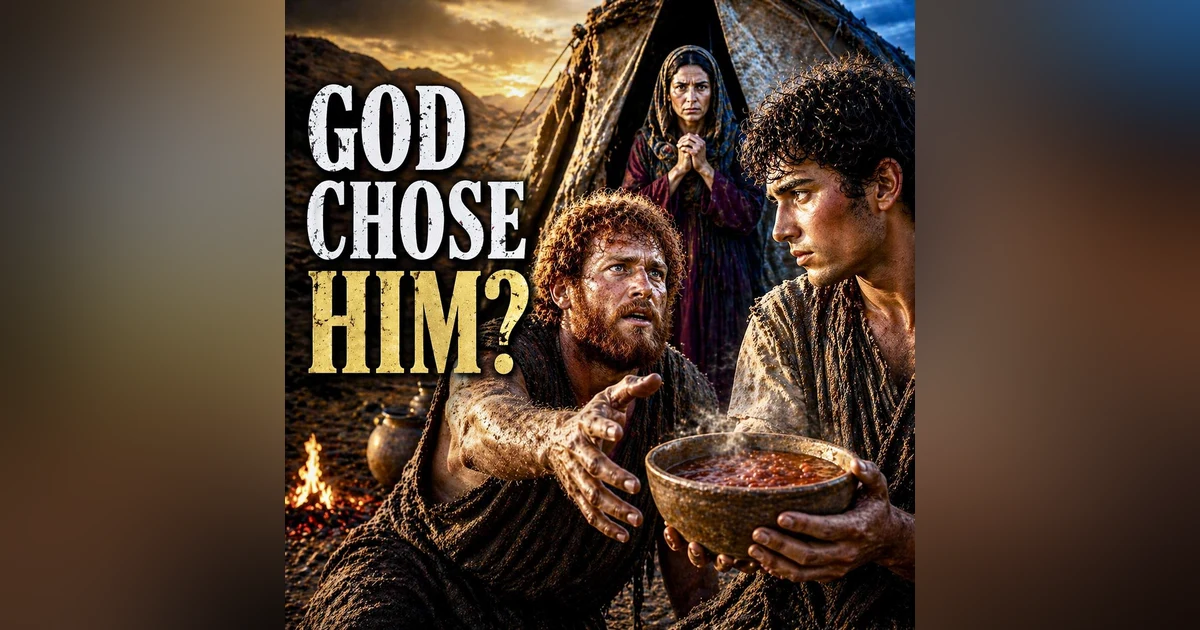
Unknown Speaker (14:17): you look at the thumbnail, if you're listening on audio, you won't be able to see it unless you blew it up on your phone. By the way, we're on all of them. Apple Podcasts, Spotify, Amazon Music. Thank you, by the way, to all of you who have accepted us there. IHeartRadio, Pocketcasts, Overcasts, Castbox, Goodpod all of them, in, like, 10 more.
Unknown Speaker (14:39): So if you're listening on that, you might not see it, but they were dirty. They were muddy. They sustained injuries from just living. It was dangerous wild life. They were in the wild world.
Speaker 0 (14:56): It was wild then. It wasn't like it is now. It's just wild in a little different way. And if you were barren, if you couldn't have children, it was devastating. Rebecca's barren.
Speaker 0 (15:18): We can't hurry past that. Sarah was barren. What? Now now now Rebecca what? Come wouldn't how'd that happen?
Unknown Speaker (15:32): That repetition matters, and sometimes we rush through. I got a a note the other day. Somebody said, I shouldn't tell you this stuff, but I'm gonna well, I get a note from somebody. They they don't listen to the show. Come on.
Speaker 0 (15:47): They go,
Unknown Speaker (15:48): I don't know why. I don't know why you take so forever long to go through the bible. You ain't never gonna get through the bible in ten years at this rate. Okay.
Speaker 0 (16:02): I'm trying to teach you these important things. Something Heschel said, something sacred hangs in the balance of every moment. And, oh, how it does. Something sacred hangs in the balance of every moment. And in this repetition, you could
Unknown Speaker (16:24): read past it. You could go past it. You could
Unknown Speaker (16:26): miss it. You could go, oh, no big deal. Or not even notice it. The repetition, Sarah was barren. Now Rebecca is barren.
Unknown Speaker (16:33): Both covenant women. They're covenant women. They're critically important,
Unknown Speaker (16:38): and the repetition matters. And if you don't know to look for it, you
Unknown Speaker (16:42): will miss it, and you will miss that the Bible is showing us that the covenant line doesn't advance by natural human power.
Unknown Speaker (16:52): It advances because God acts. The promised future cannot be manufactured. It has to be given. Some of you are so worn out because you're trying to produce by flesh what can only come by the grace and mercy of a living God. You're straining the force what has it has to be received.
Speaker 1 (17:18): It has to be received. It has to be it must be received from God's hand.
Unknown Speaker (17:29): Genesis 25 says the line of promise still depends on God, not human ability, not visible. Pardon me, not visible odds, not natural momentum, God. So Isaac prays to the Lord for his wife that matters. Because there's a there's a difference here. There's a difference between, Abraham and Sarah.
Speaker 0 (18:10): Right? He doesn't scheme. Isaac doesn't scheme like Abraham and Sarah did. He learned. He learned from the past.
Unknown Speaker (18:16): He learned from the experience. He learned from the pain. He doesn't scheme like Abraham and Sarah did with Hagar. He doesn't he doesn't reach for a flesh built workaround. What's he do?
Unknown Speaker (18:31): He prays. Sometimes we hate to pray because that means When we pray, we are confronted by the ultimate reality of who we are. He prays. That's growth in the family line, and the Lord grants his prayer. That's beautiful because it's just so beautiful, but it doesn't remove all the tension.
Speaker 0 (19:27): It doesn't. Because when Rebecca conceives, the children struggle together within her. Oh, ow. Ow. Ow.
Speaker 0 (19:36): Ow. This isn't some peaceful pregnancy scene. This is conflict before birth, and Rebecca asks a very raw question. If it is thus, why is this happening to me? This isn't some sort of polished religious language.
Speaker 0 (20:03): That's the cry of a woman who received the answer to prayer and then found out the answer came with pain. Some of you know exactly what that feels like right now. You're in
Unknown Speaker (20:15): the midst of it. You've prayed for
Unknown Speaker (20:17): the thing. God gave you the thing, and now you're saying, Lord, why does the answer hurt like this? Genesis 25 understands that very well. So Rebecca inquires of the Lord. Rebecca inquires of the Lord.
Speaker 0 (20:51): That's the pattern. When pain and confusion collide, inquire of the lord. I don't know how many of you have been there. I don't know who I'm talking to right now, But I can tell you there have been times in the biggest struggle of my life I did not inquire of the Lord. I knew to, but it didn't.
Speaker 0 (21:21): As a last thing, the last thing I would wanna do, and I didn't. Look. Don't just spiral. Don't just vent. Don't just assume.
Unknown Speaker (21:36): Go to God. Don't go to him once and thinking, oh, we got this resolved. That's handled. Go to God over and over and over and listen. And you may not like the answer.
Unknown Speaker (21:55): Go to God. You see, God answers with one of the most important oracle statements in Genesis here. This is an oracle statement. This is this is a history changing statement. He says, two nations are in your womb.
Speaker 0 (22:13): Two peoples will be divided. One shall be stronger than the other. The older shall shall serve the younger. The older shall serve the younger. That's explosive, my friends.
Speaker 0 (22:27): In the ancient Near Eastern world, the firstborn carried privilege, rank, inheritance, and expectation. This was completely opposite. This is what God was saying. The older son was the obvious one, the natural one, the culturally expected one, but God announces before either child has built a resume that his covenant purpose won't bow to human custom. The older shall serve the younger.
Unknown Speaker (23:00): That isn't random. That's revelation. God's purpose is moved by his word, not by our ranking systems. Now be careful. Be careful here.
Speaker 0 (23:16): This doesn't mean God hates order or family structure. It means he is not imprisoned by human expectation. He's lord. And that's it. Look.
Speaker 0 (23:31): That hits so hard because we love what looks, what appears to be obvious. We love public strength. We love first place. We love platform. We love pedigree.
Speaker 0 (23:47): We love whatever looks like it should win. But the god of the bible repeatedly chooses in ways that humble human pride. He chose Abel's offering over Cain's. He chose Shem's line. He chose Abraham out of Er.
Speaker 0 (24:07): He chose Isaac, not Ishmael, as the covenant line. Now he says the older shall serve the younger. The Bible keeps breaking the world's confidence in the flesh, and we need that. People say, well, this story this story,
Unknown Speaker (24:23): I don't I don't understand what this story is about because because why why y'all going into all that? What if I'm always talk about all that? Don't make no sense to me.
Unknown Speaker (24:38): You gotta read it deeper, man. You gotta read it deeper. You just can't it's getting through the Bible in a year is that's not the accomplishment. That's not the goal. The goal is to take in the truth.
Unknown Speaker (24:58): Something sacred hangs in the balance of every moment no matter how small. The flesh always wants to turn advantage into entitlement. Then the twins are born. Esau comes out first, red, hairy. He's hairy, visibly marked.
Speaker 0 (25:21): Then Jacob comes out grasping Esau's heel. Even his entrance is a sermon. Jacob name look. That name, Jacob's name, it carries the sense of heel grabber, one who grasps, one who overtakes. From the start, the Bible tells us that these boys embody tension.
Speaker 0 (25:45): Some of you live that. Esau becomes a skillful hunter, a man of the field. Jacob is a quiet man. He dwells in tents. He's a thinker.
Unknown Speaker (25:57): Now don't turn this into some sort of cheap stereotype. He wasn't in the tent playing video games. This isn't saying outdoor men are bad or indoor men are holy. Look. I'm an outdoor guy.
Speaker 0 (26:10): I'm an indoor guy. I love them both. Doesn't prefer one over the other. That's not the point of this. The point is that these brothers carry different dispositions and different value systems, and those values are about to collide.
Speaker 0 (26:29): Listen. The family is already unhealthy here. It's already unhealthy. Isaac loves Esau because he eats his game. Rebecca loves Jacob.
Speaker 0 (26:46): That isn't some sort of sweet family detail. That's a warning flare. Parental favoritism is poison. It's poison. Happens in every family.
Speaker 0 (27:01): Look. I'm the youngest of five. I guarantee you, all of my siblings probably thought I was the favorite, but I wasn't. We found out at the end of my mother's, my dear mother's life. Oh, I sure wasn't.
Speaker 0 (27:18): My siblings were wrong if they thought that. If you have more than one child, listen. Parental favorite look. Look. Look.
Unknown Speaker (27:28): Look. Look. Look. We're not gonna lie here. We're not gonna lie.
Unknown Speaker (27:30): We're not gonna we're not gonna come at this with some sort of fluffy. We're not coming at it with some sort of fluffy.
Unknown Speaker (27:37): But I love all my children.
Unknown Speaker (27:38): I love all my children the same just the same. No. You don't. Come on. You may love them fully and completely, but there's if in in the case of multiple one is easier.
Unknown Speaker (27:53): One is one one is sometimes the easier one isn't the favorite one. It's the one that is unique. There's something unique. They have some there's just something about them. You just say, man, that is a fascinating human.
Speaker 0 (28:09): Yeah. It came out of me or, yeah, this was, you know, product. If if it's your son or your daughter or whatever, you know, you look at, wow. Man, what a person. And maybe they weren't the easiest one.
Unknown Speaker (28:21): This isn't this is not that. Parental favoritism is poison. You gotta work on it. Some of your children either already have or will break your heart. They will break your heart, And that's one of the hardest things ever in life to get over.
Speaker 0 (28:49): But look, the Bible, this precious Bible, it doesn't flatter the covenant family by hiding it. This house is already leaning toward a fracture, and some of you know that pain right now. You know that pain. Families often become battlefields when love gets attached to preference, appetite, or projection instead of covenant wisdom. And then comes the stew.
Speaker 0 (29:20): Esau comes in from the field exhausted because he works hard. Jacob is cooking. Esau says, let me get some of that let me let me eat some of that red stew because I'm exhausted. When I made the the thumbnail, I I made it red lentil bean red lentil bean soup, a, because I like it. And probably that's what it was.
Unknown Speaker (29:42): I don't know. I wasn't there, and I didn't you know, I'm not in their text stream. Grew up in this. Family divided will fall. Amen.
Unknown Speaker (29:53): True story. So so he he comes in exhausted. He's let me get let me let me hold some of that red stew. That smells good. Let me get some of that.
Unknown Speaker (30:07): I'm hungry. I'm exhausted. Jacob says, sell me your birthright now. Now. Let's be honest.
Speaker 0 (30:15): Jacob isn't noble here. He's opportunistic. He sees weakness, and he presses the advantage. The Bible isn't telling us that Jacob is polished and Esau is terrible in every visible moment. No.
Speaker 0 (30:31): It's showing us a messy house, a a grasping brother, and a hungry brother standing in a moment of moral exposure. Then Esau says something chilling. I'm about to die. Of what use is a birthright to me? He's probably exaggerating.
Speaker 0 (30:59): Sometimes you do that when you get real, real hungry. He's drained because he's hunting in a wild, wild, dangerous world. Yeah. He's dramatic, but that's the point. Appetite.
Speaker 0 (31:21): Don't please don't miss this. Please. I will have wasted all of my time. All of my time, the so many hours, if you only know. Don't waste my time by missing this.
Speaker 0 (31:39): Appetite distorts value. Appetite distorts value. When flesh screams loudly enough, sacred things start looking disposable. When lust burns hot enough, purity looks disposable. When loneliness burns hot enough, standards look disposable.
Speaker 0 (32:07): When ambition burns hot enough, integrity looks disposable. When fear burns hot enough, truth looks disposable. Appetite has a way of making holy things feel inconvenient. Genesis 25 drags that into the open, into the light. Jacob presses him.
Speaker 0 (32:37): Swear to me now. And Esau swears. He sells the birthright. Then he eats and he drinks and he gets up and he leaves. And the bible gives divine interpretation.
Speaker 0 (32:54): Thus, Esau despised his birthright. That's cold. That's pointedly clear. Thus, Esau despised his birth rate. It's cold.
Speaker 0 (33:10): It's clear, and it is terrifying. The issue isn't that Esau had a bad day here. The issue isn't hunger alone. The issue is contempt for what was sacred, something sacred hangs in the balance of every moment. He treated inheritance like it was something expendable.
Speaker 0 (33:36): He treated covenant privilege like it mattered less than immediate appetite. That is heart exposure, and it's a warning for us. Modern people do this every day. We trade the lasting for the immediate. We trade the holy for the convenient.
Speaker 0 (33:55): We trade covenant for craving. Then we act shocked when the loss cuts deep. Esau isn't just a man with bad timing. He is a warning about what happens when appetite becomes lord. He didn't just give away some small thing.
Speaker 0 (34:19): Birthright wasn't just extra money. It involved inheritance, family leadership, standing, responsibility, and future. And in this family, it touched the line through which god's promises. We're moving in history. And today, we look back on this story and go, well, I don't care about them.
Speaker 0 (34:44): I'm out. I'm out. I don't I don't need to be in this. I'm gonna need y'all. It's easier now.
Speaker 0 (34:52): Back then, that meant your life. Your family was your community, your team, your everything, and your birthright. Wow. It was honored. This wasn't God's promises were moving in history here, and this wasn't just some foolish sort of lunch trade.
Speaker 0 (35:23): It was spiritual. It was it was a I don't know how to put this. It was a spiritual valuation problem. Esau's body was hungry. Sure.
Speaker 0 (35:35): But his heart his heart, that was the deeper issue. The deeper issue was his heart. He didn't treasure what God placed before him. The book of Hebrews later warns believers not to be godless like Esau who sold his birthright for a single meal. That means the Bible itself tells us how to read him.
Speaker 0 (35:56): He becomes the picture of a person ruled by appetite who later understands just what was lost, our culture disciples people into Esau's logic every hour, every moment. Feel it now. Feel it now. Take it now. Relieve it now.
Speaker 0 (36:13): Feed it now. Don't wait. Don't think. Don't honor what lasts. Just satisfy that urge, man.
Speaker 0 (36:20): Genesis 25 says, path can cost more than you think. But don't let Jacob off the hook. Jake Jacob is the chosen line. Jacob is the chosen line for sure, but he's still a heel grabber. He's still grasping.
Speaker 0 (36:41): He's still scheming, still trying to seize what God has already spoken, and that matters too. God's choice doesn't demand. I'll put it this way. God's choice doesn't equal human maturity. God appoints Jacob, but Jacob still needs to be broken, renamed, and transformed, and that's a word for many of us all because some of us are in the process or we're about to be of being broken, renamed, or transformed.
Speaker 0 (37:21): And Tammy, you're right. Family isn't the same. But going back generations, families have fought. Families have families have collided, and they fracture, and heartbreak happens. Trust God.
Unknown Speaker (37:42): Being called by God doesn't mean that you're already mature, that you make all the right decisions. It doesn't mean that. It means that God has claimed you for his purposes, and he's going to deal with what still needs to die in your life. Some of you are grateful God called you, but you also know there's still too much Jacob in you. There's too much Jacob in you, too much grasping, too much scheming, too much self protection, too much control.
Speaker 0 (38:11): And Genesis will show us that god doesn't ignore that. He transforms it through long, painful, holy dealings, and sometimes we don't like it. I'd say most of the time, we don't like it. So what does Genesis twenty five nineteen to 24 or 34 say to us? It says the covenant line moves by God's word, not by human custom.
Speaker 0 (39:01): It says God isn't trapped by visible strength, rank, or first place. It says appetite can blind you to what is sacred. Something sacred hangs in the balance of every moment. It says family dysfunction does real damage. It says prayer matters when barrenness and confusion show up.
Speaker 0 (39:26): And it says both brothers expose something deeply human. Hey. Esau exposes impulsive appetite. Jacob exposes grasping control. If we're honest, most of us, we can find ourselves in both.
Speaker 0 (39:47): Sometimes we're Esau. We're trading what matters for what we want right now. Sometimes we're Jacob. We're trying to seize what we're afraid God won't give us, so we say we're gonna go take it. Either way, Genesis 25 says flesh isn't fit to lead.
Speaker 0 (40:05): God must lead. There's a bigger redemptive thread here. The older serving the younger is part of the Bible's repeated humbling of human pride. God keeps overturning the systems, the very systems people trust most. And ultimately, that road leads us to messiah, Jesus Christ.
Speaker 0 (40:31): The kingdom doesn't come through worldly power, visible prestige, or human expectation. It comes through the one. Many didn't expect and many didn't want. But God doesn't he doesn't confront our he doesn't He he look. I'm gonna put it simply here.
Speaker 0 (41:03): Just simple. God doesn't have a conversation with our human ranking systems, how we rank things before writing redemptive history doesn't do it. Amen. Ty Kai Foster 7028 says it's it's being called numb. You see people kill each other every day.
Speaker 0 (41:37): You get numb from death. Life means nothing. Well, it's true. Anything you can absorb blind you just like in this world. You eat too much of one thing.
Speaker 0 (41:47): You develop cancer. It's true. Thank you for joining. I don't think I've seen you here before, but I'm I'm glad you're here, all of you. Share it.
Speaker 0 (41:58): I mean, it's it's free. It's a cool thing. Why not? God does not. He doesn't he he doesn't need to consult our human ranking systems before writing redemption history.
Speaker 0 (42:22): Bless his holy name for that because if he did, most of us wouldn't have any hope. I wouldn't. Straight up, I wouldn't. Maybe it's time for a question in the comments below. Where are you most tempted right now to trade something lasting for something immediate?
Speaker 0 (42:46): Where are you most tempted right now to trade something lasting for something immediate? I have for you today way later, way longer than I gotta shorten these. I know you people have stuff to do. Free is in his price range. He says first time viewer, free is in his price range.
Speaker 0 (43:08): Hello. Everyone say hello to Ty Guy Foster. 7028. Good to have you. We treat each other kindly here, and I appreciate you being here.
Speaker 0 (43:22): So so here's the question. There's a challenge and a choice. I have for you today a challenge and a choice as I do every day. Look. We get together early, Monday through Friday, 7AM eastern.
Speaker 0 (43:35): Sundays, we go deep, 06:30PM eastern. Here's the question. Where have you been assuming that what looks strongest must be what God it must be what God has chosen. It looks looks like it's obvious. Where have you where have you let appetite set the terms?
Speaker 0 (43:56): Where have you treated something sacred like it's expendable? I can identify. He says since I'm in a nursing home after my accident in 2019, I'm 47 now. I traded my freedom for comfort, they say. I can identify with that.
Unknown Speaker (44:21): Go to truewordfaithforlife.com and look up my story. You'll be surprised. Where have you treated something sacred like it's expendable? Oh my. We do it all the time.
Unknown Speaker (44:35): Where look. Okay. We'll ask this. It leads leads here. Where have you been grasping in your own strength instead of trusting the word of God?
Speaker 0 (44:46): And here is the choice. You can. You can. You can keep living by impulse, urgency, and visible logic. Sure you can.
Speaker 0 (44:59): Seems like that would be easy. We're leaning in. Why not? It's easy enough. Or you can submit to the wisdom of God.
Speaker 0 (45:08): You can keep trading holy things for temporary relief, or you can honor what lasts. You can keep grasping and scheming because you're afraid god just won't come through, or you can say, lord, train my appetites. Humble my instincts. Teach me to treasure what you call holy. Oh, prayer is not asking for an easy journey.
Speaker 0 (45:43): It's asking for a strong back, and some of you need to place your faith in Christ. Handle it. Make it happen right now. Pray this prayer with me. Father, I know I've done wrong things, and I need your mercy.
Speaker 0 (45:57): I believe Jesus died for me, was buried, and rose again. Today, I turn from my sin, and I place my trust in him as my lord and my king. Forgive me. Make me new, and fill me with your spirit. From this day forward, I want to follow you.
Speaker 0 (46:17): In Jesus' name, amen. Oh, man. Come on. Somebody somebody rejoice because there's people out there. I know it because I hear about it every day that place their faith in Christ.
Unknown Speaker (46:27): They they they get off the fence, and they say, you know what? I don't know all the answers, but I know this. I believe, and I'm turning my life over to him. That's not a small thing, but let me tell you what. You might be scared a little bit.
Unknown Speaker (46:41): You aren't alone. Reach out to me through true word faith for life dot com slash contact. I will absolutely help you. I mean it. I do it all the time.
Unknown Speaker (46:50): I'd personally help you. Help you with the next steps, help you in the way. God sees deeper. God chooses wisely. God doesn't lose the thread.
Speaker 0 (47:01): And what flesh treats lightly heaven still calls holy. Oh, man. Look. You you might know somebody. I'm thinking you probably do.
Speaker 0 (47:15): No matter no matter where your life is, no matter how big or small your circle is, you know somebody that could use this message. Post the link on your social media share. You never know. Tomorrow morning at 7AM. Woof.
Speaker 0 (47:34): Gone to rock your world. Until then, shalom. Shalom. Shalom. Yeshua.
Unknown Speaker (47:44): Shalom.