What Does Unity in Messiah Really Look Like?
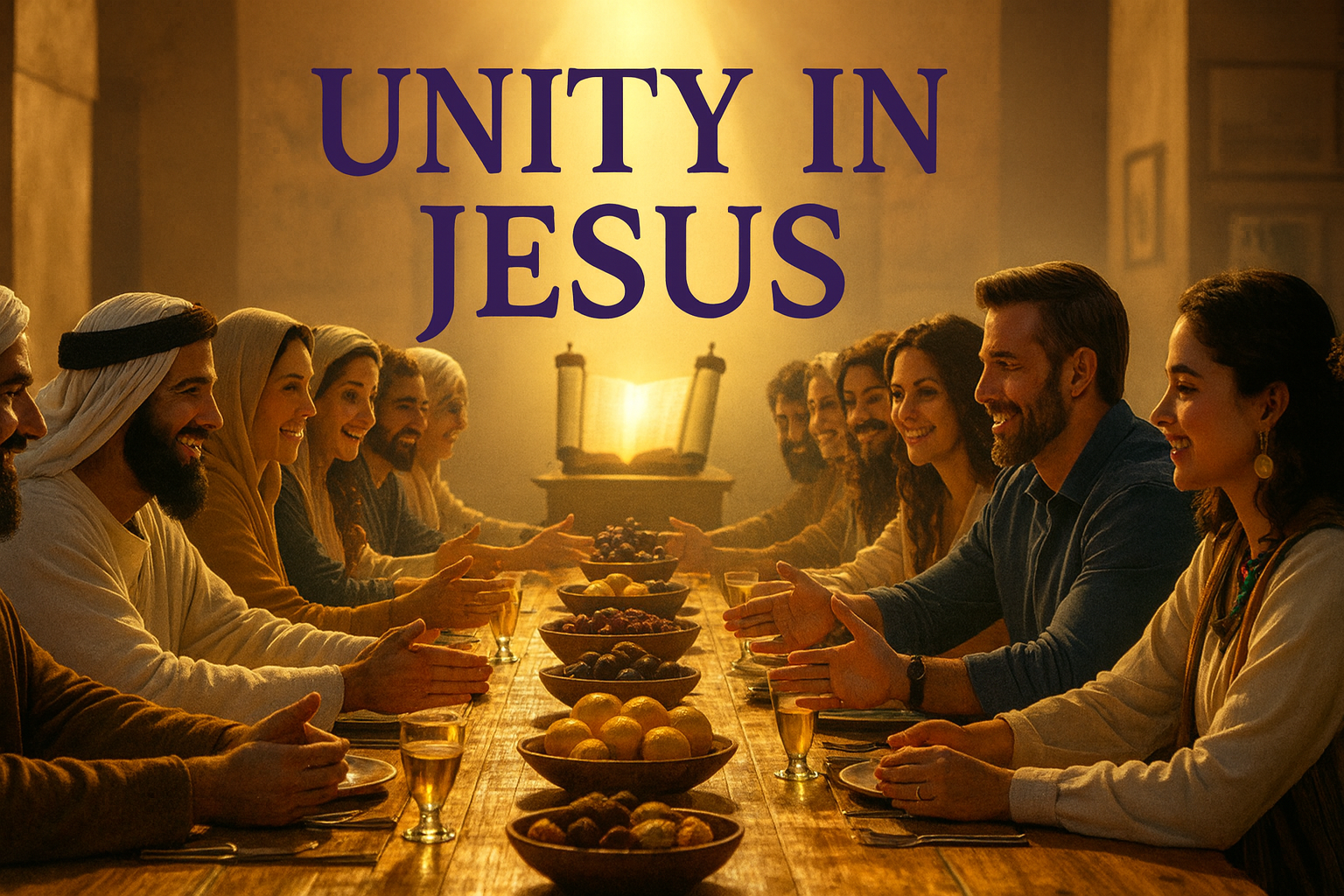
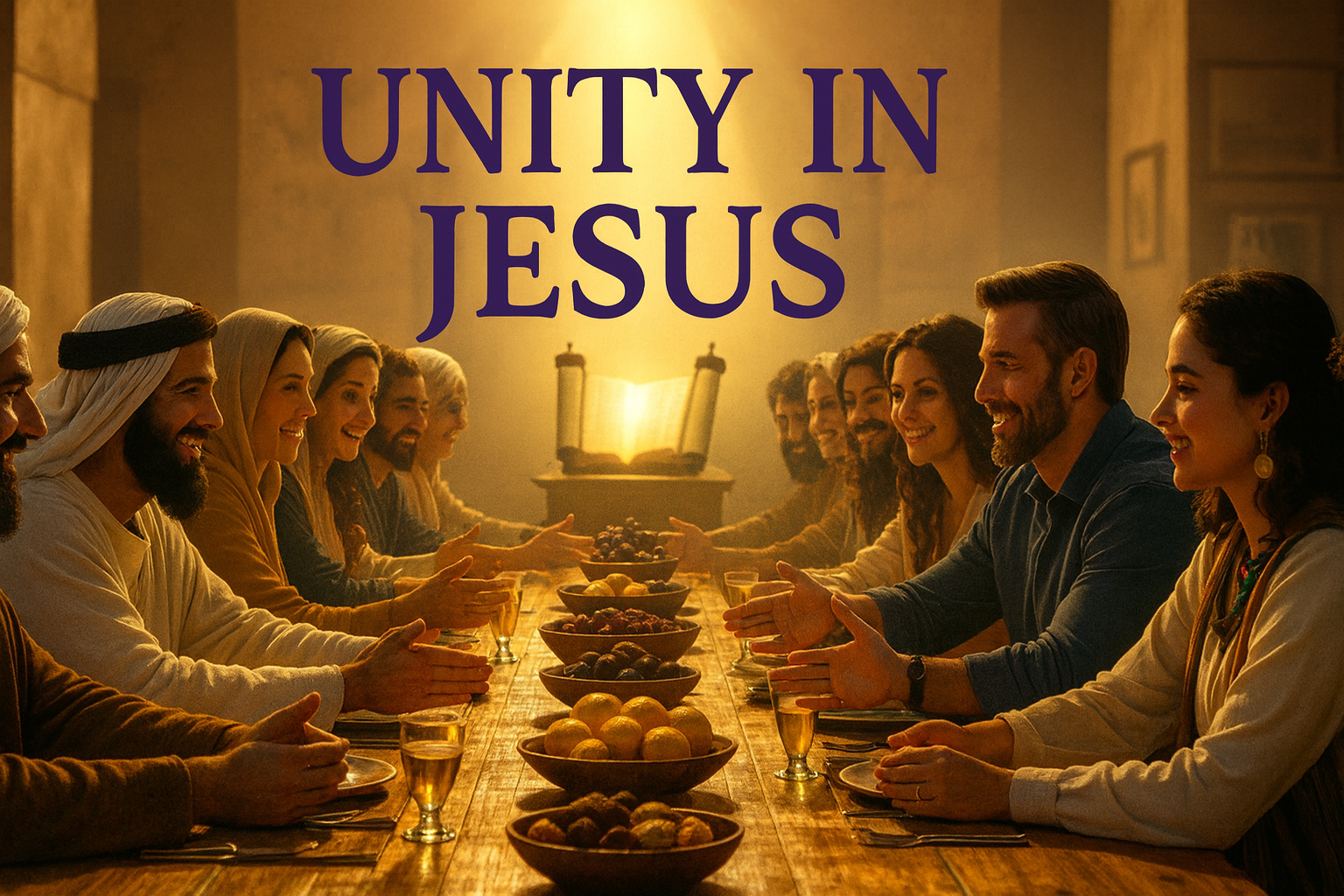
What Does Unity in Messiah Really Look Like?
Unity in Messiah is not soft, sentimental, or theoretical. Unity in Messiah is costly love lived out between real people, with real differences, who refuse to walk away from each other. In Romans 14 to 16, Paul shows us that unity in Messiah is not just an idea; it is a table, a family, and a way of life.
When Discipleship Meets Disagreement
What if the truest measure of your discipleship is not how many verses you can quote, not how sharp your theology sounds, and not how confidently you post online, but how you treat the person who disagrees with you?
What if God is not impressed by how loudly you defend your position, but by how gently you love your brother or sister in the faith?
As Paul closes the letter to the Romans, he does not end with a victory lap over his opponents. He ends with a family picture. Jew and Gentile. Strong and weak. Longtime believers and brand new disciples. Men and women. Households and workers. Real human beings who have to learn how to stay at the same table when they do not see everything the same way.
- That is harder than memorizing a chapter.
- That is harder than sharing a meme.
- That is where real unity in Messiah is either proven or exposed as pretend.
The Dinner Table in Rome
Most of us love Romans 8. Many of us quote Romans 10. Some of us wrestle with Romans 9 through 11. But a lot of believers quietly skim Romans 14 to 16. It feels like “family business” after the big theology.
In reality, Romans 14 to 16 is where the theology of covenant, faith, grace, Israel, and the nations walks into a first century dining room.
It is the late fifties of the first century. Rome is the heart of the empire. Inside that pagan city, small house fellowships meet in crowded rooms. Some are mostly Jewish believers in Yeshua who grew up in synagogue, formed by Torah and the feasts, careful about food and days. Others are mostly Gentile believers who came out of idol temples, Roman banquets, and very messy moral lives.
A few years earlier, the emperor Claudius expelled many Jews from Rome. Jewish believers had to leave too. The assemblies went on without them and became mostly Gentile. Gentile leadership. Gentile assumptions. Gentile patterns of life.
When the edict ended and Jewish believers returned, they walked back into fellowships that no longer looked or felt like the synagogues they knew. Their Gentile brothers and sisters loved the same Messiah, but treated food, calendar, and boundaries very differently.
You can almost feel the tension at the table!
The Jewish believer looks at the meat and thinks, “Was this offered to an idol? Is it even clean?” The Gentile believer looks at the vegetable only plate and thinks, “What is wrong with you? God made all food. Why are you so uptight?”
Weak, Strong, and the Same Lord
In Romans 14 Paul talks about the “weak” and the “strong.” The weak are not fake Christians. They are not less loved. They are believers with tender consciences. Their faith in Messiah is real, but fragile in certain areas. They cannot eat certain foods without feeling spiritually contaminated.
The strong are not bullies who win every argument. They are believers who understand that righteousness does not come through what enters the stomach, but through union with Messiah. In that sense, they grasp the gospel more fully.
The tragedy is that both sides have started to sin against each other.
The strong begin to despise the weak. “If you were really free in Messiah, you would grow up and just eat this.”
The weak begin to judge the strong. “If you really cared about holiness you would stop playing with things that look and smell like idolatry.”
So Paul says, “Stop despising. Stop judging. God has accepted them both.”
In Hebraic thought, covenant love is chesed, pronounced kheh sed. Chesed is loyal love. It protects belonging. It says, “I am committed to you even when we are not the same.”
- In the Ancient Near Eastern world, community meant survival.
- Fragmentation meant danger.
- Unity was not a luxury; it was life or death.
When Paul fights for unity in Messiah, he is not doing sentimental group therapy. He is doing spiritual triage to keep the covenant community alive inside a hostile empire.
Love That Limits Its Liberty
Romans 14 also contains one of the most searching lines in the New Testament.
“The kingdom of God is not eating and drinking, but righteousness and peace and joy in the Holy Spirit.”
The Complete Jewish Study Bible renders it as “righteousness, shalom, and joy in the Ruach HaKodesh.”
Shalom, pronounced shah lohm, is more than quiet. It is wholeness, everything in its proper place. Ruach HaKodesh, pronounced roo akh ha koh desh, means the Holy Spirit, the holy breath and wind of God.
In Hebraic terms, righteousness is tsedeq, pronounced tseh dek. Tsedeq is not just an abstract legal status; it is relational rightness, life that is aligned with God and with people.
Paul is saying, “If your freedom wounds your brother or sister for whom Messiah died, you are not walking in love. The kingdom is not about what goes on your plate; it is about what is happening in your heart.”
Liberty is a gift. Love is the command.
Taco Tony might put it this way: “Doc, if my freedom to eat four street tacos at midnight makes my brother stumble, maybe I need to move two of them to breakfast. But if unity requires kale, I am going to need extra grace.” We laugh, but the point is serious. Mature believers sometimes choose less for themselves so that another believer can stand.

Jew and Gentile, One Voice of Praise
Paul does not stop with the dinner table. In Romans 15 he zooms out to the whole story.
He says that Messiah became a servant to Israel to confirm the promises to the fathers, and that the Gentiles, the ethne, pronounced eth nay, would glorify God for His mercy.
Then he quotes the Torah, the Prophets, and the Writings. Every section of the Hebrew Bible bears witness to the same goal. God always intended that Jew and Gentile would praise Him together.
In the ancient pagan world, gods belonged to tribes and territories. Deities divided people. Only the God of Israel takes former enemies and seats them at one table, around one Messiah, singing one song with many accents.
Unity in Messiah is not an accident. It is the goal.
When Doctrine Ends With Names
Romans 16 is one of the most beautiful chapters in the Bible. For many readers it looks like a list of names to skip. Phoebe. Priscilla. Aquila. Andronicus. Junia. Households and workers. Jews and Gentiles. Women and men. Slaves and free.
For Paul, these are not footnotes. They are trophies of grace. They are living proof that the gospel he preached did not just produce ideas; it produced a family.
Romans does not end with a systematic theology exam. It ends with a community.
If you want to know whether your theology is healthy, you cannot only look at your statements of faith. You have to look at your relationships. If your theology leads to isolation, contempt, or constant division over secondary issues, something is deeply off.
A Needed Warning
Near the end of Romans 16 Paul gives a sober warning. He tells the believers to watch out for those who cause divisions and create obstacles that contradict the teaching they have received. He describes them as smooth talkers who deceive the naive.
- Division is not automatically discernment. There is a holy kind of separation from sin and heresy.
- There is also a fleshly kind of division that tears apart what God is building.
We live in a time when outrage, conspiracy driven narratives, and constant suspicion are often packaged as courage. Paul would ask a different question. “Does this voice lead to holiness, humility, and unity in Messiah, or does it gather a following around the speaker and leave the body fractured?”
Believers are COMMANDED not to Gossip or Spread Rumors!
(That link will take you to an episode that I am sure will challenge some of the things you always thought were true and right, but aren't.)
A Challenge For Real Life
So what does unity in Messiah look like in real life?
It looks like refusing to despise believers who wrestle with things that seem obvious to you. It looks like refusing to judge believers whose conscience gives them freedom where yours does not.
It looks like holding your preferences with open hands and saying, “Lord, if my freedom is harming someone else, teach me how to love them more than I love being right.”
It looks like reaching out to the person you quietly wrote off over a secondary issue and asking forgiveness where pride got in the way.
It looks like seeing every brother and sister as someone Messiah died for, someone God has accepted, and deciding that unity in Messiah matters more than you winning the moment.
- Unity in Messiah is not weakness.
- Unity is worship.
- Unity is not pretending differences do not exist.
- Unity is choosing love in the middle of those differences.
Internal and External Links
To explore the earlier message in this series, see our Romans 1 study, “Is God’s Judgment Just Anger or Something Far More Terrifying,” at This Episode Has Something BIG to say!
To better understand the history of the Jewish people and the long story of hostility against them, visit the resources at Yad Vashem, Israel’s official Holocaust remembrance center.

A Prayer Of Salvation
If you are reading this and you are tired of confusion, tired of religious games, and ready to place your trust in Yeshua the Messiah, you can pray with me now from your heart.
Heavenly Father, I come to You today with an open and humble heart. I know that I have sinned and fallen short of Your glory, and I am asking for Your forgiveness. Right now I turn away from my sins and I turn fully toward You. I believe that Jesus, Your Son, is the promised Messiah, that He died for my sins, was buried, and rose again on the third day just as the Bible says.
Today I call on Your holy Name. Please forgive me, cleanse me, and make me new. Fill me with Your Holy Spirit and write Your truth on my heart. From this day forward I choose to follow Jesus as my Lord, my Redeemer, and my King. Thank You for loving me, for saving me, and for making me part of Your family forever. In the name of Jesus Christ, the King of Kings, I pray. Amen.
If you prayed that prayer today, I want to welcome you into the family of God. You do not have to walk this road alone. Reach out to me at TrueWordFaithforLife.com so I can help you take your next steps as a follower of the Way.
Share This With Someone Who Needs Hope
If this message on unity in Messiah has spoken to you, I want to ask you to share it.
- Think of one person in your life who needs truth and hope right now.
- Send them this article or the matching podcast episode.
- Post it on your social media.
Your share may be the very thing God uses to draw a heart back to Him!
Closing Blessing
Live humble.
Live loving.
Live united.
Live the grafted in life.

Shalom b’Shem Yeshua.
© 2025 Dr. Shawn M. Greener. All Rights Reserved.
True Word, Faith for LIFE.
⸻
STUDY GUIDE
Title: Unity in Messiah: Jew and Gentile Together
Series: Romans: Covenant, Faithfulness, and the Grafted In Life
Primary Texts: Romans 14 to 16
SUMMARY
Unity in Messiah is not a soft slogan. It is the costly, beautiful work of real people learning to stay at one table under one Lord. In Romans 14 to 16, Paul applies everything he has taught about covenant, grace, Israel, and the nations to the concrete conflicts of Jew and Gentile believers in Rome.
Some believers in Rome have strong consciences and eat anything with thanksgiving. Others are weak in conscience and eat only vegetables to avoid idolatry and impurity. Some set apart specific days; others treat every day alike. Paul refuses to let these “disputable matters” become reasons to break fellowship. Instead he calls the strong to love and the weak to trust, and he reminds both groups that God has already accepted their brother or sister in Messiah.
Paul then zooms out to show that Jew and Gentile praising God together was always God’s plan. He ends Romans with a list of names, a warning about divisive teachers, and a doxology to the God who brings about the obedience of faith among all the nations. Unity in Messiah, rooted in the gospel and expressed in patient love, becomes the visible sign that the God of Israel has created one new family in His Son.
PRIMARY TEXTS (NASB 2020 AND CJSB)
Romans 14.1 to 3
NASB 2020
“Now accept the one who is weak in faith, but not to have quarrels over opinions. One person has faith that he may eat all things, but the one who is weak eats only vegetables. The one who eats is not to regard with contempt the one who does not eat, and the one who does not eat is not to judge the one who eats, for God has accepted him.”
Complete Jewish Study Bible (paraphrased)
“Now as for a person whose trust is weak, welcome him — but not to get into arguments over opinions. One person has the trust that will allow him to eat anything, while another whose trust is weak eats only vegetables. The one who eats anything must not look down on the one who abstains, and the abstainer must not pass judgment on the one who eats; because God has accepted him.”
Romans 14.17 to 19
NASB 2020
“For the kingdom of God is not eating and drinking, but righteousness and peace and joy in the Holy Spirit. For the one who serves Christ in this way is acceptable to God and approved by other people. So then we pursue the things which make for peace and the building up of one another.”
CJSB (paraphrased)
“For the Kingdom of God is not eating and drinking, but righteousness, shalom and joy in the Ruach HaKodesh. Anyone who serves the Messiah in this fashion both pleases God and wins the approval of other people. So then, let us pursue the things that make for shalom and mutual upbuilding.”
Romans 15.8 to 9, 12 to 13
NASB 2020
“For I say that Christ has become a servant to the circumcision in behalf of the truth of God to confirm the promises given to the fathers, and for the Gentiles to glorify God for His mercy; as it is written, ‘Therefore I will give praise to You among the Gentiles, and I will sing praises to Your name.’ … And again Isaiah says, ‘There shall come the root of Jesse, and He who arises to rule over the Gentiles, in Him will the Gentiles hope.’ Now may the God of hope fill you with all joy and peace in believing, so that you will abound in hope by the power of the Holy Spirit.”
CJSB (paraphrased)
“For I say that the Messiah became a servant to the Jewish people in order to show God’s truthfulness by making good His promises to the Patriarchs, and in order to cause the Gentiles to glorify God for His mercy; as it is written, ‘Because of this I will acknowledge you among the Gentiles and sing praise to your name.’ … And again, Isaiah says, ‘The root of Yishai will come, He who arises to rule the Gentiles; on Him will the Gentiles rest their hope.’ May God, the source of hope, fill you completely with joy and shalom as you continue trusting, so that by the power of the Ruach HaKodesh you may overflow with hope.”
Romans 16.17 to 20
NASB 2020
“Now I urge you, brothers and sisters, keep your eye on those who cause dissensions and hindrances contrary to the teaching which you learned, and turn away from them. For such people are slaves, not of our Lord Christ but of their own appetites; and by their smooth and flattering speech they deceive the hearts of the unsuspecting. For the report of your obedience has reached everyone; therefore I am rejoicing over you, but I want you to be wise in what is good, and innocent in what is evil. The God of peace will soon crush Satan under your feet. The grace of our Lord Jesus be with you.”
CJSB (paraphrased)
“Now I urge you, brothers, to watch out for those who cause divisions and snares contrary to the teaching you have learned. Stay away from them. For people like these are not serving our Lord the Messiah but their own belly; by smooth talk and flattery they deceive the minds of the innocent. Everyone has heard about your obedience, so I rejoice over you; but I want you to be wise concerning what is good and innocent concerning what is evil. And God, the source of shalom, will soon crush the Adversary under your feet. The grace of our Lord Yeshua be with you.”
KEY HEBREW AND GREEK TERMS
Chesed (Hebrew, pronounced kheh sed)
Covenant loyalty, steadfast love, mercy that acts. Chesed is love that protects belonging. In Romans 14 to 16, unity in Messiah is an expression of chesed inside the covenant family.
Shalom (Hebrew, pronounced shah lohm)
Wholeness, harmony, everything in its proper place. Shalom is more than the absence of conflict; it is the presence of right relationship with God and others. Unity in Messiah is meant to produce shalom in the community.
Ruach HaKodesh (Hebrew, pronounced roo akh ha koh desh)
“Holy Spirit” or “Holy Breath.” The Spirit of God who indwells and empowers believers. Paul says the kingdom is righteousness, shalom, and joy in the Ruach HaKodesh.
Tsedeq (Hebrew root behind “righteousness,” pronounced tseh dek)
Rightness, justice, covenant faithfulness. In Hebraic thought, tsedeq is relational and practical. It is shown in how we treat others, not only in legal status.
Ethnē (Greek, ἔθνη, pronounced eth nay)
Nations, peoples, Gentiles. Paul uses ethnē to describe the non Jewish nations who are now being brought into the worship of the God of Israel through Messiah.
Leitourgos (Greek, λειτουργός, pronounced lie toor gahs)
A public servant or priestly minister. Paul describes himself as a leitourgos of Messiah to the Gentiles, offering the nations as a kind of priestly sacrifice of praise.
ANE AND HISTORICAL CONTEXT
The Roman congregations were not modern, independent churches. They were networks of house assemblies meeting under pressures we can barely imagine.
The emperor Claudius had expelled many Jews from Rome, including Jewish believers in Yeshua. During those years, the assemblies became mostly Gentile. When Jews returned after Claudius’s death, they found communities that had grown under Gentile leadership and Gentile assumptions.
Jewish believers in Yeshua had lived their whole lives within Torah, the feasts, and the laws of kashrut. For them, questions about food and days were questions about covenant identity and faithfulness in a pagan world. Gentile believers had come out of idol temples, public feasts, and morally chaotic lives. For them, the grace of God and freedom in Messiah felt like a doorway out of fear and superstition.
Now they sat at one table!
In the Ancient Near Eastern world, community was survival. You did not live alone, and you did not worship alone. Your identity was tied to your people. Fragmentation could mean exposure and danger. When Paul addresses disputes about food and days, he is not tidying up minor church squabbles; he is protecting the unity and witness of this fragile, multi ethnic body in the heart of the empire.
DISCUSSION QUESTIONS
1. When you hear the phrase “unity in Messiah,” what comes to mind first. Agreement. Shared feelings. Avoiding conflict. Or something deeper.
2. In Romans 14, why do you think Paul calls some believers “weak” and others “strong” while still insisting that God has accepted both. How does that challenge your own categories?
3. Think of an issue in your church or community that is a “disputable matter” rather than a core doctrine. How might Romans 14 call you to approach that issue differently?
4. How does Paul’s phrase, “The kingdom of God is not eating and drinking, but righteousness, shalom, and joy in the Ruach HaKodesh,” reshape your view of Christian freedom?
5. Look at the list of names in Romans 16. What does the diversity of Phoebe, Priscilla, Aquila, Andronicus, Junia, Rufus, and others reveal about unity in Messiah?
6. Paul warns about people who cause divisions and create obstacles contrary to sound teaching. How can you distinguish between necessary separation from false teaching and sinful division that destroys unity?
7. Where have you seen “being right” prioritized over “walking in love” in your own life, your church, or online spaces. What would repentance look like in those places?
8. If someone watched the way you treat people who disagree with you, what conclusions would they draw about your view of God?
PRACTICAL APPLICATION
1. Identify one relationship where a secondary issue has damaged fellowship. Pray over that relationship and ask the Ruach HaKodesh to show you any contempt, judgment, or pride in your heart. If possible, take one concrete step toward reconciliation.
2. Make a short list of issues that are core to the faith in your understanding, and a separate list of issues that are important but secondary. Ask God to give you courage on the core issues and humility on the secondary ones.
3. Consider a way you can voluntarily limit your liberty for the sake of another believer’s conscience. This might involve how you speak, what you post, or how you use your time, rather than food and days.
4. Spend time reading Romans 14.1 to 3 and 14.17 to 19 out loud. Ask, “What would it look like for our congregation or small group to be known for pursuing peace and mutual upbuilding.”
5. Pray over your local congregation by name, asking God to make you a community where Jew and Gentile, men and women, young and old, different ethnicities and backgrounds, can worship together in true unity in Messiah.
REFLECTION PRAYER
Father of our Lord Yeshua,
Thank You for grafting me into Your people by grace. Thank You that unity in Messiah is not a human invention, but Your eternal plan.
Ruach HaKodesh, search my heart. Show me where I have despised or judged a brother or sister whom You have accepted. Show me where I have loved my opinions more than Your people.
Lord Yeshua, teach me to walk in chesed. Make me willing to limit my liberty when it would wound someone for whom You died. Give me courage to stand for truth, and humility to love in the midst of difference.
Let my life, my relationships, and my church become a living doxology, a walking song of praise to the God who unites Jew and Gentile, strong and weak, in one body.
In Your holy Name I pray. Amen.
FOOTNOTES
1. Douglas J. Moo, The Epistle to the Romans, New International Commentary on the New Testament (Grand Rapids: Eerdmans, 1996), 834–842.
2. Michael S. Heiser, The Unseen Realm: Recovering the Supernatural Worldview of the Bible (Bellingham, WA: Lexham Press, 2015), 319–325.
3. David H. Stern, Complete Jewish Bible (Clarksville, MD: Jewish New Testament Publications, 1998), Rom 14–16.
4. N. T. Wright, Paul for Everyone: Romans, Part Two (Louisville: Westminster John Knox, 2004), 76–98.
BIBLIOGRAPHY
Heiser, Michael S. The Unseen Realm: Recovering the Supernatural Worldview of the Bible. Bellingham, WA: Lexham Press, 2015.
Moo, Douglas J. The Epistle to the Romans. New International Commentary on the New Testament. Grand Rapids: Eerdmans, 1996.
Stern, David H. Complete Jewish Bible. Clarksville, MD: Jewish New Testament Publications, 1998.
Wright, N. T. Paul for Everyone: Romans, Part Two. Louisville: Westminster John Knox, 2004.

Shalom b’Shem Yeshua.
© 2025 Dr. Shawn M. Greener. All Rights Reserved.
True Word, Faith for LIFE.

Author / Host / Theologian
I am just a beggar who found Bread, helping other hungry beggars to find Him too. My life has certainly been complex and I and my halo has many dents. Heschel said; "Something Sacred hangs in the balance of every moment." I live like it. I teach like it.
As a person who survived a fatal 92 mph vs 51 mph head on crash, after dying and re-animating, and surviving several other brushes with death, my perspective is, let's say, unique. I haven't always been a theologian and I'm living REAL life, just like you... I have my hurts, habits and hangups too.
I've learned a few very important things along the way that I'm confident you'll find useful... butter for the Gluten free Bread so to speak.. Oh, you may chuckle or full on snort along the way, but you might also shed a few tears... Faith for LIFE... That's how it happens.

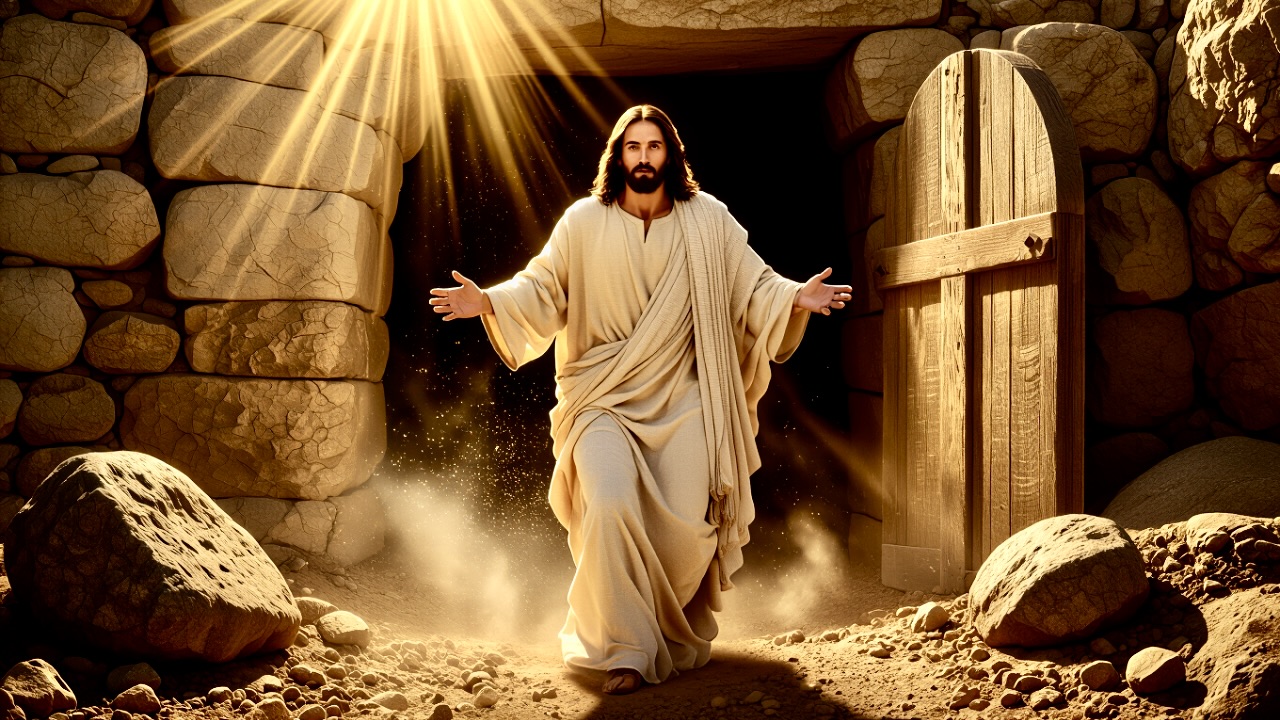
The Stone Was Moved, But Not for Him
