What Do I DO NOW?
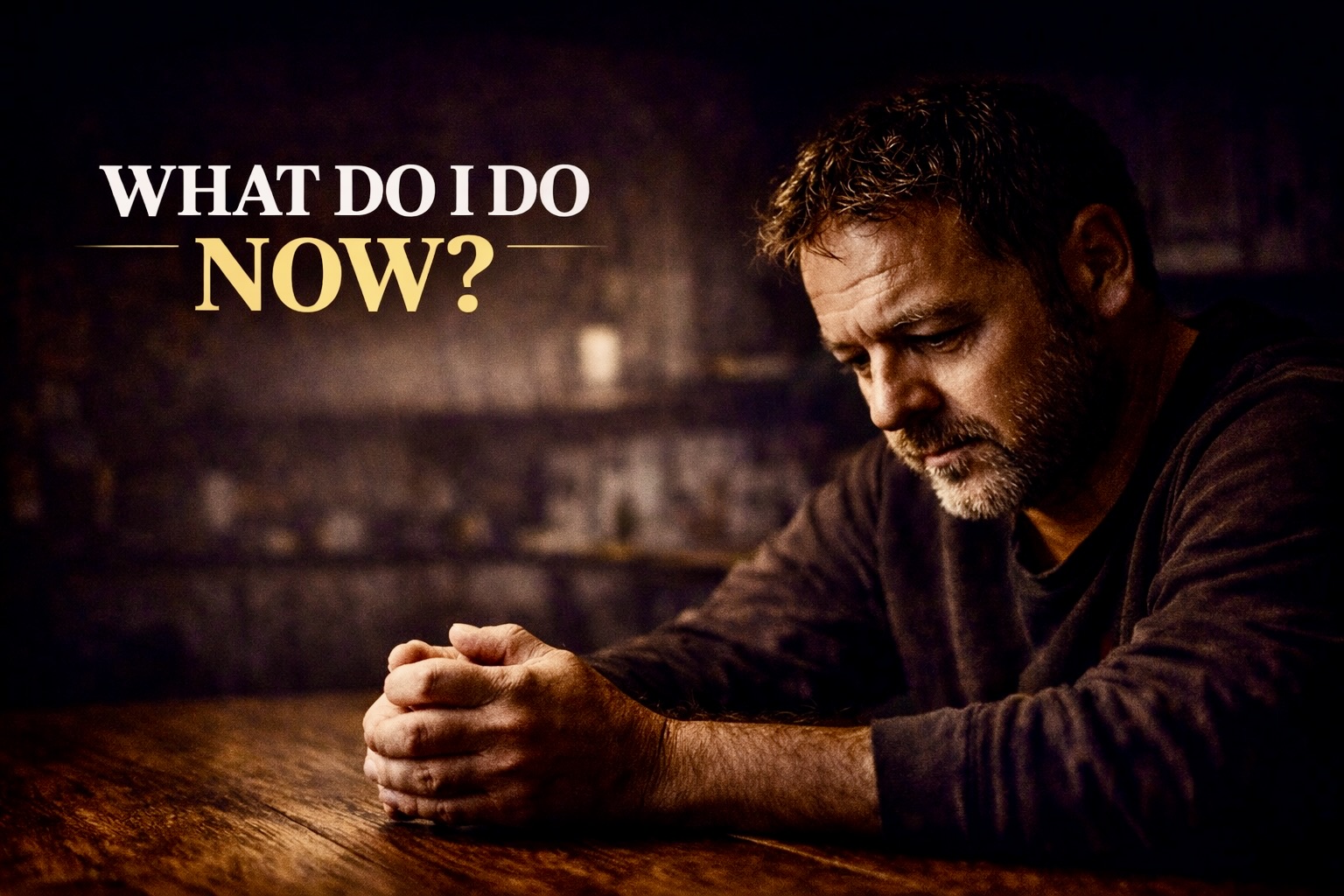
Episode One: What Do I Do Now?
You’ve survived Christmas Day. Now what? https://www.youtube.com/live/4ih1_WoD_so?si=QWa66ltOOkilNhXh

⸻
LISTEN the Series Finale' of What Lead to This Series
When the Noise Fades and the Questions Get Loud
There is a strange silence that settles in after the holidays.
The lights come down.
The calendar empties.
The expectations ease.
And suddenly, you are left alone with your thoughts.
Many followers of Jesus are surprised by what they feel in January. There is gratitude, yes. But there is also exhaustion, emotional residue, unresolved family tension, financial stress, and a subtle spiritual disorientation that is hard to name.
If that's you, hear this clearly. Feeling spiritually off doesn't automatically mean you're unfaithful. It often means you're human.
After intense emotional seasons, the soul needs time to reorient. The Bible never treats recovery as rebellion. In fact, Scripture consistently shows God meeting His people in moments of weariness, not shaming them for it.
That inner voice that says, “If you were really strong in faith, you wouldn’t feel this way,” isn't the voice of the Holy Spirit. The Ruach HaKodesh convicts with hope. He doesn't accuse with shame.
So the real question after the holidays isn't, “What is wrong with me?”
It is, “What do I do now?”
Coming Back to the Center
The apostle Paul answers that question in Romans 12:1–2, not with emotion, but with covenant clarity.
Lexham English Bible (LEB)
1 Therefore I exhort you, brothers, through the mercies of God, to present your bodies as a living sacrifice, holy and acceptable to God, which is your reasonable service.
2 And do not be conformed to this age, but be transformed by the renewing of your mind, so that you may approve what is the will of God, what is good and acceptable and perfect.
King James Version (KJV)
1 I beseech you therefore, brethren, by the mercies of God, that ye present your bodies a living sacrifice, holy, acceptable unto God, which is your reasonable service.
2 And be not conformed to this world: but be ye transformed by the renewing of your mind, that ye may prove what is that good, and acceptable, and perfect, will of God.
Paul is writing to a community under tremendous pressure. Jewish and Gentile believers are navigating identity, worship, and faithfulness in the shadow of empire. His message isn't theoretical. It's embodied.
Present your bodies.
In the Ancient Near Eastern world, worship was never abstract. Loyalty was lived out physically, relationally, and publicly. Paul is calling believers to re-center their entire lives around God’s mercy, not just their feelings.
To present your body means offering your real life. Your schedule. Your habits. Your reactions. Your stress. Your relationships. Your thought patterns.
Paul is saying, “Because God has been merciful to you, give Him the next faithful step of your real life.”
Not perfection.
Not emotional intensity.
Faithful alignment.
Four Anchors for the Days After the Holidays
The path forward is not complicated, but it is intentional.
First, re-center your identity.
Family dynamics often pull us back into old roles. Covenant reminds us who we belong to now. God’s chesed, His loyal covenant love, is not mood based. It is steadfast. You are not defined by exhaustion or dysfunction. You are defined by belonging.
Second, re-center your mind.
Paul uses the word anakainosis, renewal, renovation. The mind is rebuilt over time by replacing the loudest voice. One verse. One truth. One honest moment with God repeated faithfully.
Third, re-center your body.
Sleep, hydration, rest, and stewardship are spiritual matters. Presenting your body is an act of worship. Exhaustion is not a moral failure.
Fourth, re-center your relationships.
Covenant life is not meant to be lived alone. One faithful relational step matters. A prayer request. A boundary. A conversation. A moment of forgiveness.
Jesus never treats weary people with contempt. In Matthew 11, He invites them closer. His yoke is not crushing. It is life-giving.

Matthew 11 (NASB 2020)
1 When Jesus had finished giving instructions to His twelve disciples, He went on from there to teach and preach in their cities.
2 Now while in prison, John heard about the works of Christ, and he sent word by his disciples
3 and said to Him, “Are You the Coming One, or are we to look for someone else?”
4 Jesus answered and said to them, “Go and report to John what you hear and see:
5 those who are blind receive sight and those who limp walk, those with leprosy are cleansed and those who are deaf hear, the dead are raised, and the poor have the gospel preached to them.
6 And blessed is any person who does not take offense at Me.”
7 As these disciples of John were going away, Jesus began speaking to the crowds about John: “What did you go out into the wilderness to see? A reed shaken by the wind?
8 But what did you go out to see? A man dressed in soft clothing? Those who wear soft clothing are in kings’ palaces!
9 But what did you go out to see? A prophet? Yes, I tell you, and one who is more than a prophet.
10 This is the one about whom it is written:
‘Behold, I am sending My messenger ahead of You,
Who will prepare Your way before You.’
11 Truly I say to you, among those born of women there has not arisen anyone greater than John the Baptist! Yet the one who is least in the kingdom of heaven is greater than he.
12 And from the days of John the Baptist until now the kingdom of heaven has been treated violently, and violent men take it by force.
13 For all the Prophets and the Law prophesied until John.
14 And if you are willing to accept it, John himself is Elijah who was to come.
15 The one who has ears to hear, let him hear.
16 “But to what shall I compare this generation? It is like children sitting in the marketplaces, who call out to the other children,
17 and say, ‘We played the flute for you, and you did not dance;
we sang a song of mourning, and you did not mourn.’
18 For John came neither eating nor drinking, and they say, ‘He has a demon!’
19 The Son of Man came eating and drinking, and they say, ‘Behold, a gluttonous man and a heavy drinker, a friend of tax collectors and sinners!’ And yet wisdom is vindicated by her deeds.”
20 Then He began to reprimand the cities in which most of His miracles were done, because they did not repent.
21 “Woe to you, Chorazin! Woe to you, Bethsaida! For if the miracles that occurred in you had occurred in Tyre and Sidon, they would have repented long ago in sackcloth and ashes.
22 Nevertheless I say to you, it will be more tolerable for Tyre and Sidon on the day of judgment than for you.
23 And you, Capernaum, will not be exalted to heaven, will you? You will descend to Hades; for if the miracles that occurred in you had occurred in Sodom, it would have remained to this day.
24 Nevertheless I say to you that it will be more tolerable for the land of Sodom on the day of judgment, than for you.”
25 At that time Jesus said, “I praise You, Father, Lord of heaven and earth, that You have hidden these things from the wise and intelligent, and have revealed them to infants.
26 Yes, Father, for this way was well-pleasing in Your sight.
27 All things have been handed over to Me by My Father; and no one knows the Son except the Father; nor does anyone know the Father except the Son, and anyone to whom the Son determines to reveal Him.
28 “Come to Me, all who are weary and burdened, and I will give you rest.
29 Take My yoke upon you and learn from Me, for I am gentle and humble in heart, and you will find rest for your souls.
30 For My yoke is comfortable, and My burden is light.”
The Holy Bible. New American Standard Bible, 2020 Update. La Habra, CA: The Lockman Foundation, 2020.
The Next Faithful Step
You don't need to solve everything in January.
You just need one faithful step.
Five minutes a day.
One Scripture.
One decision toward alignment.
God isn't asking for emotional performance. He's inviting you back into covenant rhythm.
Come back to the center.
Come back to the King.
Take the next faithful step.
Shalom b’Shem Yeshua
© 2025 Dr. Shawn M. Greener. All Rights Reserved.
True Word, Faith for LIFE!
Footnotes
1. The Holy Bible, Lexham English Bible (Bellingham, WA: Lexham Press, 2012), Rom. 12:1–2.
2. The Holy Bible, New American Standard Bible 2020 (La Habra, CA: The Lockman Foundation, 2020), Rom. 12:1–2.
3. David H. Stern, Complete Jewish Bible (Clarksville, MD: Jewish New Testament Publications, 1998), Rom. 12:1–2.
4. N. T. Wright, Paul and the Faithfulness of God (Minneapolis: Fortress Press, 2013), 1043–1051.
5. John Barclay, Paul and the Gift (Grand Rapids: Eerdmans, 2015), 562–579.
6. James D. G. Dunn, Romans 9–16, Word Biblical Commentary, vol. 38B (Dallas: Word Books, 1988), 708–715.
7. The Holy Bible, Lexham English Bible, Matt. 11:28–30.
8. Michael S. Heiser, The Unseen Realm (Bellingham, WA: Lexham Press, 2015), 45–48.
9. Skip Moen, Living Torah (Enumclaw, WA: Hebraic Foundations Press, 2012), 91–97.
10. HALOT, s.v. “חֶסֶד (chesed).”
11. BDAG, s.v. “ἀνακαίνωσις (anakainōsis).”
STUDY GUIDE
What Do I Do Now?
Episode One: What Do I Do Now?
⸻
SUMMARY
Episode One addresses a critical but rarely named moment in the life of faith: the season after emotional intensity fades. Rather than framing post holiday spiritual disorientation as failure or hypocrisy, this study establishes it as a moment of reorientation. Faith, biblically understood, is not sustained by emotional highs but by covenant alignment.
Drawing primarily from Romans 12:1–2 and Matthew 11:28–30, this episode invites believers to re-center their identity, mind, body, and relationships. Through a Hebraic and Ancient Near Eastern lens, worship is presented not as emotional expression alone but as embodied loyalty, lived out through daily faithfulness.
The core theological claim of this episode is that spiritual quietness is not abandonment by God but an invitation to re align one’s life under covenant faithfulness.
⸻
PRIMARY BIBLICAL TEXTS
Romans 12:1–2
Lexham English Bible (LEB)
Therefore I exhort you, brothers, through the mercies of God, to present your bodies as a sacrifice, living, holy, acceptable to God, which is your reasonable service. And do not be conformed to this age, but be transformed by the renewal of your mind, so that you can approve what is the will of God, what is good and acceptable and perfect.
NASB 2020
Therefore I urge you, brothers and sisters, by the mercies of God, to present your bodies as a living and holy sacrifice, acceptable to God, which is your spiritual service of worship. And do not be conformed to this world, but be transformed by the renewing of your mind, so that you may prove what the will of God is, that which is good and acceptable and perfect.
Complete Jewish Study Bible (CJSB)
I urge you therefore, brothers, by the compassions of God, to offer yourselves as a living sacrifice, holy and pleasing to God; this is your logical Temple worship. In other words, do not let yourselves be conformed to the standards of the olam hazeh, this present world age. Instead, keep letting yourselves be transformed by the renewing of your minds; so that you will know what God wants and will agree that what he wants is good, satisfying and able to succeed.
⸻
NARRATIVE AND HISTORICAL CONTEXT
The letter to the Romans is written by Sha’ul, known in Greek as Paul, to a mixed Jewish and Gentile community living under Roman imperial power. This is not a comfortable audience. These believers are navigating ethnic tension, social suspicion, and pressure to assimilate into Roman cultural norms.
In the Ancient Near Eastern worldview, worship was never detached from daily life. To “present your body” is covenant language. It means to bring one’s whole existence under God’s authority. Time, habits, speech, money, relationships, and physical care are all part of worship.
Paul isn't introducing a new idea. He is reaffirming Israel’s covenant logic in Messiah. Faith is not merely internal belief but visible loyalty.
⸻
KEY HEBREW AND GREEK TERMS
Ruach HaKodesh (roo-ahkh hah-KOH-desh)
Meaning Holy Spirit. In Hebrew thought, ruach refers to breath, wind, or active presence. Conviction by the Spirit restores with hope, not shame.
Olam Hazeh (oh-LAHM hah-ZEH)
Meaning this present age. Refers not simply to time, but to a value system opposed to covenant faithfulness.
Chesed (KHEH-sed)
Meaning loyal love, covenant faithfulness. God’s relationship with His people is rooted in covenant, not emotion or mood.
Anakainosis (ah-nah-kai-NOH-sis)
Greek term meaning renewal or renovation. Refers to a mind that is reshaped over time through alignment, not instant emotional change.
⸻
THEOLOGICAL INSIGHTS
1. Spiritual fatigue is not rebellion
The Bible consistently recognizes human limitation. Weariness is treated with invitation, not accusation.
2. Worship is embodied loyalty
Paul’s use of sacrificial language echoes Temple worship, where the whole life is given to God.
3. Transformation is progressive
Renewal of the mind is not instantaneous. It is a process shaped by repeated faithfulness.
4. Quiet seasons test alignment
Moments without emotional reinforcement reveal whether faith is rooted in covenant or sensation.
⸻
PRACTICAL APPLICATION
Daily Five Minute Re Centering Practice
•. One minute: Acknowledge belonging. “Father, I belong to You.”
•. Two minutes: Read Romans 12:1–2 slowly.
•. One minute: Ask what pattern of this age is pressing today.
•. One minute: Choose one faithful action.
This practice reflects biblical formation rather than modern performance spirituality.
⸻
DISCUSSION QUESTIONS
1. Why do modern believers often equate emotional quiet with spiritual failure?
2. How does Romans 12 redefine worship in practical terms?
3. Which area of re-centering challenged you most: identity, mind, body, or relationships?
4. How does understanding chesed reshape how you interpret God’s presence during dry seasons?
⸻
FINAL REFLECTION
Yeshua’s invitation in Matthew 11 is not to the strong but to the weary. Faith does not collapse in quiet seasons. It is refined.
Re-centering is not regression. It is covenant recalibration.
⸻
BIBLIOGRAPHY
The Holy Bible, Lexham English Bible. Bellingham, WA: Lexham Press.
The Holy Bible, New American Standard Bible 2020. La Habra, CA: Lockman Foundation.
The Holy Bible, Complete Jewish Study Bible. Peabody, MA: Hendrickson Publishers.
Heiser, Michael S. The Unseen Realm. Bellingham, WA: Lexham Press.
Moen, Skip. The Words We Missed. Seattle, WA: Ancient Hebrew Press.
⸻
Shalom b’Shem Yeshua
© 2025 Dr. Shawn M. Greener. All Rights Reserved.
True Word, Faith for LIFE!

Author / Host / Theologian
I am just a beggar who found Bread, helping other hungry beggars to find Him too. My life has certainly been complex and I and my halo has many dents. Heschel said; "Something Sacred hangs in the balance of every moment." I live like it. I teach like it.
As a person who survived a fatal 92 mph vs 51 mph head on crash, after dying and re-animating, and surviving several other brushes with death, my perspective is, let's say, unique. I haven't always been a theologian and I'm living REAL life, just like you... I have my hurts, habits and hangups too.
I've learned a few very important things along the way that I'm confident you'll find useful... butter for the Gluten free Bread so to speak.. Oh, you may chuckle or full on snort along the way, but you might also shed a few tears... Faith for LIFE... That's how it happens.

The Stone Was Moved, But Not for Him

