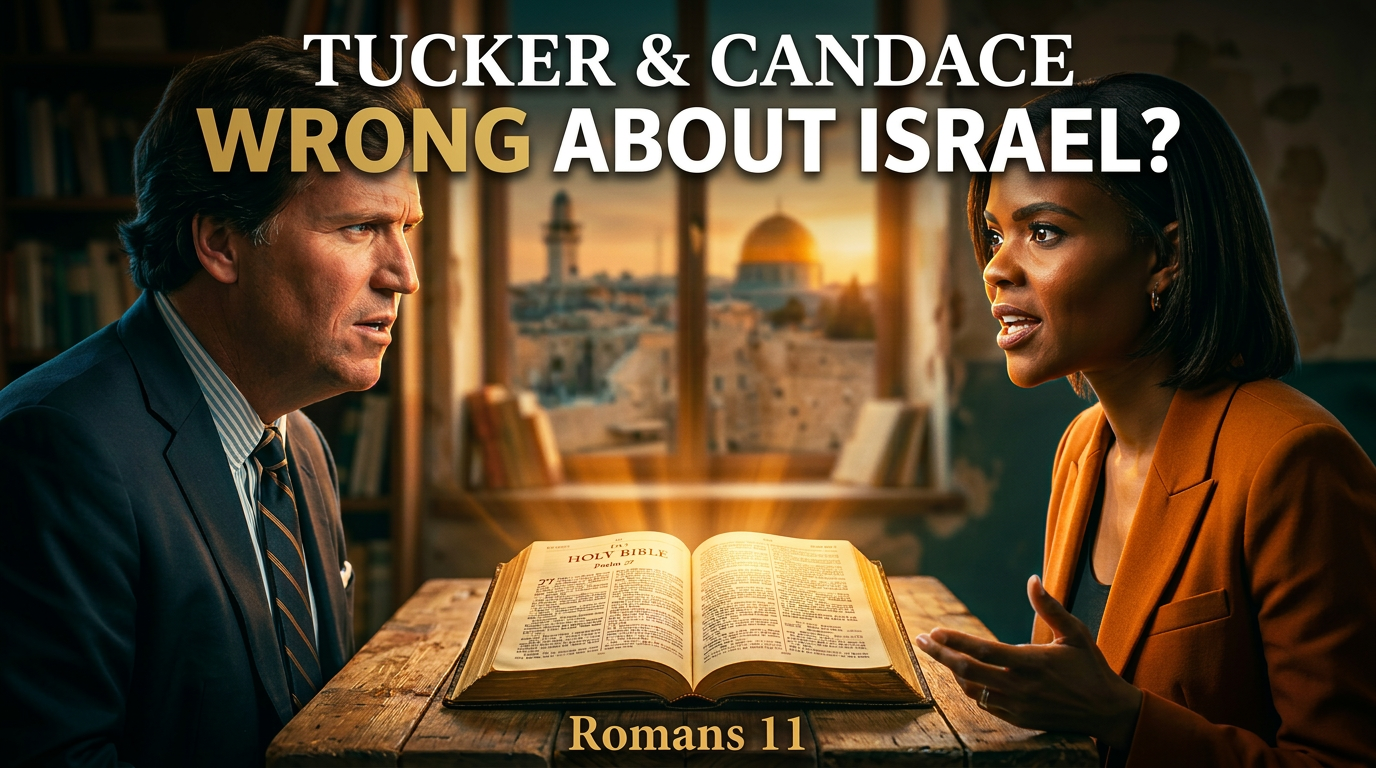
Tucker and Candace Lie About Israel and God
BLOG POST
Tucker and Candace Lie About Israel and God
Romans 9 through 11, Israel, the Nations, and the Faithfulness of God
WATCH on True Word Faith for Life with Dr. Shawn on YouTube
Watch on True Word Faith for Life with Dr. Shawn Rumble Channel
There is a particular kind of error that spreads quickly in an age of clips, outrage, and performative certainty. It does not usually begin by denying the Bible outright. It begins by sounding as though it is finally brave enough to tell the truth about the Bible. It uses biblical words while quietly draining those words of their actual meaning.

That is what happens when public voices tell believers that Israel in Romans no longer means the Jewish people, that the land promises never meant the land, and that Gentile inclusion means Jewish displacement. That may sound bold. It may sound anti establishment. It may even sound theological. But once Romans 9 through 11 is read in its own covenant world, the argument begins to collapse.[1]
Paul does not open Romans 9 through 11 as a detached religious philosopher inventing a new faith after Israel failed. He opens in grief. "I have great sorrow and unceasing anguish in my heart" for "my kinsmen according to the flesh."[2] He then names them. "They are Israelites, and to them belong the adoption, the glory, the covenants, the giving of the law, the worship, and the promises."[3] That is not the language of replacement. It is the language of covenant continuity.
The issue pressing on the Roman believers was real and painful. Gentiles were entering the covenant community through trust in Israel's Messiah. At the same time, many Jewish people had not recognized Yeshua as Messiah. That produced the question running through these chapters. Has God's word failed? Has God rejected His people? Paul answers that directly in Romans 11. "By no means."[4] He even points to himself as evidence. "I myself am an Israelite, a descendant of Abraham, a member of the tribe of Benjamin."[5]
That is why the modern move to redefine Israel into a floating spiritual category is not a small interpretive tweak. It guts Paul's argument. If Israel no longer means Israel, Paul's anguish becomes incoherent, his evidence becomes meaningless, and his whole covenant defense collapses.
Primary Bible Texts
Genesis 12:1 to 3
ESV: "Go from your country... to the land that I will show you... I will make of you a great nation... and in you all the families of the earth shall be blessed."[6]
CJB: "Get yourself out of your country... to the land that I will show you... I will make of you a great nation... and by you all the families of the earth will be blessed."[7]Romans 11:1 to 2
ESV: "Has God rejected his people? By no means!... God has not rejected his people whom he foreknew."[8]
CJB: "Isn't it that God has repudiated his people? Heaven forbid!... God has not repudiated his people."[9]Romans 11:17 to 18
ESV: "You, although a wild olive shoot, were grafted in... Remember it is not you who support the root, but the root that supports you."[10]
CJB: "You, a wild olive branch, were grafted in... you are not supporting the root, the root is supporting you."[11]Jeremiah 31:33 and 35 to 37
ESV: God promises a new covenant with "the house of Israel and the house of Judah," then ties Israel's ongoing status as a nation before Him to the fixed order of creation.[12]
CJB: God says He will make this covenant "with the house of Isra'el," and He speaks of Isra'el continuing before Him as a nation.[13]
Now step into the Ancient Near Eastern covenant world for a moment. In that world, covenant was not a misty inward sentiment. It was a binding relational structure involving loyalty, inheritance, continuity, and frequently land. The Abrahamic promise joins those things together. A people. A land. A blessing to the nations. Those are not detachable pieces. They form one covenant frame.[14]
This is exactly why the olive tree matters so much in Romans 11. Paul does not describe Gentiles planting a new tree. He describes them being grafted into a tree whose root already exists.[15] Abraham is already there. Isaac is already there. Jacob is already there. The covenants are already there. The prophets are already there. Messiah comes from that story, not from a rival one. Gentile believers are welcomed into that life by mercy, not enthroned over it by superiority.

Paul's warning is devastatingly clear. "Do not be arrogant toward the branches."[16] That line should have ended centuries of Christian arrogance against the Jewish people. It should also sober every modern teacher who uses Gentile inclusion to justify Jewish erasure. Mercy does not make you arrogant. Mercy makes you grateful.
This is where the phrase "partial hardening" matters. Paul does not speak of total rejection, permanent cancellation, or covenant abandonment. He speaks of a partial hardening until the fullness of the Gentiles comes in.[17] That language fits the Bible's wider covenant pattern. Israel sins. God disciplines. God preserves. God restores. The prophets repeatedly announce both judgment and restoration.[18] Paul is not inventing a new story. He is reading the present through the old covenant grammar of exile, mercy, and divine faithfulness.
That is also why "all Israel will be saved" cannot simply mean "the Church replaced Israel." Paul has already told you who he means by Israel in these chapters. He means his kinsmen according to the flesh.[19] Then he reaches for Isaiah and Jeremiah, not to cancel Israel, but to anchor the future in prophetic restoration and covenant renewal.[20]
Zion matters here too. In the Hebrew Bible, Zion is not an imaginary place or a modern propaganda code. It begins as a real location associated with David's city and then develops into a theological center tied to Jerusalem, temple, kingship, and hope.[21] That does not mean every modern political act by the State of Israel is beyond criticism. The prophets criticized kings, courts, and covenant unfaithfulness relentlessly. But moral criticism is not the same thing as historical erasure. Once criticism becomes denial that the Jewish people are historically bound to the covenant story and the land named in the Bible, it has crossed a line from discernment into denial.[22]
The land promises belong here as well. In the Bible's own world, land is not ornamental. It is part of covenant structure. Exile from the land is covenant curse. Return to the land is covenant mercy.[23] So when modern readers insist the land never meant land, they are not becoming more spiritual. They are becoming less honest with the text. And once that habit takes hold, it rarely stops with Israel. Soon promises stop meaning promises. Warnings stop meaning warnings. Holiness stops meaning holiness. The text becomes clay in the hands of the loudest personality.
The deepest issue is not finally Israel or the nations by themselves. It is the character of God. Romans 9 through 11 is Paul's great defense of divine faithfulness. God keeps covenant in promise. God keeps covenant in discipline. God keeps covenant in mercy.[24] If God could simply cast off Israel when history gets difficult, why should any believer trust Him when life gets difficult? But Paul's answer is stronger than our anxiety. God has not rejected His people. The root still stands. The story still holds. The gifts and the calling of God are irrevocable.[25]
That means this conversation is not merely about being right online. It is about whether believers will let the Bible discipline their instincts. Will we read Romans with humility, or will we let monetized outrage teach us to boast over the branches? Will we submit to Paul's warning, or will we baptize arrogance as insight?
And then the passage turns from argument to invitation. Jew and Gentile stand before God the same way, by mercy in Messiah.[26] The ground is level. The proud are humbled. The outsider is welcomed. The sinner is summoned. The Gospel is not an ethnic trophy. It is God's merciful summons into covenant life through Yeshua the Messiah.
So read Romans 9 through 11 slowly. Read it in its historical setting. Read it in its covenant frame. Read it with humility toward the story that began long before you arrived. Then hear Paul one more time. Do not boast over the branches. Remember, the root supports you.[27]
That is not weakness. That is wisdom.
That is not compromise. That is covenant honesty.
That is not confusion. That is faithfulness.
Shalom b'Shem Yeshua
© 2026 Dr. Shawn M. Greener. All Rights Reserved.
True Word, Faith for LIFE!
Footnotes for Blog Post
[1] Rom. 9 to 11, ESV and CJB.
[2] Rom. 9:2 to 3, ESV.
[3] Rom. 9:4 to 5, ESV.
[4] Rom. 11:1, ESV.
[5] Rom. 11:1, ESV.
[6] Gen. 12:1 to 3, ESV.
[7] Gen. 12:1 to 3, CJB.
[8] Rom. 11:1 to 2, ESV.
[9] Rom. 11:1 to 2, CJB.
[10] Rom. 11:17 to 18, ESV.
[11] Rom. 11:17 to 18, CJB.
[12] Jer. 31:31 to 37, ESV.
[13] Jer. 31:32 to 37, CJB.
[14] Gen. 12:1 to 3; 15:1 to 21; 17:1 to 8, ESV; Michael S. Heiser, The Unseen Realm: Recovering the Supernatural Worldview of the Bible (Bellingham, WA: Lexham Press, 2015), 104 to 109.
[15] Rom. 11:17 to 24, ESV.
[16] Rom. 11:18, ESV.
[17] Rom. 11:25, ESV; Rom. 11:12, CJB.
[18] Jer. 31:1 to 14, 31 to 37, ESV; Ezek. 36:22 to 28, ESV.
[19] Rom. 9:3 to 5; 11:1, ESV.
[20] Rom. 11:26 to 27, ESV; Isa. 59:20 to 21; Jer. 31:31 to 34.
[21] 2 Sam. 5:7; Ps. 132:13 to 14; Isa. 2:1 to 4, ESV.
[22] David H. Stern, Jewish New Testament Commentary (Clarksville, MD: Jewish New Testament Publications, 1992), 395 to 401.
[23] Deut. 28:63 to 68; 30:1 to 10, ESV.
[24] Rom. 11:28 to 36, ESV; N. T. Wright, Paul and the Faithfulness of God, 2 vols. (Minneapolis: Fortress Press, 2013), 1196 to 1208.
[25] Rom. 11:29, ESV.
[26] Rom. 11:30 to 32, ESV.
[27] Rom. 11:18, ESV.
The Bible Rebinder I Mentioned on the Podcast
This is one of the three Bibles Melissa of MooseWorks Bible restored for me, beautifully rebound with a rugged new cover and exceptional attention to detail.
A Bible is more than a book. It is often a treasury of prayers, notes, promises, memories, and the record of a life spent seeking God.
If you have a treasured Bible that deserves to be preserved with excellence, I am honored to recommend Melissa of MooseWorks Bible.
Her work is marked by beautiful craftsmanship, thoughtful detail, and genuine kindness. She does not simply repair Bibles. She helps preserve the story they carry.
Visit MooseWorks Bible today:
Click HERE to Check out MooseWorks Bibles!
© 2026 Dr. Shawn M. Greener. All Rights Reserved.
True Word, Faith for LIFE!
STUDY GUIDE
Tucker and Candace Lie About Israel and God
Romans 9 through 11, Israel, the Nations, and the Faithfulness of God.
Summary
Romans 9 through 11 is one of the most important passages in the New Testament for understanding Israel, the nations, and the character of God. Paul is not writing an abstract theological essay detached from history. He is addressing a covenant crisis. Gentiles are entering the people of God through trust in Israel's Messiah. At the same time, many Jewish people in Paul's day have not recognized Yeshua as Messiah. That tension raises a devastating question. Has God's word failed? Has God rejected His people?
Paul's answer is emphatic. No. God has not rejected His people.[1] Instead, Paul argues that the present moment must be read inside the larger covenant story that began with Abraham and was carried through Israel, Torah, prophets, exile, restoration hope, and finally Messiah. Gentiles are not described as replacing Israel. They are described as wild branches grafted into an already existing olive tree.[2] The root supports them. They do not support the root.[3]
That means Romans 9 through 11 is not a manifesto for replacement theology. It is a defense of God's covenant faithfulness. Israel still means Israel in Paul's argument. "All Israel will be saved" cannot simply be turned into a code phrase for a Church that erases Jewish peoplehood, because Paul has already defined Israel as his kinsmen according to the flesh.[4] The point of the passage is not that God changed His mind about Israel. The point is that God keeps covenant even when history becomes painful, complex, and difficult to read in the moment.[5]
Key Hebrew and Greek Terms
Israel / Isra'el
In Romans 9 through 11, Paul uses Israel to refer to the Jewish people, especially in phrases like "my kinsmen according to the flesh" and "I myself am an Israelite."[6]
Diatheke
The Greek term often rendered covenant. In biblical usage it carries more than contract language. It points to God's binding commitment and ordered relationship with His people.[7]
Porosis
The Greek term behind "hardening" in Romans 11:25. Paul qualifies it. It is partial, not total or final.[8]
Rhiza
The Greek word for root in Romans 11:18. The root nourishes the branches and reminds Gentile believers that their life in Messiah is dependent on a covenant story older than themselves.[9]
Berit
The Hebrew word for covenant. It frames the promises to Abraham, the Sinai covenant, the Davidic hope, and the promised new covenant.[10]
Tziyon / Zion
Originally a real location associated with David's city, later carrying profound theological significance connected to Jerusalem, temple, kingship, and restoration hope.[11]
Context and Exegesis
Author and Audience
Paul writes to believers in Rome, a mixed body of Jewish and Gentile followers of Yeshua. The Roman house churches had experienced social and ethnic strain, and Romans reflects Paul's effort to unify them around the Gospel while correcting arrogance, confusion, and covenant misunderstanding.[12]
What Set the Message in Motion
The practical crisis is obvious. If Israel is the covenant people of God and many Israelites have not embraced Yeshua, while many Gentiles are entering the covenant family, what should believers conclude? Has God failed? Paul answers not by flattening Israel into abstraction, but by defending God's faithfulness.[13]
Primary Text Comparison
Genesis 12:1 to 3
ESV:
"Go... to the land that I will show you... I will make of you a great nation... and in you all the families of the earth shall be blessed."[14]CJB:
"Go... to the land that I will show you... I will make of you a great nation... and by you all the families of the earth will be blessed."[15]
This matters because the Abrahamic covenant ties together people, land, and blessing to the nations. Paul never severs those dimensions in order to make Gentile blessing possible. He argues that Gentile blessing comes through that covenant frame, not against it.[16]
Romans 11:1 to 2
ESV:
"Has God rejected his people? By no means!... God has not rejected his people whom he foreknew."[17]CJB:
"Isn't it that God has repudiated his people? Heaven forbid!... God has not repudiated his people."[18]
Paul's denial is absolute. This is not soft rhetoric. It is a formal rejection of the idea that God has cast off Israel.
Romans 11:17 to 18
ESV:
"You... were grafted in... it is not you who support the root, but the root that supports you."[19]CJB:
"You... were grafted in... you are not supporting the root, the root is supporting you."[20]
The imagery is not ambiguous. Gentile believers are incorporated into an already existing covenant life. They are not its replacement headwaters.
Jeremiah 31:31 to 37
ESV:
The new covenant is promised to "the house of Israel and the house of Judah," and Israel's ongoing identity is tied to the fixed order of creation.[21]CJB:
The new covenant is likewise made "with the house of Isra'el" and "the house of Y'hudah," while Isra'el continues before God as a nation.[22]
This is critical. The new covenant is not announced as the negation of Israel but as covenant renewal involving Israel and Judah themselves.
The Olive Tree
The olive tree in Romans 11 is one of Paul's most important theological images. The root already exists. Some natural branches are broken off in unbelief. Wild branches are grafted in by grace. Gentile believers share the nourishing sap of a story that was not born with them.[23]
This image rebukes two temptations. First, it rebukes Jewish unbelief by showing that unbelief has consequences. Second, it rebukes Gentile arrogance by showing that inclusion by mercy is never permission for superiority.[24]
Partial Hardening and Future Mercy
Paul speaks of a partial hardening upon Israel until the fullness of the Gentiles comes in.[25] The partial nature of the hardening matters deeply. It aligns with the broader biblical pattern of covenant discipline without covenant annihilation. The prophets repeatedly speak of judgment and restoration together. Paul is reading the present in that same covenant logic.[26]
Then Paul says, "And in this way all Israel will be saved."[27] Whatever debates surround the exact mechanics of that statement, it cannot be used to erase Jewish peoplehood from the very chapters where Paul has just defined Israel ethnically and covenantally. Paul's answer to the crisis is not replacement. It is divine faithfulness.
Zion, Land, and Historical Continuity
Zion in the Hebrew Bible is not an invented modern slogan. It is biblical language rooted in David's city, Jerusalem, temple hope, kingship, and restoration.[28] Likewise, the land promises to Abraham and his descendants are not decorative background. In the Bible's covenant world, land functions as part of inheritance, covenant life, exile, and restoration.[29]
This doesn't mean every modern political act by the State of Israel is beyond criticism. The prophets criticized injustice within Israel and Judah repeatedly.[30] But careful moral criticism is not the same thing as erasing Jewish continuity, covenant categories, or the historical meanings of Israel, Zion, and land in the Bible.
Why This Matters Today
Modern media environments reward speed, outrage, and confidence. That is dangerous when readers begin to absorb theological inversion from viral voices faster than they read the text in context. Romans 9 through 11 calls believers back to humility. The Church does not stand over Israel. Gentile believers stand by mercy.[31]
Discussion Questions
What does Paul mean by "my kinsmen according to the flesh," and why does that matter for reading Romans 9 through 11?
How does the olive tree image undercut replacement theology?
Why does the Abrahamic covenant's combination of people, land, and blessing matter for interpreting Paul?
What is the difference between moral criticism of a modern state and historical or theological erasure?
Why does Paul's phrase "God has not rejected his people" matter not only for Israel, but also for confidence in God's character?
How should "the root supports you" reshape the attitude of Gentile believers toward Israel and the Jewish people?
Practical Application
First, read disputed passages slowly. Read Romans 9 through 11 in one sitting, not as disconnected proof texts.
Second, watch your instincts. If a teacher's reading makes you more contemptuous, more arrogant, and more eager to erase people from the biblical narrative, that reading should be tested hard against Paul's warning.[32]
Third, learn to distinguish critique from erasure. The prophets model serious moral courage, but they do not erase Israel's covenant identity.
Fourth, remember that mercy should humble you. Gentile inclusion is not grounds for pride. It is grounds for gratitude.
Fifth, let the text restore your confidence in God's character. The same God who keeps covenant through Israel's complex history is the God who keeps His promises to everyone who trust in Messiah.[33]
Footnotes
[1] Rom. 11:1 to 2, ESV.
[2] Rom. 11:17, ESV.
[3] Rom. 11:18, ESV.
[4] Rom. 9:3 to 5; 11:26, ESV.
[5] Rom. 11:28 to 29, ESV.
[6] Rom. 9:3 to 5; 11:1, ESV.
[7] David H. Stern, Jewish New Testament Commentary (Clarksville, MD: Jewish New Testament Publications, 1992), 393 to 401.
[8] Rom. 11:25, ESV.
[9] Rom. 11:18, ESV.
[10] Gen. 15:18; 17:7 to 8; Jer. 31:31 to 34, ESV.
[11] 2 Sam. 5:7; Ps. 132:13 to 14; Isa. 2:1 to 4, ESV.
[12] N. T. Wright, Paul and the Faithfulness of God, 2 vols. (Minneapolis: Fortress Press, 2013), 1155 to 1178.
[13] Rom. 9:6; 11:1, ESV.
[14] Gen. 12:1 to 3, ESV.
[15] Gen. 12:1 to 3, CJB.
[16] Michael S. Heiser, The Unseen Realm: Recovering the Supernatural Worldview of the Bible (Bellingham, WA: Lexham Press, 2015), 104 to 109.
[17] Rom. 11:1 to 2, ESV.
[18] Rom. 11:1 to 2, CJB.
[19] Rom. 11:17 to 18, ESV.
[20] Rom. 11:17 to 18, CJB.
[21] Jer. 31:31 to 37, ESV.
[22] Jer. 31:32 to 37, CJB.
[23] Rom. 11:17 to 24, ESV.
[24] Rom. 11:20 to 22, ESV.
[25] Rom. 11:25, ESV.
[26] Jer. 31:1 to 14; Ezek. 36:22 to 28, ESV.
[27] Rom. 11:26, ESV.
[28] Isa. 2:1 to 4; 59:20; Joel 2:32, ESV.
[29] Deut. 28:63 to 68; 30:1 to 10, ESV.
[30] Amos 5:21 to 24; Mic. 6:8; Isa. 1:10 to 17, ESV.
[31] Rom. 11:18 to 20, ESV.
[32] Rom. 11:18, 20, ESV.
[33] Rom. 11:29 to 36, ESV.
Bibliography
Heiser, Michael S. The Unseen Realm: Recovering the Supernatural Worldview of the Bible. Bellingham, WA: Lexham Press, 2015.
Stern, David H. Jewish New Testament Commentary. Clarksville, MD: Jewish New Testament Publications, 1992.
Wright, N. T. Paul and the Faithfulness of God. 2 vols. Minneapolis: Fortress Press, 2013.
The Holy Bible, English Standard Version. Wheaton, IL: Crossway, 2016.
The Complete Jewish Bible. Translated by David H. Stern. Clarksville, MD: Jewish New Testament Publications, 1998.
Shalom b'Shem Yeshua
© 2026 Dr. Shawn M. Greener. All Rights Reserved.
True Word, Faith for LIFE!

Author / Host / Theologian
I am just a beggar who found Bread, helping other hungry beggars to find Him too. My life has certainly been complex and I and my halo has many dents. Heschel said; "Something Sacred hangs in the balance of every moment." I live like it. I teach like it.
As a person who survived a fatal 92 mph vs 51 mph head on crash, after dying and re-animating, and surviving several other brushes with death, my perspective is, let's say, unique. I haven't always been a theologian and I'm living REAL life, just like you... I have my hurts, habits and hangups too.
I've learned a few very important things along the way that I'm confident you'll find useful... butter for the Gluten free Bread so to speak.. Oh, you may chuckle or full on snort along the way, but you might also shed a few tears... Faith for LIFE... That's how it happens.
How to Pray So You Feel Close to God in Luke 11