The Next Faithful Step

Episode Two: The Next Faithful Step

⸻
When Faith Feels Stuck, It’s Usually Not Rebellion; It’s Hesitation
Most people assume that when faith feels stalled, the answer is more information.
More Bible study.
More insight.
More clarity.
But the Bible paints a different picture.
Most believers don’t get stuck because they’re rebelling.
Most believers get stuck because they’re hesitating.
We say things like:
“I just need a little more time.”
“I’m waiting for confirmation.”
“I’ll get serious soon.”
Meanwhile, life keeps moving. The heart keeps being shaped. And slowly, delay begins discipling us more than obedience ever has.
Yeshua says in Luke 16:10 that faithfulness in “very little” reveals whether we can be trusted with more. In the first century, that wasn’t theoretical. Stewards managed everything that belonged to their master. Their entire reputation was built on reliability.
Not feelings.
Not intentions.
Faithfulness.
In the Hebraic world, listening always implied responding. The word shema (shah-MAH) means hearing in a way that leads to obedience. If you heard but didn’t act, no one believed you had truly heard.
And that’s where so many of us quietly drift.
We don’t walk away from God.
We just delay God.
And delay slowly trains the heart to treat His voice as negotiable.
A Story We Don’t Like Admitting
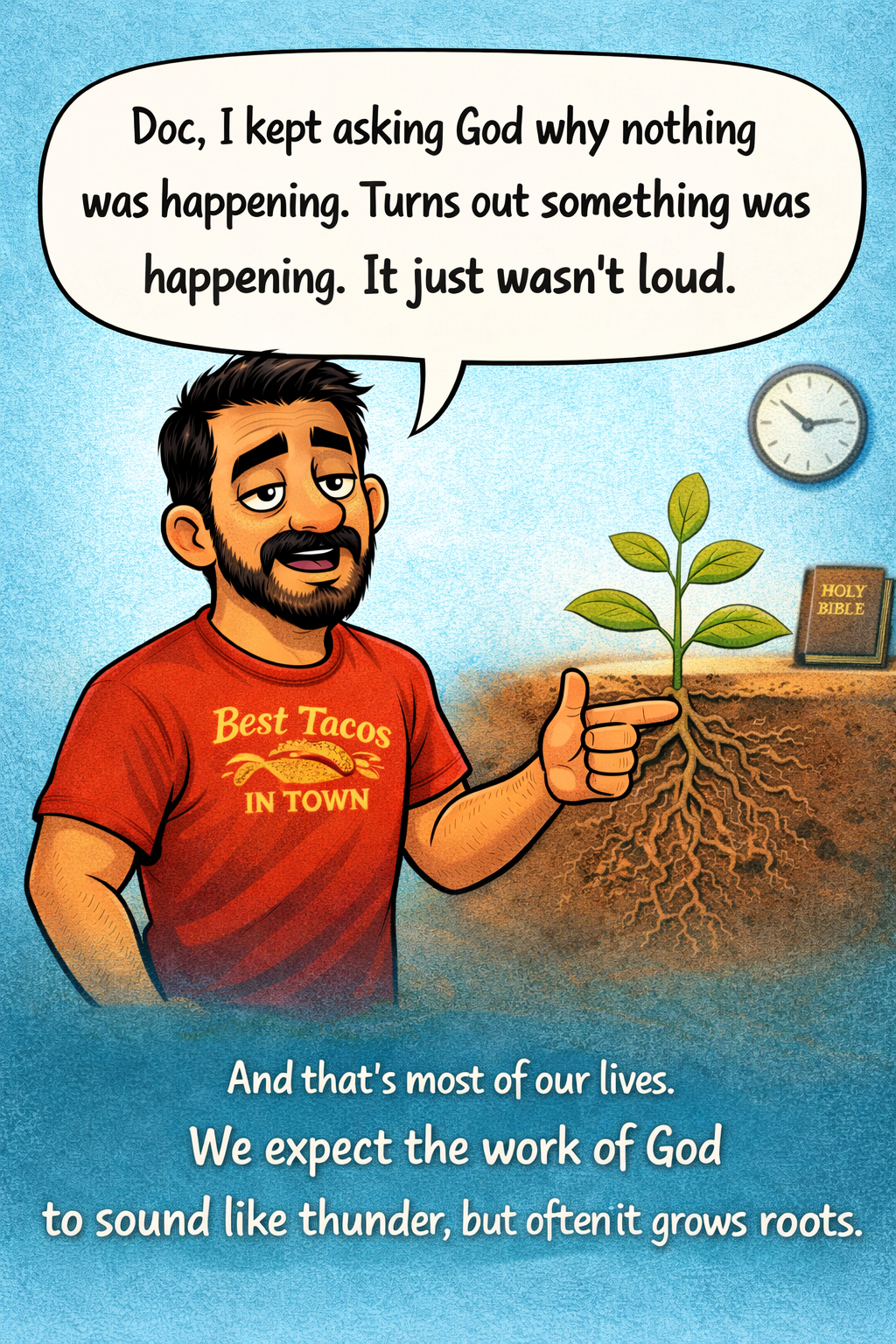
A man once told me,
“Doc, I know God wants more from me. I just need time.”
God nudged him about his marriage, his compromises, his priorities. He promised he’d change “soon.”
But soon never came.
He didn’t become an atheist.
He became numb.
His marriage grew distant.
The Bible felt dry.
Temptation felt stronger.
He said,
“I thought delay was harmless. I didn’t realize delay was discipling my heart.”
That’s drift.
Quiet. Slow. Respectable.
But deadly.
Why God Rarely Hands You the Full Map
We like to say, “I’m waiting on the Lord.” Sometimes that’s true. Sometimes it’s fear in religious clothing.
In Scripture, waiting never meant inactivity. It meant attentiveness while walking in what God had already revealed.
Abraham left before knowing the destination.
Israel followed one move at a time.
The disciples left their nets without guarantees.
God shapes His people through steps, not leaps.
And yes, delayed obedience is still disobedience. Not because God is harsh, but because delay reshapes desire.
Transformation doesn’t always precede obedience.
Very often, obedience produces transformation.
Small steps form the heart.
Rolling the Weight Onto God
Proverbs 16:3 tells us to commit our works to the Lord. The Hebrew word galal (gah-LAHL) means to roll something onto someone else.
You act faithfully.
You roll the outcome to God.
And sometimes, that means trusting Him when progress feels painfully slow.
I know that tension personally.
There are days I get frustrated over channel growth. Views. Shares. Reach. Impact. I wonder,
“Lord, is this even working?”
But then God reminds me:
Elijah preached truth and felt alone.
Jeremiah ministered for decades with almost no visible fruit.
Noah obeyed God faithfully while the world laughed.
Heaven keeps different scorecards.
Obedience is never wasted.
Even when results lag behind faithfulness.
God meets His people in motion.
Your Next Faithful Step
You don’t need dramatic faith.
You need daily faithfulness.
Ask yourself this week:
What is the next faithful step in front of me?
Not the five-year plan.
Not the big leap.
The next step.
Take it.
Then trust God with what you cannot control.
Because faith isn’t proven by what we feel.
Faith proves itself in what we do next.
Take the next faithful step.
Shalom b’Shem Yeshua
© 2025 Dr. Shawn M. Greener. All Rights Reserved.
True Word, Faith for LIFE!
Study Guide
Summary
Episode Two confronts a truth most believers sense, but rarely name: spiritual stagnation is usually not rebellion, it is hesitation. Drawing from Luke 16:10 and Proverbs 16:3, this study explores how God shapes His people through small, faithful steps rather than dramatic leaps. We discover that clarity often follows obedience, not the other way around, and that delay quietly disciples the heart away from responsiveness. Through biblical context, real-life reflection, and stories of Elijah, Jeremiah, and Noah, listeners are invited to move from theory into faithful movement.
Primary Bible Passages
Luke 16:10
Proverbs 16:3
James 2:17
Key Hebrew and Greek Terms
Shema (shah-MAH)
To hear in such a way that obedience follows. Hearing that does not result in response was not considered “hearing” at all.
Galal (gah-LAHL)
To roll something onto someone else. The word communicates entrusting outcomes to God while acting faithfully.
Pistos (PEE-stos)
Greek term meaning reliable, trustworthy, dependable. A person proven by consistent action, not sentiment.
Historical and Cultural Context
In the first-century world, wealthy households relied on stewards who managed resources on behalf of the master. These stewards didn’t own what they managed, but they were entrusted with everything. Their entire identity rested on faithfulness in everyday responsibilities. Small acts revealed character long before large opportunities appeared.
Luke presents Yeshua redefining faithfulness away from religious performance and toward covenant reliability. In the Hebraic worldview, faith was not primarily intellectual agreement. Faith was lived allegiance. To “hear” God meant to respond. Hearing without acting was considered disobedience.
Proverbs 16:3 reflects ancient wisdom about action and trust: you move in faith, and God bears the weight of results. The call wasn’t to passivity or emotional assurance. It was to obedient movement grounded in trust.
Why This Matters
Drift rarely arrives in dramatic rebellion. It grows through quiet delay. Hesitation slowly trains the heart to treat God’s voice as optional. Delayed obedience reshapes desire. At the same time, Scripture consistently reveals that God works through steps, not leaps. Hearts are formed through ordinary acts of faithfulness.
Discussion Questions
1. Where in your life have you mistaken hesitation for wisdom?
2. How does the idea that “delay disciples the heart” challenge you?
3. What does Luke 16:10 reveal about how God evaluates “small” obedience?
4. When have you seen God bring clarity after you obeyed rather than before?
5. Which biblical story (Elijah, Jeremiah, Noah) reminds you that fruit may come slowly?
Practical Application
For the next seven days, choose one faithful step and practice it consistently. Keep it small, simple, and doable. Each morning ask:
1. What is the next faithful step in front of me today?
2. Is it within my control to do it?
3. Will it align me more closely with God’s ways?
Take the step. Then consciously roll the outcome to God. Watch how obedience begins reshaping desire and momentum.
Closing Reflection
God does not ask you to see the whole map. He asks you to trust Him with the next step. Faith proves itself not in feelings, but in movement. He meets His people in motion.
Shalom b’Shem Yeshua
© 2025 Dr. Shawn M. Greener. All Rights Reserved.
True Word, Faith for LIFE!
Footnotes
1. The Holy Bible, Lexham English Bible (Bellingham, WA: Lexham Press, 2012), Luke 16:10.
2. The Holy Bible, New American Standard Bible 2020 (La Habra, CA: The Lockman Foundation, 2020), Luke 16:10.
3. David H. Stern, Complete Jewish Bible (Clarksville, MD: Jewish New Testament Publications, 1998), Luke 16:10.
4. The Holy Bible, Lexham English Bible, Prov. 16:3.
5. HALOT, s.v. “שָׁמַע (shama).”
6. HALOT, s.v. “גָּלַל (galal).”
7. The Holy Bible, Lexham English Bible, Jas. 2:17.
8. Craig S. Keener, The IVP Bible Background Commentary: New Testament (Downers Grove, IL: IVP Academic, 2014), 246–248.
9. Michael S. Heiser, The Unseen Realm (Bellingham, WA: Lexham Press, 2015), 72–75.
10. Skip Moen, More Than Words (Enumclaw, WA: Hebraic Foundations Press, 2014), 131–138.
Bibliography
Heiser, Michael S. The Unseen Realm: Recovering the Supernatural Worldview of the Bible. Bellingham, WA: Lexham Press, 2015.
Keener, Craig S. The IVP Bible Background Commentary: New Testament. Downers Grove, IL: IVP Academic, 2014.
Moen, Skip. More Than Words: How to Think Like a Hebrew. Enumclaw, WA: Hebraic Foundations Press, 2014.
Stern, David H. Complete Jewish Bible. Clarksville, MD: Jewish New Testament Publications, 1998.
The Holy Bible. Lexham English Bible. Bellingham, WA: Lexham Press, 2012.
The Holy Bible. New American Standard Bible 2020. La Habra, CA: The Lockman Foundation, 2020.

Author / Host / Theologian
I am just a beggar who found Bread, helping other hungry beggars to find Him too. My life has certainly been complex and I and my halo has many dents. Heschel said; "Something Sacred hangs in the balance of every moment." I live like it. I teach like it.
As a person who survived a fatal 92 mph vs 51 mph head on crash, after dying and re-animating, and surviving several other brushes with death, my perspective is, let's say, unique. I haven't always been a theologian and I'm living REAL life, just like you... I have my hurts, habits and hangups too.
I've learned a few very important things along the way that I'm confident you'll find useful... butter for the Gluten free Bread so to speak.. Oh, you may chuckle or full on snort along the way, but you might also shed a few tears... Faith for LIFE... That's how it happens.

The Stone Was Moved, But Not for Him
