LIES we LIVE By
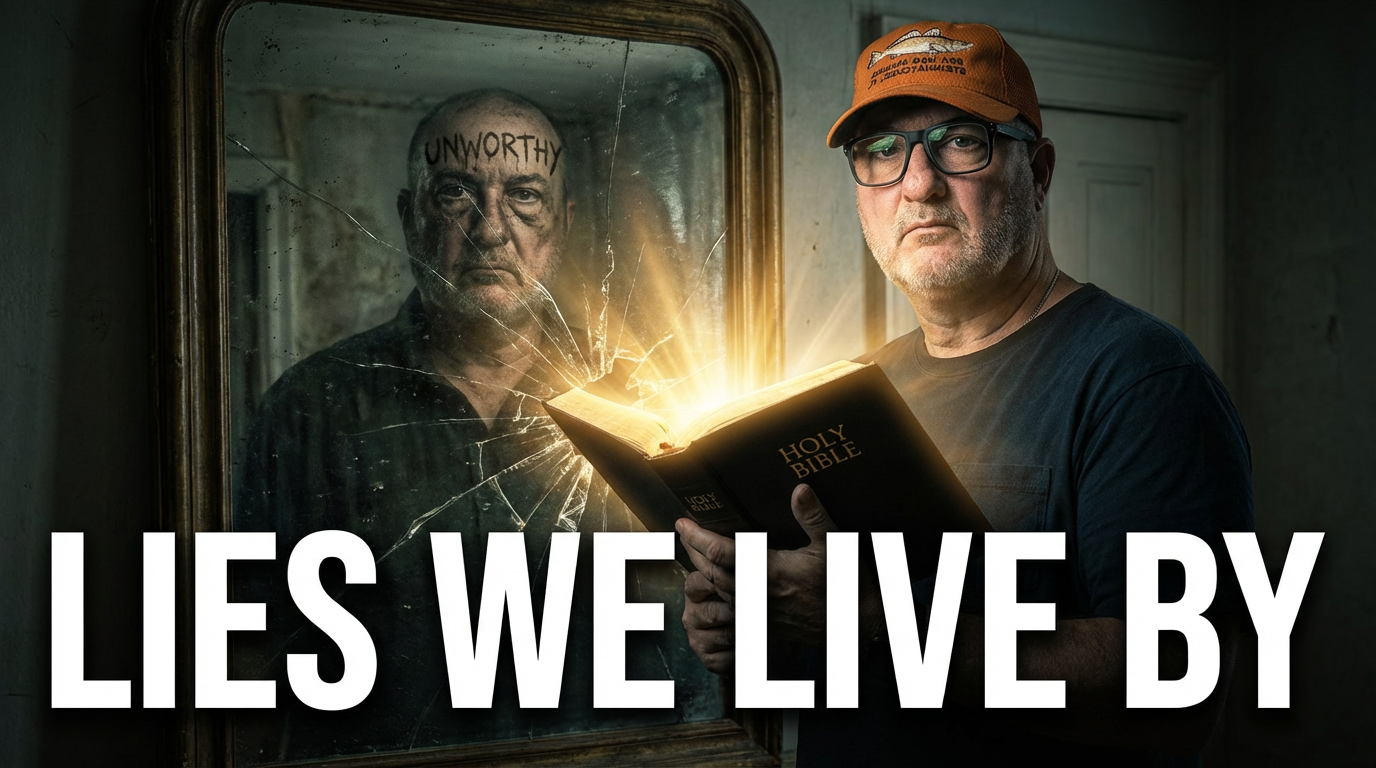
WHAT LIES ARE YOU LIVING BY?
Sunday at 6:30 PM EST, we go after the lies we live by, the quiet ones, the reasonable ones, the ones that feel like “just me,” but slowly steer your whole life off course.
Watch LIVE here: Click HERE to WATCH Episode on our YouTube channel!
There is a kind of spiritual warfare that never shows up in a horror movie.
No shadows in the hallway.
No furniture flying.
No dramatic voice in the night.
This is a REAL Question to answer for REAL People like YOU:
What is one belief you carried for years about God or yourself that you later discovered was not biblical at all?
What is one belief you carried for years about God or yourself that you later discovered was not biblical at all?
It is quieter than that.
It is older than that.
It is more effective than that.
It is the war of meaning.
It is the war of labels.
It is the war of stories.
Because the enemy does not have to attack you to ruin you.
He only has to mislabel your life.
He only has to convince you to call a lie “normal.”
And once you do, you will start building a life around it.
Choice by choice.
Step by step.
Year by year.
Not because you stopped believing in God.
But because you started believing a version of God that God never revealed.
Let me say it plainly.
Most lies do not feel like lies.
They feel like you.
And that is why they are so dangerous.
If you want a single sentence to hold in your hands today, here it is.
A lie you call normal becomes a life you call fate.
Engagement Question.
What is one belief you carried for years about God or yourself that you later discovered was not biblical at all?
THE MOST HUMAN PLACE THIS WAR HAPPENS
If you are trying to live real faith in a real world, you already know the pressure.
You have bills, responsibilities, relationships, health concerns, a past, regrets, disappointments, prayers that did not get answered the way you hoped, and days when you are strong, and days when you feel hollow.
So here is what happens to many believers.
They do not wake up one morning and decide to rebel.
They wake up tired.
They wake up wounded.
They wake up disappointed.
And in that pain, they pick up a story that “explains” it.
And the story becomes a label.
And the label becomes an interpretation.
And the interpretation becomes a lifestyle.
This is why I call it narrative warfare.
Because if the enemy can rename God, he can reshape your worship.
If he can rename you, he can shrink your calling.
If he can rename suffering, he can break your endurance right before it becomes strength.

Three lie buckets show up again and again.
1. Lies about God.
“God is distant.”
“God is harsh.”
“God is disappointed in me.”
“God loves others more.”
2. Lies about you.
“I’m too broken.”
“I’m behind.”
“I’m ruined.”
“I’m tolerated, not loved.”
3. Lies about what suffering means.
“If life is hard, I must be out of God’s will.”
“If I’m anxious, I must be failing.”
“If I hurt, God must be absent.”
These are not small lies.
These are worship lies.
These are identity lies.
These are endurance lies.
And once they settle in, they do not shout.
They narrate.
They interpret everything you see.
A biblical Hebraic worldview does not treat the “heart” as a sentimental organ.
In the Bible’s world, the heart is the control center of loyalty, will, and direction. Dr. Skip Moen often presses this point: your inner posture is not just what you feel, it is what you choose to trust and obey. That is why this episode is not about emotional hype. It is about covenant loyalty under King Yeshua.
JOHN 8: TRUTH IS A PATHWAY, NOT TRIVIA
Before we can replace lies, we have to remember what “truth” means in the Bible.
Truth is not merely correct information.
Truth is what is reliable, what you can lean on, what holds you steady when life shakes.
Yeshua ties truth to remaining, obeying, and living in His teaching.
Not just agreeing.
Not just admiring.
Remaining.
Author and audience.
John writes to bring people to faith that Yeshua is the Messiah, the Son of God, and that by believing they may have life in His Name. In John 8, Yeshua is addressing people who claim spiritual heritage, but resist truth when it confronts their story. They would have heard this as both confrontational and clarifying, because it exposes a terrifying reality: you can be religious and still enslaved.
LEB, John 8:31 to 32
“Then Jesus said to the Jews who had believed him, ‘If you remain in my word, you are truly my disciples, and you will know the truth, and the truth will set you free.’”
CJSB, John 8:31 to 32
“So Yeshua said to the Judeans who had trusted him, ‘If you obey what I say, then you are really my talmidim, you will know the truth, and the truth will set you free.’”
Do you see the pathway?
Remain.
Obey.
Know.
Free.
Truth is not a fact you memorize.
Truth is a road you walk.
And then Yeshua names the enemy’s signature. Lies.
LEB, John 8:44
“When he lies, he speaks from his own nature, because he is a liar and the father of lies.”
CJSB, John 8:44
“When he lies, he is speaking in character; because he is a liar and the father of lies.”
This means lies are not accidental.
They are strategic.
A piercing question for today.
What lie have you been calling “my personality” that is actually spiritual sabotage?
GENESIS 3: THE ENEMY RENAMES GOD FIRST
If you want to see the pattern at the root, go to Genesis 3.
The serpent does not begin by denying God.
He begins by reframing God’s words and implying God’s heart cannot be trusted.
Author and audience.
Genesis functions as covenant formation for Israel, traditionally associated with Moses, shaping a people learning loyalty in a world crowded with rival gods and rival stories. Israel would have heard Genesis 3 as the anatomy of betrayal and drift, not merely rule breaking. It is the collapse of trust through a question.
LEB, Genesis 3:1 to 5
“Now the serpent was more crafty than any wild animal which Yahweh God had made, and he said to the woman, ‘Did God really say, “You shall not eat from any tree in the garden”?’ And the woman said to the serpent, ‘We may eat from the fruit of the trees in the garden, but from the fruit of the tree that is in the midst of the garden God said, “You shall not eat from it, and you shall not touch it, lest you die.”’ And the serpent said to the woman, ‘You shall not surely die, for God knows that on the day you eat from it your eyes will be opened and you will be like God, knowing good and evil.’”
CJSB, Genesis 3:1 to 5
“Now the serpent was more crafty than any wild animal which ADONAI, God, had made. He said to the woman, ‘Did God really say, “You are not to eat from any tree in the garden”?’ The woman answered the serpent, ‘We may eat fruit from the trees in the garden, except the fruit from the tree in the middle of the garden. God said, “You are not to eat from it or touch it, or you will die.”’ The serpent said to the woman, ‘It is not true that you will surely die, because God knows that on the day you eat from it, your eyes will be opened, and you will be like God, knowing good from evil.’”
Watch the progression.
Question.
Distortion.
Implication.
Accusation.
God is withholding.
God is restrictive.
God cannot be trusted.
That is the war.
Rename God, and you can redirect the human heart.
This is why Dr. Michael Heiser’s work on the unseen realm matters in a practical way. The unseen realm is not there for entertainment or obsession. It is there to expose loyalties. The war is often not “What do you see?” It is “Who do you trust?” The battlefield is not mainly spectacle. It is allegiance.
ROMANS 12: THIS PRESENT AGE IS ALWAYS DISCIPLING YOU
Most believers think spiritual warfare is primarily about extraordinary moments.
Paul assumes it is also about ordinary conformity.
Author and audience.
Romans is Paul writing to a mixed community of Jewish and Gentile believers, pressing them into covenant faithfulness in Messiah while they live inside the pressure of empire and competing narratives. They would have heard Romans 12 as resistance training. Do not let “this present age” write your script.
LEB, Romans 12:1 to 2
“Therefore I exhort you, brothers, by the mercies of God, to present your bodies as a living sacrifice, holy and acceptable to God, which is your reasonable service, and do not be conformed to this present world, but be transformed by the renewal of your mind, in order for you to test what is the will of God, what is good and well pleasing and perfect.”
CJSB, Romans 12:1 to 2
“I exhort you, therefore, brothers, in view of God’s mercies, to offer yourselves as a sacrifice, living and set apart for God. This will please him; it is the logical ‘Temple worship’ for you. In other words, do not let yourselves be conformed to the standards of the ‘olam hazeh. Instead, keep letting yourselves be transformed by the renewing of your minds; so that you will know what God wants and will agree that what he wants is good, satisfying and able to succeed.”
Olam hazeh, oh LAHM hah ZEH, this present age.
It has standards.
It has scripts.
It has labels.
It has a way of renaming God, renaming you, and renaming suffering.
So here is the hard, tender truth for real life.
Some of us are not being attacked.
We are being conformed.
We are absorbing stories we did not choose.
We are rehearsing thoughts we never cross-examine.
We are living out vows we made in pain, and calling them wisdom.
PRACTICAL: HOW A LIE BECOMES A LIFE
Let me give you an intensely human example.
Someone betrayed you.
You felt exposed.
You needed an explanation, because pain always asks, “What does this mean?”
So the meaning formed, “People aren’t safe.”
Then the vow formed, “I will never need anyone again.”
Then the pattern formed, isolation and control.
And you called it maturity.
Or you prayed and prayed.
The answer did not come the way you wanted.
So the meaning formed, “God ignores me.”
Then the vow formed, “I won’t expect anything.”
Then the pattern formed, numb faith, low prayer, low-risk obedience.
That is not just psychology.
That is spiritual warfare through interpretation.
Not through spectacle.
Engagement Question.
Can you trace one recurring struggle in your life back to a belief you accepted in pain?
ONE SIMPLE ACTION THAT SHIFTS THE WAR TODAY
Here is the action step I want you to take today, not someday.
Step 1.
Write down one sentence your mind repeats when you fail, when you hurt, or when you feel afraid.
Just one sentence.
Step 2.
Write one word beside it.
“Proof?”
Because the enemy’s most effective lies are often the ones you never demand evidence for.
Step 3.
Replace it with one Bible sentence.
Not a paragraph.
A sentence.
Step 4.
Practice that sentence with one obedience move this week.
Truth becomes yours when you obey it.
If the lie says, “I’m alone,” practice truth by reaching out.
If the lie says, “God is distant,” practice truth by praying out loud.
If the lie says, “I’m ruined,” practice truth by taking one obedient step anyway.
You do not have to overhaul your life in a day.
But you do have to stop agreeing with the lie.
Because freedom begins the moment you stop agreeing with the lie.
IF YOU WANT THE DEEPEST LIE EXPOSED
There is one lie beneath so many others.
It is the lie that you can be your own savior.
You cannot.
You need a King.
You need forgiveness.
You need a new heart.
You need truth that does not change when your feelings change.
That is why King Yeshua does not merely give advice.
He gives life.
He does not merely offer coping.
He offers covenant.
If you want to walk this episode with me live, join us Sunday at 6:30 PM EST.
Watch here: WATCH Here on our YouTube Channel!
One more thing, and I mean it sincerely.
If you want to go deeper in covenant life and learn to read the Bible with clarity, context, and courage, my book True Word, Faith for LIFE! is available in the STORE at GO to STORE above and to the right!
Shalom b’Shem Yeshua
© 2025 Dr. Shawn M. Greener. All Rights Reserved.
True Word, Faith for LIFE!
STUDY GUIDE
WHAT LIES ARE YOU LIVING BY?
Spiritual Warfare Series, Episode 2: LIES WE LIVE BY
Series: The Armor They Never Told You About
PURPOSE AND HOW TO USE THIS GUIDE
This guide is designed to work in two ways at the same time.
First, as a deeply human devotional for the weary believer who wants real freedom, not hype.
Second, as a durable theological resource you can return to for years, with scholarly grounding, key terms, and documented sources.
Use it alone with a notebook, or with a small group. Move slowly. The goal is not to finish quickly. The goal is to stop agreeing with the lie.
CORE IDEA
A lie you call normal becomes a life you call fate.
KEY CLAIMS FROM THE EPISODE
1. Spiritual warfare is often narrative warfare. If the enemy can rename God, rename you, and rename suffering, he can redirect your life without spectacle.
2. Many believers do not drift because they rebel loudly. They drift because they interpret quietly through a false story that feels like “just me.”
3. In the Bible, truth is not only correct information. Truth is covenant reliability, something you can lean on. Freedom comes through remaining, obeying, and walking in Messiah’s teaching.
4. Strongholds are often protected lies, reinforced by emotion and habit, not always dramatic manifestations.
5. Renewal of the mind is not self improvement. It is covenant resistance against “this present age” writing your script.
SUMMARY TEACHING, DEVOTIONAL AND SCHOLARLY
There is a kind of spiritual warfare that does not announce itself. It does not terrify you with horror movie drama. It simply narrates. It labels. It interprets. It sits inside your mind like old furniture and it convinces you that what you are hearing is truth, when it is only familiarity.
That is why these lies are so dangerous. They do not feel like lies. They feel like you.
Most believers do not wake up and decide to betray God. They wake up tired, disappointed, burdened, and pressured by real life. In that pain, they reach for meaning. Pain always asks, “What does this mean?” And if you do not let God define the meaning, something else will. Sometimes it is your wounded inner narrator. Sometimes it is the voice of the age. Sometimes it is a spiritual adversary exploiting a moment of weakness. But the pattern is consistent. Pain seeks meaning. Meaning becomes a label. The label becomes an interpretation. The interpretation becomes a lifestyle.
This is why the biblical Hebraic worldview matters so much here. In modern Western talk, the “heart” is often reduced to emotions. In the Bible’s world, the heart is the control center of loyalty, will, and direction. It is where decisions form. It is where allegiance lives. Dr. Skip Moen presses this point repeatedly. The inner posture is not merely what you feel. It is what you choose to trust and obey. That is covenant language, not therapy language. It is deeply human, but it is also deeply theological. Because what you trust will eventually govern what you do.¹
So we name the fight accurately. The battlefield is not only behavior. The battlefield is meaning.
THREE BUCKETS OF LIES
These show up again and again as “reasonable thoughts” that eventually become spiritual prisons.
Bucket 1, Lies about God.
God is distant.
God is harsh.
God is disappointed in me.
God loves others more than me.
Bucket 2, Lies about you.
I am too broken.
I am behind.
I am ruined.
I am tolerated, not loved.
Bucket 3, Lies about suffering.
If life is hard, I must be out of God’s will.
If I am anxious, I must be failing.
If I hurt, God must be absent.
These are not small lies. They are worship lies, identity lies, and endurance lies. Once they settle in, they do not shout. They narrate. They interpret everything you see.
PRIMARY PASSAGE 1, JOHN 8, TRUTH AS A PATHWAY
Author and audience.
The Gospel of John is written so that people may believe Yeshua is the Messiah, the Son of God, and by believing have life in His Name.² In John 8, Yeshua confronts people who claim spiritual heritage yet resist truth when it challenges their story of freedom. This would have landed as both confrontational and clarifying: you can be religious and still enslaved.
Side by side Bible text, LEB and CJSB.
LEB, John 8:31–32
“Then Jesus said to the Jews who had believed him, ‘If you remain in my word, you are truly my disciples, and you will know the truth, and the truth will set you free.’”³
CJSB, John 8:31–32
“So Yeshua said to the Judeans who had trusted him, ‘If you obey what I say, then you are really my talmidim, you will know the truth, and the truth will set you free.’”⁴
Notice the sequence. Remain. Obey. Know. Free.
This is not trivia. This is covenant pathway.
Then Yeshua identifies the enemy’s signature. Lies are not accidental. They are strategic.
LEB, John 8:44
“When he lies, he speaks from his own nature, because he is a liar and the father of lies.”³
CJSB, John 8:44
“When he lies, he is speaking in character; because he is a liar and the father of lies.”⁴
Devotional reality check.
Ask yourself: What lie have I been calling “my personality” that is actually spiritual sabotage? Many people confuse familiarity with identity. The lie survives because it feels normal. But normal is not a moral category. Normal is a repetition category.
PRIMARY PASSAGE 2, GENESIS 3, THE ENEMY RENAMES GOD FIRST
Author and audience.
Genesis functions as covenant formation for Israel, shaping identity and loyalty in a world full of rival gods and rival stories. The community would have heard Genesis 3 as the anatomy of betrayal through mis-trust, not merely rule breaking. The serpent’s first move is not atheism. It is insinuation. “God cannot be trusted.” That is a direct strike on covenant loyalty.⁵
Side by side Bible text, LEB and CJSB.
LEB, Genesis 3:1–5
“Now the serpent was more crafty than any wild animal which Yahweh God had made, and he said to the woman, ‘Did God really say, “You shall not eat from any tree in the garden”?’ And the woman said to the serpent, ‘We may eat from the fruit of the trees in the garden, but from the fruit of the tree that is in the midst of the garden God said, “You shall not eat from it, and you shall not touch it, lest you die.”’ And the serpent said to the woman, ‘You shall not surely die, for God knows that on the day you eat from it your eyes will be opened and you will be like God, knowing good and evil.’”³
CJSB, Genesis 3:1–5
“Now the serpent was more crafty than any wild animal which ADONAI, God, had made. He said to the woman, ‘Did God really say, “You are not to eat from any tree in the garden”?’ The woman answered the serpent, ‘We may eat fruit from the trees in the garden, except the fruit from the tree in the middle of the garden. God said, “You are not to eat from it or touch it, or you will die.”’ The serpent said to the woman, ‘It is not true that you will surely die, because God knows that on the day you eat from it, your eyes will be opened, and you will be like God, knowing good from evil.’”⁴
Watch the progression.
Question. Distortion. Implication. Accusation.
Did God really say?
Any tree? God sounds restrictive.
God is withholding good.
The war is meaning. Rename God, and you can redirect the heart.
Where Dr. Michael Heiser helps.
Heiser’s “unseen realm” work is not for obsession or paranoia. It re-centers allegiance. The unseen realm frames the reality that loyalty is contested. The question is often not “What do you see?” but “Who do you trust?”⁶
Devotional reality check.
Write the sentence you assume about God when you are disappointed. That sentence is often the serpent’s modern paraphrase. Then confront it with one sentence from the Bible that tells the truth about His character.
PRIMARY PASSAGE 3, ROMANS 12, THIS PRESENT AGE WRITES SCRIPTS
Author and audience.
Romans is Paul’s letter to a mixed community of Jewish and Gentile believers living under the pressure of empire and competing narratives. Romans 12 is not only an ethical section. It is resistance training. Covenant faithfulness in Messiah reshapes the mind, and the body follows.⁷
Side by side Bible text, LEB and CJSB.
LEB, Romans 12:1–2
“Therefore I exhort you, brothers, by the mercies of God, to present your bodies as a living sacrifice, holy and acceptable to God, which is your reasonable service, and do not be conformed to this present world, but be transformed by the renewal of your mind, in order for you to test what is the will of God, what is good and well pleasing and perfect.”³
CJSB, Romans 12:1–2
“I exhort you, therefore, brothers, in view of God’s mercies, to offer yourselves as a sacrifice, living and set apart for God. This will please him; it is the logical ‘Temple worship’ for you. In other words, do not let yourselves be conformed to the standards of the ‘olam hazeh. Instead, keep letting yourselves be transformed by the renewing of your minds; so that you will know what God wants and will agree that what he wants is good, satisfying and able to succeed.”⁴
Key phrase. Olam hazeh, “this present age.”
This age has standards. It has scripts. It has labels. It renames God, renames you, and renames suffering. Paul says you must resist passive conformity through ongoing renewal.⁸
Devotional reality check.
Some believers are not being attacked. They are being conformed. They are consuming narratives they never cross examine. That is why a seven day “story fast” can be a spiritual discipline. Remove one discipling source, and replace it with daily Bible intake.
PRIMARY PASSAGE 4, 2 CORINTHIANS 10, STRONGHOLDS AS PROTECTED LIES
Author and audience.
Second Corinthians addresses a troubled community dealing with accusations, competing narratives, and spiritual immaturity. Paul calls believers to fight with spiritual tools, not fleshly weapons. The focus is arguments, obstacles to knowing God, and thoughts that must be brought under obedience to Messiah.⁹
Side by side Bible text, LEB and CJSB.
LEB, 2 Corinthians 10:3–5
“For although we walk about in the flesh, we do not wage war according to the flesh, for the weapons of our warfare are not fleshly, but powerful by God for the destruction of fortresses, destroying arguments and every arrogant obstacle raised up against the knowledge of God, and taking every thought captive to the obedience of Christ.”³
CJSB, 2 Corinthians 10:3–5
“For although we do live in the world, we do not wage war in a worldly way, because the weapons we use to wage war are not worldly. On the contrary, they have God’s power for demolishing strongholds. We demolish arguments and every proud obstacle that raises itself against the knowledge of God; we take every thought captive and make it obey the Messiah.”⁴
This is not spectacle. This is thought warfare, loyalty warfare, narrative warfare.
THE ANATOMY OF A LIFESTYLE LIE
Use this diagnostic pattern.
1. Pain happens.
2. Pain demands meaning.
3. Meaning becomes a label.
4. The label becomes a vow.
5. The vow becomes a habit.
6. The habit becomes a prison you call “wisdom.”
Example, betrayal.
Meaning: People aren’t safe.
Vow: I will never need anyone again.
Pattern: Isolation and control.
Result: A prison wearing a suit.
Example, disappointment in prayer.
Meaning: God ignores me.
Vow: I will not expect anything.
Pattern: Low prayer, numb faith, low risk obedience.
This is intensely human. It is also intensely spiritual. Because interpretation governs allegiance.
KEY TERMS, WITH PRONUNCIATION AND MEANING
1. Emet (eh MET), Hebrew, “truth” as reliability, firmness, what can be trusted. In Hebraic thought, truth is not only accuracy. Truth is faithfulness, something you can lean on.¹⁰
2. Olam hazeh (oh LAHM hah ZEH), Hebrew, “this present age,” the current world order with its pressures and narratives that disciple you if you do not resist.⁴
3. Heart (lev, levav), Hebrew, the seat of will, loyalty, and decision, not merely emotion. What you trust and choose shapes what you become.¹¹
DISCUSSION QUESTIONS
1. What lie feels most “normal” to you right now, and which bucket does it belong to: God, self, or suffering?
2. In John 8, why does Yeshua tie freedom to remaining and obeying, not merely agreeing? What does that change about how you pursue freedom?
3. In Genesis 3, what is the serpent’s first move, and how do you see that same move in your own inner narrator?
4. Where are you most vulnerable to “this present age” discipling you? Name one feed, one voice, or one habit that is shaping your thinking.
5. Can you identify a vow you made in pain that still governs your decisions? What would releasing that vow look like in one concrete step?
6. What does it mean to “take every thought captive” in a practical, non performative way? What would you do differently tomorrow morning?
PRACTICAL APPLICATION, A FOUR STEP EXERCISE YOU CAN REPEAT WEEKLY
Step 1, Identify the sentence.
Write one sentence your mind repeats when you fail, when you hurt, or when you feel afraid. Only one sentence.
Step 2, Cross examine it.
Write one word next to it: Proof?
Then ask, “Who told me that?”
Step 3, Replace it with one Bible sentence.
Not a paragraph. A sentence. Put it on a card. Read it out loud morning and night for seven days.
Step 4, Obey one inch of truth.
Truth becomes yours when you obey it. Choose one small action that proves you are no longer agreeing with the lie.
If the lie says, “I’m alone,” reach out to one trusted person today.
If the lie says, “God is distant,” pray out loud for two minutes today.
If the lie says, “I’m ruined,” take one obedient step you have been avoiding.
A SEVEN DAY “STORY FAST” OPTION
Pick one source that repeatedly shapes you with fear, outrage, despair, or identity distortion. Fast from it for seven days. Replace it with daily Bible reading, even if it is only ten minutes. This is not legalism. It is mental discipleship.
CLOSING DEVOTIONAL EXHORTATION
Beloved, the enemy does not need to attack you to ruin you. He only needs you to agree with the lie. But agreement can be revoked. A vow can be released. A story can be rewritten.
Start here.
Name the lie.
Cross examine it.
Replace it with truth.
Obey the truth once.
Freedom begins the moment you stop agreeing with the lie.
FOOTNOTES
1. Skip Moen, “Heart,” At God’s Table (blog tag page).
2. See John’s stated purpose in John 20:31; for canonical context and interpretive framing, consult a standard Johannine commentary such as Craig S. Keener, The Gospel of John: A Commentary (Peabody, MA: Hendrickson, 2003).
3. Lexham English Bible (Bellingham, WA: Lexham Press, 2012).
4. David H. Stern, ed., Complete Jewish Study Bible: Notes (Peabody, MA: Hendrickson Publishers, 2016).
5. For covenant formation and ANE story shaping, see John H. Walton, The Lost World of Adam and Eve: Genesis 2–3 and the Human Origins Debate (Downers Grove, IL: IVP Academic, 2015).
6. Michael S. Heiser, The Unseen Realm: Recovering the Supernatural Worldview of the Bible (Bellingham, WA: Lexham Press, 2015).
7. Douglas J. Moo, The Epistle to the Romans, 2nd ed., New International Commentary on the New Testament (Grand Rapids, MI: Eerdmans, 2018).
8. “Olam hazeh” appears as a clarifying interpretive gloss in the CJSB rendering of Romans 12:2; see Stern, Complete Jewish Study Bible: Notes.
9. For a detailed exegetical treatment of 2 Corinthians 10 and “strongholds” as arguments and thought patterns, see Murray J. Harris, The Second Epistle to the Corinthians, New International Greek Testament Commentary (Grand Rapids, MI: Eerdmans, 2005).
10. For Hebrew “truth” as reliability and covenant faithfulness, see standard lexical resources such as Ludwig Koehler and Walter Baumgartner, The Hebrew and Aramaic Lexicon of the Old Testament (Leiden: Brill, 1994–2000), entry on אמת.
11. For “heart” as will and loyalty center in Hebraic thought, see Moen, “Heart,” and any standard Hebrew anthropology treatment; Moen is especially accessible for devotional formation.
BIBLIOGRAPHY (TURABIAN STYLE)
Harris, Murray J. The Second Epistle to the Corinthians. New International Greek Testament Commentary. Grand Rapids, MI: Eerdmans, 2005.
Heiser, Michael S. The Unseen Realm: Recovering the Supernatural Worldview of the Bible. Bellingham, WA: Lexham Press, 2015.
Keener, Craig S. The Gospel of John: A Commentary. Peabody, MA: Hendrickson, 2003.
Lexham English Bible. Bellingham, WA: Lexham Press, 2012.
Moo, Douglas J. The Epistle to the Romans. 2nd ed. New International Commentary on the New Testament. Grand Rapids, MI: Eerdmans, 2018.
Moen, Skip. “Heart.” At God’s Table. Accessed January 25, 2026.
Stern, David H., ed. Complete Jewish Study Bible: Notes. Peabody, MA: Hendrickson Publishers, 2016.
Walton, John H. The Lost World of Adam and Eve: Genesis 2–3 and the Human Origins Debate. Downers Grove, IL: IVP Academic, 2015.
Shalom b’Shem Yeshua
© 2025 Dr. Shawn M. Greener. All Rights Reserved.
True Word, Faith for LIFE!
lies we live by, spiritual warfare, armor of god, biblical discernment, mind renewal, renew your mind, strongholds, taking thoughts captive, John 8, Genesis 3, Romans 12, 2 Corinthians 10, Hebraic worldview, ancient near eastern context, covenant loyalty, discipleship, Christian living, Bible teaching, truth sets you free, Yeshua, Messiah, Ruach HaKodesh, true word faith for life, Dr Shawn M Greener, Wilmington NC, Hampstead NC, Christian podcast, live Bible teaching
#BibleTeaching
#SpiritualWarfare
#Discipleship
#RenewYourMind
#TrueWordFaithForLIFE

Author / Host / Theologian
I am just a beggar who found Bread, helping other hungry beggars to find Him too. My life has certainly been complex and I and my halo has many dents. Heschel said; "Something Sacred hangs in the balance of every moment." I live like it. I teach like it.
As a person who survived a fatal 92 mph vs 51 mph head on crash, after dying and re-animating, and surviving several other brushes with death, my perspective is, let's say, unique. I haven't always been a theologian and I'm living REAL life, just like you... I have my hurts, habits and hangups too.
I've learned a few very important things along the way that I'm confident you'll find useful... butter for the Gluten free Bread so to speak.. Oh, you may chuckle or full on snort along the way, but you might also shed a few tears... Faith for LIFE... That's how it happens.
Tucker and Candace Lie About Israel and God