Judas Ate Too: The Table, the Cross, and the Empty Tomb
BLOG POST
Judas Ate Too: The Table, the Cross, and the Empty Tomb
POEM - Judas Ate Too
by © 2023 Shawn M. Greener. All rights reserved.
In the hush of night, with lamps burned low,
Twelve souls reclined where love would go.
The Lamb, unblemished, broke the bread
With heavy heart and thorns ahead.
He knew.
The sting of silver in a traitor’s hand,
The whispered deal, the kiss so planned.
He knew the weight of every lie,
And still He came, still chose to die.
He knelt before the filth-stained feet,
Of one whose heart would soon retreat.
He washed the grime, He met the eyes,
Of one whose soul wore thin disguise.
He fed him.
The bread, His body. The wine, His grace.
He didn’t flinch, avert His face.
He offered mercy, deep and wide,
To the very one who’d soon collide
With soldiers’ swords and midnight shame
Yet Jesus loved him just the same.
And I…
Am Judas, too. In thought, in deed,
I’ve sold Him out to lesser need.
I’ve kissed His cheek, then turned away,
To chase the dark, avoid the day.
But, oh! the joy, the trembling truth:
That mercy isn’t earned by proof.
He saw me then, He sees me now,
Still wraps the towel, still bows somehow.
He feeds me grace, though I betray,
He loves me still, and will not sway.
I should have fled… I should have died…
But Jesus drew me to His side.
So here I stand, amazed, undone…
The traitor touched by Heaven’s Son.
And through the tears, I lift my view…
And whisper, “Thank You… Judas ate too.”
The risen Messiah did not defeat death by loving the worthy, but by carrying holy covenant love all the way through betrayal, suffering, and the grave itself.
Resurrection Sunday often arrives wrapped in familiar language. Empty tomb. Risen Savior. Victory over death. Hope for the broken. And all of that is gloriously true. But sometimes the truth becomes so familiar that we stop feeling its weight.

That is why one line must be allowed to strike us again with fresh force.
Judas ate too.
That line doesn't weaken the resurrection. It reveals its depth.
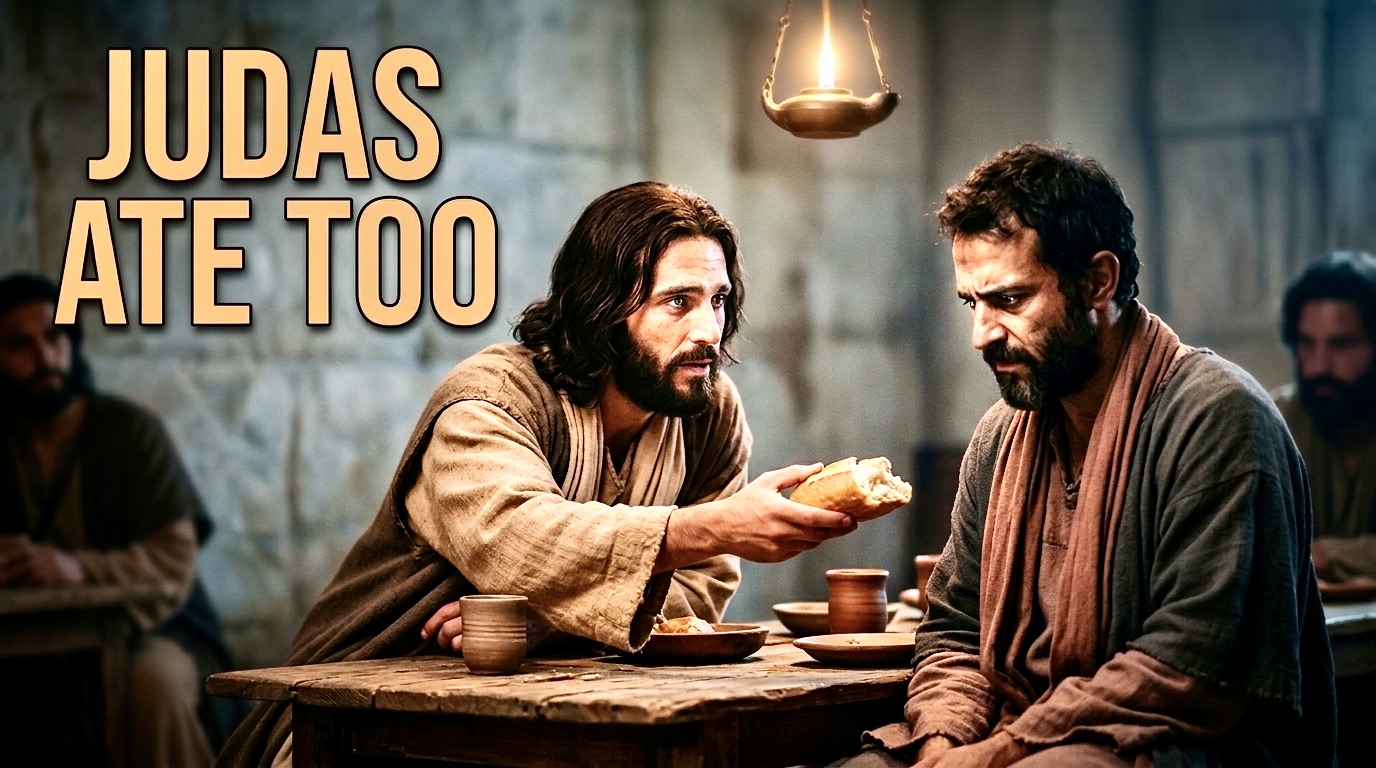
It tells us that Yeshua did not go to the cross as a sentimental idealist who misunderstood the people around Him. He was not naïve. He was not surprised. He was not tragically optimistic about Judas. He knew. He knew the silver had already been set in motion. He knew treachery was in the room. He knew betrayal was not theoretical, but personal, near, intimate. And still, Judas ate too.
For people inside the church, that should humble us. For people outside the church, or wounded by it, that should arrest us. Because this is not shallow religion. This is not positive thinking baptized with Bible words. This is the blazing holiness of divine love.
Luke records the words of Yeshua at the table with chilling force: “But behold, the hand of him who betrays me is with me on the table.”^1 That detail matters. With Me on the table. Not in the distance. Not hidden in an enemy camp. Not outside the room. At the table.
In the world of the Bible, meals were not casual. In the Ancient Near Eastern and Mediterranean setting, table fellowship signaled relationship, solidarity, trust, and often covenantal peace.^2 To share bread was to say more than, “We are eating.” It was to say, “You are welcomed near.” Meals carried moral and relational weight. That is why betrayal at table was not merely disappointing. It was a deep act of treachery.
That background helps us hear Psalm 41:9 with greater force: “Even my close friend in whom I trusted, who ate my bread, has lifted his heel against me.”^3 The psalm is not simply describing political inconvenience or emotional sadness. It is describing the agony of violated nearness. The one who ate my bread. The one admitted to fellowship. The one welcomed close. That one lifted his heel against me.
John’s Gospel tightens the scene even more. Yeshua says, “It is he to whom I will give this morsel of bread when I have dipped it.” Then He gives it to Judas.^4 This is not a random detail. It is a deliberate act. The hand of Messiah extends bread to the betrayer. That is the kind of holiness the resurrection vindicates.
This is where many readers need to slow down. The point is not that Judas’ betrayal did not matter. It did matter. The Bible does not sentimentalize treachery. Judas is not excused by proximity to grace. Judgment is real. Responsibility is real. Truth is real. But before Judas acted in full, Yeshua had already loved him in full view of what he would do.
That means the mercy of God is not based on ignorance.
We often love because we do not yet know the worst. We are generous because we have not been fully disappointed. We are open because someone has not yet wounded us in the place we fear most. But the love of Messiah is not fragile like ours. He loved while knowing the worst.
He fed knowing the worst.
He served knowing the worst.
He walked toward Golgotha knowing the worst.
And still He loved.
That is why Resurrection Sunday must never be reduced to a generic celebration of hope. It is not merely the announcement that life beats death in the abstract. It is the declaration that the covenant faithfulness of God is stronger than human betrayal, stronger than cowardice, stronger than denial, stronger than violence, stronger than hell, and stronger than the grave.
The resurrection vindicates the kind of love Yeshua carried all the way to the cross.
The world says, protect yourself first. Messiah says, give yourself.
The world says, preserve your image. Messiah moves in obedience.
The world says, love those who earn it. Messiah loves in a way that exposes how little any of us deserve.
And that brings us uncomfortably close to the point.
Judas ate too. But so did the others.
The fearful ate too.
The confused ate too.
The weak ate too.
The men who would soon scatter ate too.
Peter, who would deny Him three times, ate too.
The table was full of imperfect men. That does not flatten Judas into Peter, or treachery into confusion. The Bible does not erase moral distinctions. But it does force us to admit something every reader needs to hear. Everyone at that table needed mercy.
So do we.
That is why this message matters far beyond a sanctuary on Easter Sunday. People from every walk of life know what it is to fail. Some know the shame of private compromise. Some know the ache of betrayal. Some know what it is to trade obedience for comfort, truth for acceptance, conviction for convenience. Some know what it is to smile outwardly while crumbling inwardly. Some know the heavy weariness of carrying guilt that has never been honestly named.
The resurrection answers that world.
It says your sin is real, but it is not sovereign.
It says your shame is real, but it is not sovereign.
It says your past is real, but it is not sovereign.
It says your wound is real, but it is not sovereign.
Because the risen Christ is Lord.
Peter’s restoration proves this. Peter failed grievously, yet his collapse was not his final name. The risen Messiah restored him and recommissioned him.^5 That means your worst moment does not have to become your permanent identity if you bring it into the light of the risen Christ.
This is where the message cuts both ways.
For the broken, it offers hope.
For the casual, it brings a warning.
Grace is not permission.
Mercy is not indulgence.
The resurrection is not a pep talk for people who want to keep sinning comfortably.
The same Messiah who fed Judas also named the betrayal. The same Messiah who loved deeply also walked in truth. The call of Easter is not, “Relax, sin does not matter.” The call is, “Look how holy, costly, and staggering the love of God is, then repent, worship, and come alive.”
That is what many people still misunderstand. They imagine God forgives with clenched teeth. They imagine one more failure means the table is gone forever. They imagine the risen Christ standing at a cold distance, waiting to see whether they can repair themselves enough to be received.
But the gospel tells another story.
The One who extended bread even to the betrayer now extends mercy to sinners, wanderers, rebels, the ashamed, and the exhausted. He does not bless sin. He breaks its claim. He does not flatter compromise. He calls people out of darkness into life.
So the resurrection is not merely an event to admire. It is an announcement.
Come alive.
Come clean.
Come home.
Look again at the table.
Look again at the cross.
Look again at the empty tomb.
The table tells you His mercy is deeper than you thought.
The cross tells you your sin is worse than you thought.
The empty tomb tells you His victory is greater than you thought.
And that leaves every reader with a choice.
Will you keep hiding behind the ugliest thing you have ever done?
Will you keep defending the compromise that is starving your soul?
Will you keep identifying yourself by failure, betrayal, grief, or shame?
Or will you come into the light and let the risen Messiah name you again?
If you belong to Him, your truest name is not what you did.
Your truest name is what He has done.
Forgiven.
Restored.
Beloved.
Called.
Made new.
Judas ate too.
Peter was restored too.
And because the tomb is empty, mercy still reigns and love still lives.
Which strikes you more deeply today, that Judas ate too, or that Peter was restored too, and why?
Footnotes
1. Luke 22:21, English Standard Version.
2. John H. Walton and Victor H. Matthews, The IVP Bible Background Commentary: Old Testament, 2nd ed. (Downers Grove, IL: InterVarsity Press, 2014), 774; Craig S. Keener, The IVP Bible Background Commentary: New Testament, 2nd ed. (Downers Grove, IL: InterVarsity Press, 2014), 247.
3. Psalm 41:9, English Standard Version.
4. John 13:26, English Standard Version.
5. John 21:15–19, English Standard Version.
6. Darrell L. Bock, Luke 9:51–24:53, Baker Exegetical Commentary on the New Testament (Grand Rapids, MI: Baker Academic, 1996), 1723–25.
7. Andreas J. Kostenberger, John, Baker Exegetical Commentary on the New Testament (Grand Rapids, MI: Baker Academic, 2004), 406–9.
8. R. T. France, The Gospel of Matthew, New International Commentary on the New Testament (Grand Rapids, MI: Eerdmans, 2007), 1002–5.
9. Michael S. Heiser, The Unseen Realm: Recovering the Supernatural Worldview of the Bible (Bellingham, WA: Lexham Press, 2015), 287–90.
10. David H. Stern, Jewish New Testament Commentary (Clarksville, MD: Jewish New Testament Publications, 1992), 206–8.
11. Skip Moen, Guardian Angel: Discovering the Way of Israel (Houston, TX: At God’s Table, 2007), 91–96.
12. N. T. Wright, The Resurrection of the Son of God (Minneapolis, MN: Fortress Press, 2003), 717–24.
Shalom b’Shem Yeshua.
Shalom Aleikum.
© 2026 Dr. Shawn M. Greener. All Rights Reserved.
True Word, Faith for LIFE!
The Bible Rebinder I Mentioned on the Podcast

This is one of the three Bibles Melissa of MooseWorks Bible restored for me, beautifully rebound with a rugged new cover and exceptional attention to detail.

A Bible is more than a book. It is often a treasury of prayers, notes, promises, memories, and the record of a life spent seeking God.

If you have a treasured Bible that deserves to be preserved with excellence, I am honored to recommend Melissa of MooseWorks Bible.
Her work is marked by beautiful craftsmanship, thoughtful detail, and genuine kindness. She does not simply repair Bibles. She helps preserve the story they carry.
Visit MooseWorks Bible today:
Click HERE for MooseWorks Bible!
© 2026 Dr. Shawn M. Greener. All Rights Reserved.
True Word, Faith for LIFE!
STUDY GUIDE
Judas Ate Too: Resurrection Mercy, Table Fellowship, and the Faithfulness of Messiah
Focus Passage: Luke 22:21; John 13:26; Psalm 41:9
Primary Texts
Luke 22:21 ESV
“But behold, the hand of him who betrays me is with me on the table.”
Luke 22:21 CJSB
“But look! The person who is betraying me is here with me at the table!”
John 13:26 ESV
Jesus answered, “It is he to whom I will give this morsel of bread when I have dipped it.” So when he had dipped the morsel, he gave it to Judas, the son of Simon Iscariot.
John 13:26 CJSB
Yeshua answered, “It’s the one to whom I give the piece of matzah after I dip it in the dish.” Then he dipped the piece of matzah and gave it to Y’hudah Ben-Shim‘on from K’riot.
Psalm 41:9 ESV
Even my close friend in whom I trusted, who ate my bread, has lifted his heel against me.
Psalm 41:9 CJSB
Even my close friend, on whom I relied, who shared my table, has turned against me.
Summary
This Resurrection Sunday message presses into a painful and glorious truth: Judas ate too. That statement does not minimize Judas’s betrayal. It magnifies the holiness of Messiah’s love. Yeshua knowingly extended table fellowship to the betrayer, fulfilling the anguish of Psalm 41:9 and embodying a covenantal love far deeper than ordinary human instinct. The resurrection, then, is not merely proof that Yeshua lives. It is heaven’s vindication of the kind of love He carried all the way to the cross. The empty tomb declares that betrayal, sin, shame, and death do not have the final word. Messiah does. For the repentant, that means there is mercy after failure, restoration after collapse, and a new identity in the risen Christ.
The resurrection proves that the holy love of Messiah is stronger than betrayal and that His covenant mercy can restore all who come to Him in repentance and faith.
Key Terms
Table Fellowship
In the Bible’s world, shared meals communicated welcome, peace, relationship, and often covenant solidarity.^1 To eat together was not socially neutral.
Betrayal
In this context, betrayal is intensified because it occurs within intimacy, trust, and shared fellowship, not from a visible outsider.^2
Mercy
Mercy is God’s compassionate action toward the guilty and needy, not because sin is small, but because His covenant faithfulness is great.^3
Resurrection
The resurrection is God’s public vindication of Yeshua as Messiah and Lord, proving that sin, death, and evil powers did not defeat Him.^4
Restoration
Restoration is not mere emotional recovery. It is the gracious work of the risen Messiah in reclaiming, forgiving, recommissioning, and transforming those who return to Him.^5
Context and Exegesis
The Last Supper must be read with first century Jewish and broader Ancient Near Eastern sensitivity. Meals were never merely about calories. They were about belonging. To eat at table with someone was to be counted near, to be welcomed into relational space, and in many contexts to share a form of peace and mutual recognition.^6 That is why Luke’s statement, “the hand of him who betrays me is with me on the table,” lands with such devastating force. The betrayal is not happening from a distance. It is happening inside fellowship.
Psalm 41:9 stands in the background as a key interpretive lens. The psalmist mourns the treachery of a trusted companion who “ate my bread.” In Hebraic thought, shared bread is not disposable imagery. It embodies relational loyalty. To “lift up the heel” against one who has given bread is to answer welcome with violence, fellowship with treachery.^7 Yeshua consciously inhabits that pattern. He is not trapped by events. He knows the text, knows Judas, knows what is unfolding, and still moves forward.
John 13 sharpens the point. When Yeshua dips the morsel and gives it to Judas, He performs an act that is at once revelatory and relational. He identifies the betrayer, but He does so through a gesture of table fellowship. This is not insecurity, panic, or weakness. It is sovereign, deliberate love under full control.^8 Yeshua is not denying the reality of sin. He is exposing the depth of divine holiness. His love does not arise from ignorance. It operates in full knowledge.
That distinction matters. Human love often survives only until the wound becomes personal. We commonly love in the space before disappointment. Messiah loved in full sight of betrayal. That means His mercy is not sentimental softness. It is holy, costly, truthful love.
Still, the guide must be careful here. Judas is not a universal symbol for every kind of failure, as though all sin is morally identical. The Bible preserves distinctions. Judas’s betrayal is not the same as Peter’s denial, even though both are grievous. Judas stands as a terrible witness to treachery. Peter stands as a powerful witness to restoration. Yet both accounts reveal something essential: the table was full of needy men. All required mercy.^9
This is one reason Resurrection Sunday must not be detached from the passion narratives that precede it. The resurrection does not merely tell us that Yeshua came back to life. It tells us that the love He embodied, the obedience He maintained, and the covenant faithfulness He displayed were vindicated by God Himself. If Christ had remained in the grave, betrayal might seem final, evil might seem decisive, and death might appear sovereign. But He did not remain in the grave. Therefore, neither betrayal nor death gets the last word.^10
This also means the resurrection speaks directly to identity. Many people live as though their truest name is their worst act, deepest wound, heaviest shame, or most humiliating collapse. But the risen Messiah redefines those who belong to Him. Peter’s restoration in John 21 shows that failure need not become final identity when brought into the presence of the risen Lord.^11 The gospel is not built on the strength of disciples, but on the faithfulness of Messiah.
Practical Application
First, stop shrinking God down to your wounded instincts. Many believers quietly imagine that God forgives reluctantly, keeps score bitterly, or receives people with clenched teeth. But Messiah’s table, cross, and resurrection reveal a mercy deeper than our natural categories.
Second, refuse casual views of grace. The message “Judas ate too” is not permission to toy with sin. Yeshua named betrayal even as He extended bread. Grace and truth remain united in Him. Therefore, repentance is not optional sentiment. It is the fitting response to holy love.
Third, bring failure into the light. Peter’s story proves that collapse does not have to define the future. If you have failed, betrayed trust, compromised conviction, or hidden in shame, the risen Christ calls you into truth, not performance.
Fourth, learn how resurrection reshapes forgiveness. This does not mean ignoring boundaries, excusing abuse, or pretending evil is harmless. It does mean that followers of Messiah cannot define love merely by self-protection. The cross and empty tomb recalibrate what covenant faithfulness looks like in a fallen world.
Fifth, receive your identity from Messiah’s finished work. If you belong to Him, your deepest name is not abandoned, defiled, ruined, or hopeless. In Him, your truest name becomes forgiven, restored, beloved, called, and made new.^12
Discussion Questions
1. Why does the line “the hand of him who betrays me is with me on the table” carry such force in the Bible’s cultural world?
2. How does Psalm 41:9 deepen our understanding of Judas’s betrayal?
3. What is the difference between saying mercy is great and saying sin is small?
4. Why is it important to say Judas is not excused, even while emphasizing Messiah’s love?
5. How does Peter’s restoration keep this message from collapsing into despair?
6. In what ways do people today identify themselves by their worst failure rather than by the work of Messiah?
7. How does the resurrection prove more than mere survival after death?
8. Where have you been tempted to imagine God’s mercy as reluctant rather than holy and abundant?
9. What would true repentance look like in light of this message?
10. How should the table, cross, and empty tomb change the way followers of Yeshua think about both truth and mercy?
Practical Reflection Exercise
Read Luke 22:14–23, John 13:18–30, Psalm 41:9, and John 21:15–19 slowly and prayerfully. Then write responses to these prompts:
Where do I see myself more clearly, in Judas’s treachery, Peter’s collapse, or the other disciples’ weakness?
Where have I reduced the resurrection to a holiday rather than received it as an announcement over my life?
What compromise, shame, wound, or false identity do I need to bring into the light of the risen Messiah?
What would it mean for me to come alive, come clean, and come home?
The table tells us His mercy is deeper than we imagined.
The cross tells us our sin is worse than we admitted.
The empty tomb tells us His victory is greater than all of it.
So do not settle for admiration without surrender.
Do not settle for emotion without repentance.
Do not settle for Easter language without resurrection life.
Judas ate too.
Peter was restored too.
And the risen Messiah still calls sinners home.
Footnotes
1. Craig S. Keener, The Gospel of John: A Commentary, vol. 2 (Peabody, MA: Hendrickson, 2003), 902–4.
2. Darrell L. Bock, Luke 9:51–24:53, Baker Exegetical Commentary on the New Testament (Grand Rapids, MI: Baker Academic, 1996), 1723–24.
3. Leon Morris, The Gospel According to John, rev. ed., New International Commentary on the New Testament (Grand Rapids, MI: Eerdmans, 1995), 553–55.
4. N. T. Wright, The Resurrection of the Son of God (Minneapolis, MN: Fortress Press, 2003), 717–24.
5. Andreas J. Kostenberger, John, Baker Exegetical Commentary on the New Testament (Grand Rapids, MI: Baker Academic, 2004), 596–603.
6. David H. Stern, Jewish New Testament Commentary (Clarksville, MD: Jewish New Testament Publications, 1992), 206–8.
7. John Goldingay, Psalms, Volume 1: Psalms 1–41, Baker Commentary on the Old Testament Wisdom and Psalms (Grand Rapids, MI: Baker Academic, 2006), 589–91.
8. Kostenberger, John, 406–9.
9. R. T. France, The Gospel of Matthew, New International Commentary on the New Testament (Grand Rapids, MI: Eerdmans, 2007), 1002–5.
10. Wright, The Resurrection of the Son of God, 717–24.
11. Kostenberger, John, 596–603.
12. Michael S. Heiser, The Unseen Realm: Recovering the Supernatural Worldview of the Bible (Bellingham, WA: Lexham Press, 2015), 287–90.
Bibliography
Bock, Darrell L. Luke 9:51–24:53. Baker Exegetical Commentary on the New Testament. Grand Rapids, MI: Baker Academic, 1996.
France, R. T. The Gospel of Matthew. New International Commentary on the New Testament. Grand Rapids, MI: Eerdmans, 2007.
Goldingay, John. Psalms, Volume 1: Psalms 1–41. Baker Commentary on the Old Testament Wisdom and Psalms. Grand Rapids, MI: Baker Academic, 2006.
Heiser, Michael S. The Unseen Realm: Recovering the Supernatural Worldview of the Bible. Bellingham, WA: Lexham Press, 2015.
Keener, Craig S. The Gospel of John: A Commentary. Vol. 2. Peabody, MA: Hendrickson, 2003.
Keener, Craig S. The IVP Bible Background Commentary: New Testament. 2nd ed. Downers Grove, IL: InterVarsity Press, 2014.
Kostenberger, Andreas J. John. Baker Exegetical Commentary on the New Testament. Grand Rapids, MI: Baker Academic, 2004.
Moen, Skip. Guardian Angel: Discovering the Way of Israel. Houston, TX: At God’s Table, 2007.
Morris, Leon. The Gospel According to John. Revised edition. New International Commentary on the New Testament. Grand Rapids, MI: Eerdmans, 1995.
Stern, David H. Jewish New Testament Commentary. Clarksville, MD: Jewish New Testament Publications, 1992.
Walton, John H., and Victor H. Matthews. The IVP Bible Background Commentary: Old Testament. 2nd ed. Downers Grove, IL: InterVarsity Press, 2014.
Wright, N. T. The Resurrection of the Son of God. Minneapolis, MN: Fortress Press, 2003.
Shalom b’Shem Yeshua.
Shalom Aleikum.
© 2026 Dr. Shawn M. Greener. All Rights Reserved.
True Word, Faith for LIFE!

Author / Host / Theologian
I am just a beggar who found Bread, helping other hungry beggars to find Him too. My life has certainly been complex and I and my halo has many dents. Heschel said; "Something Sacred hangs in the balance of every moment." I live like it. I teach like it.
As a person who survived a fatal 92 mph vs 51 mph head on crash, after dying and re-animating, and surviving several other brushes with death, my perspective is, let's say, unique. I haven't always been a theologian and I'm living REAL life, just like you... I have my hurts, habits and hangups too.
I've learned a few very important things along the way that I'm confident you'll find useful... butter for the Gluten free Bread so to speak.. Oh, you may chuckle or full on snort along the way, but you might also shed a few tears... Faith for LIFE... That's how it happens.
The Stone Was Moved, But Not for Him