Flaming Arrows: How to Extinguish Them

Flaming Arrows: How to Extinguish Them

The Armor They Never Told You About
You’re not under attack because you’re weak.
You’re under pressure because an arrow landed, and you didn’t see it.
I give you the REAL & FAST solution you can use TODAY!
Click HERE to WATCH this Episode on our YouTube Channel!
Episode 3: What Are the Flaming Arrows, and How Do You Extinguish Them?
A flaming arrow becomes a wound when you treat the fire like it is truth.
Have you ever had a thought hit you so fast, so hot, so convincing, that you reacted before you even realized you agreed with it?
Not a slow reflection.
Not a careful conclusion.
A sudden line in your mind that arrives with heat, urgency, and accusation.
It is the kind of thought that does not politely knock.
It barges in and starts rearranging your worship, your identity, and your obedience.
And here is the danger for many sincere believers.
We assume spiritual warfare only counts when it looks dramatic.
But the Bible frames a major part of the war as something quieter and more common.
Flaming arrows.
Not imaginary.
Not poetic only.
A real category for how pressure lands on the mind and tries to set the inner life on fire.
Let me make it painfully practical.
Some of us are not losing because we do not love God.
We are losing because we keep catching arrows with our face!
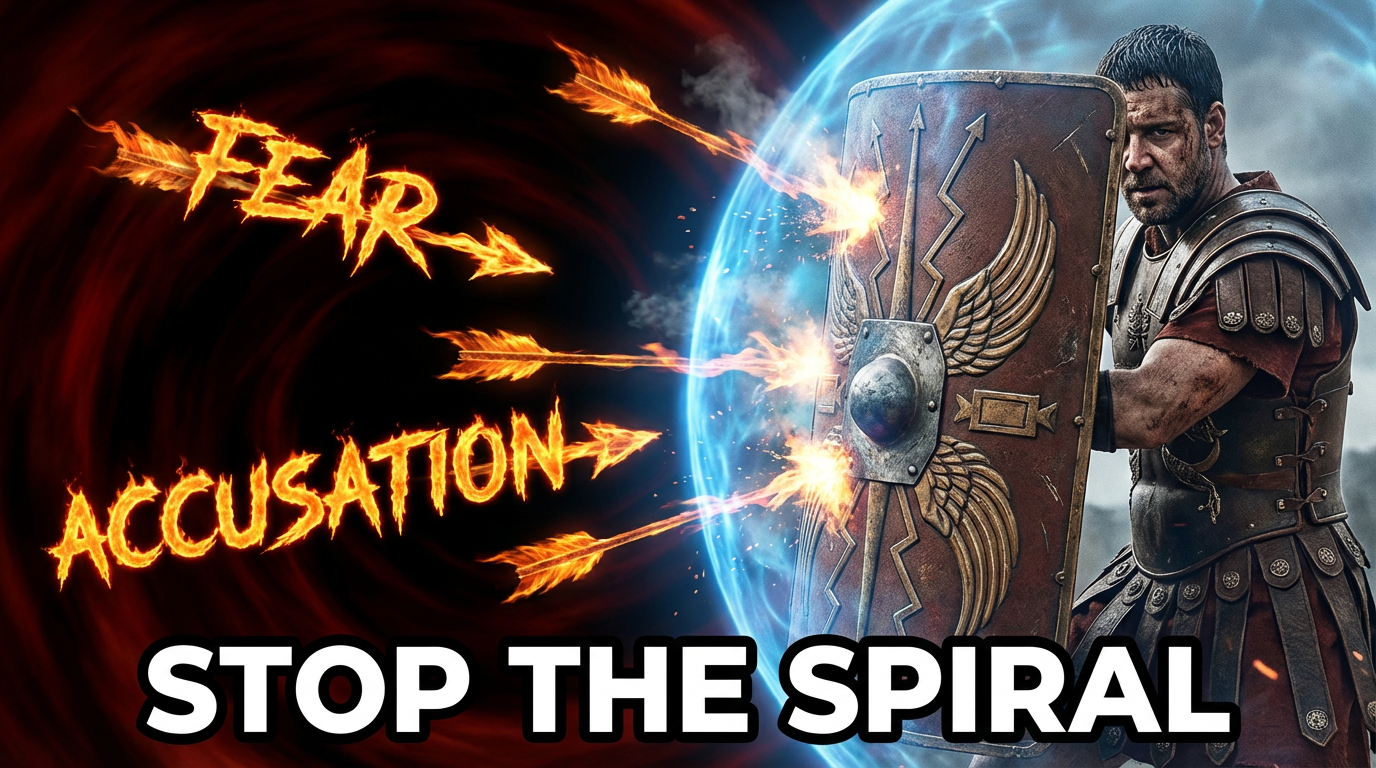
We keep treating every hot thought like it is automatically our own, automatically true, automatically urgent, automatically authoritative.
And once the mind is on fire, obedience gets sloppy.
Prayer gets thin.
Community gets avoided.
Old vows return.
Fear scripts start writing the day.
So in this episode, I want to train you like a disciple, not entertain you like a spectator.
The Bible does not only expose the enemy.
The Bible equips the follower of the Way to stand loyal under King Yeshua.
PRIMARY BIBLE TEXT, SIDE BY SIDE
Author and audience context, in plain language:
Paul wrote Ephesians to believers learning how to live under Messiah in a world filled with rival powers, rival loyalties, and constant pressure to compromise. The situation is not a horror movie. It is discipleship under pressure. The original community would have heard this as formation language for everyday life: stand, hold the line, stay loyal.
LEB, Ephesians 6:16
“In all circumstances, taking up the shield of faith, with which you will be able to extinguish all the flaming arrows of the evil one.”
CJSB, Ephesians 6:16
“Above all, taking up the shield of trust, with which you will be able to extinguish all the flaming arrows of the Evil One.”
Right there is the promise and the training.
All circumstances.
Not some.
Not only when you feel strong.
All.
And the shield is faith, or trust, which is not mere agreement.
In the Bible’s world, trust is loyalty expressed in action. It is covenant faithfulness under a King.
This is why the CJSB translation choice helps: trust is not a mood, it is reliance.
The arrow still flies, but it dies on impact.
WHAT A FLAMING ARROW SOUNDS LIKE
In real life, a flaming arrow usually sounds like one of three voices.
1. Accusation: “God’s done with you.”
2. Fear: “If you obey, you will lose everything.”
3. Resignation: “This is just who you are.”
Do you see the pattern?
Accusation tries to move you away from God.
Fear tries to move you away from obedience.
Resignation tries to move you away from identity.
And all three are trying to break loyalty.
That is why this matters.
Because if you do not learn how to extinguish the arrow, you will start living like the fire is truth.
A HUMBLE, HUMAN MOMENT
Some arrows hit at night.
The room is quiet, and suddenly your mind becomes a courtroom.
“You call yourself a believer?”
“After what you did?”
“You will never change.”
Some arrows hit when you try to pray.
You slow down, you finally come near, and the thought arrives like a slap.
“You are fake.”
“God is tired of you.”
Some arrows hit when life pressures you.
You are driving, working, carrying responsibilities, and the arrow lands.
“What if you lose your job?”
“What if you get sick?”
“What if your family falls apart?”
Listen carefully.
The thought is not automatically yours just because it is in your head.
The thought is not automatically true just because it is loud.
And the thought is not automatically urgent just because it is hot.
THE SHIELD IS NOT POSITIVE THINKING
The shield is not you repeating, “I am fine.”
The shield is you saying, “God is faithful, and I will be faithful.”
This is where the Hebraic worldview steadies you.
Biblical faith is not merely believing something is real.
It is emunah, eh moo NAH, faithfulness, steadiness, reliability.
It is a life soaked in the truth of God’s character, practiced through obedience, so that when fire hits, it dies faster.
And this is also why spiritual warfare is ultimately about allegiance, not entertainment.
The unseen conflict is not there to produce obsession.
It is there to expose loyalties.
When the arrow hits, who do you trust?
FOUR STEP SHIELD PRACTICE, DO THIS THIS WEEK
Here is the drill. Do not make it complicated.
Step 1. Identify the arrow.
Write the sentence that hits you.
Step 2. Label the category.
Accusation, fear, or resignation.
Step 3. Test it.
Ask one word: “Proof?”
Ask: “What fruit does this produce?”
Ask: “Does this make God smaller than the Bible reveals Him to be?”
Step 4. Answer and obey.
Speak one Bible sentence out loud.
Then take one obedience action that matches the truth.
Because truth becomes yours when you obey it.
If the arrow says, “God is distant,” answer with one Bible sentence about His nearness, then pray out loud anyway.
If the arrow says, “I am alone,” answer with one Bible sentence about God’s presence, then reach out to one person anyway.
If the arrow says, “I will never change,” answer with one Bible sentence about new creation life, then take one faithful step anyway.
You are not trying to eliminate all arrows in a day.
You are training your shield so the fire dies faster.
SECOND PRIMARY TEXT, SIDE BY SIDE
LEB, Ephesians 6:10 to 12
“Finally, be strengthened in the Lord and in the strength of his might. Put on the full armor of God, so that you will be able to stand against the schemes of the devil. Because our struggle is not against blood and flesh, but against the rulers, against the authorities, against the world rulers of this darkness, against the spiritual forces of evil in the heavens.”
CJSB, Ephesians 6:10 to 12
“Finally, grow powerful in union with the Lord, in union with his mighty strength. Use all the armor and weaponry that God provides, so that you will be able to stand against the deceptive tactics of the Adversary. For we are not struggling against human beings but against the rulers, authorities and cosmic powers governing this darkness, against the spiritual forces of evil in the heavenly realm.”
Paul’s verb is not “panic.”
It is stand.
The goal is not to feel intense.
The goal is to remain loyal.
And the shield is one of the primary ways God keeps you steady when pressure tries to rewrite your story.
QUESTIONS FOR YOU
4. What is one recurring thought that hits you when you are tired, stressed, or disappointed that you know is not from God?
5. When an arrow hits you, what do you do first: spiral, isolate, lash out, or shut down?
6. What Bible sentence are you going to answer with this week, and what obedience step will you take within 24 hours?
CLOSING CHALLENGE AND CHOICE
Here is your challenge.
Do the four step shield practice one time per day for seven days.
One arrow.
One truth sentence.
One obedience move.
Here is your choice.
You can keep reacting like fire is truth.
Or you can stand like Messiah is King.
You can keep letting arrows write your days.
Or you can pick up the shield and keep your formation.
If you want to go deeper, Click HERE to watch the full episode and walk it with me.
Series: Flaming Arrows: How to Extinguish Them
The Armor They Never Told You About
Episode 3: What Are the Flaming Arrows, and How Do You Extinguish Them?
SUMMARY
This study guide equips followers of the Way to recognize “flaming arrows” as a biblical category of spiritual warfare that commonly lands in the mind as accusation, fear, and resignation. Ephesians 6 does not train believers for spectacle; it trains believers for stability. The shield of faith is not mere positive thinking. It is covenant trust expressed through loyalty to God’s revealed character under King Yeshua. The goal is not the elimination of all pressure, but the extinguishing of the fire so obedience remains steady. The practical outcome is a repeatable four step “shield drill” that turns Bible truth into lived traction through one concrete obedience move.
KEY TERMS (WITH PRONUNCIATION)
7. Flaming arrows: images of hostile projectiles intended not only to pierce but to ignite panic, confusion, and collapse of formation. In lived discipleship, these often arrive as hot, urgent thoughts that demand agreement.1
8. Shield of faith: faith as trust and faithfulness, not merely mental assent. In Ephesians 6:16, the shield is the primary tool for extinguishing the flaming arrow in “all circumstances.”2
9. Pistis, PEE stis: Greek term commonly translated faith, trust, and sometimes faithfulness. In Paul, the covenant sense of allegiance and reliance is often central.3
10. Thureos, thoo REH os: Greek term for a large shield, related to thura, THOO rah, “door,” emphasizing coverage and protection.4
11. Emunah, eh moo NAH: Hebraic category of firmness, steadiness, faithfulness, reliability. Biblical trust is lived allegiance, not mood.5
12. Schemes, tactics: Ephesians 6 emphasizes strategy and deception. Warfare is often fought through meaning, interpretation, and loyalty, not merely dramatic manifestations.6
CONTEXT AND EXEGESIS
A. Author, audience, and situation: Ephesians as formation under pressure
Ephesians is written to believers being shaped into a faithful community under Messiah in a world of rival powers and competing narratives. The letter does not treat spiritual conflict as entertainment. It assumes spiritual conflict is real and that it presses upon daily life through deceptive tactics. Paul’s call is not to chase mystical experiences but to stand, to remain steady, and to resist schemes that aim to disrupt obedience and communal cohesion.7
B. Primary text: Ephesians 6:16, side by side
LEB, Ephesians 6:16
“In all circumstances, taking up the shield of faith, with which you will be able to extinguish all the flaming arrows of the evil one.”
CJSB, Ephesians 6:16
“Above all, taking up the shield of trust, with which you will be able to extinguish all the flaming arrows of the Evil One.”
Key observations:
13. “In all circumstances” establishes scope. This is not specialty warfare for rare events. It is daily discipleship stability.8
14. The shield is “faith” and “trust.” The CJSB’s “trust” is not a different concept; it illuminates the relational and covenant dimension of pistis. Faith is reliance upon God’s character and promises that expresses itself through obedience.9
15. The outcome is “extinguish.” The arrow may still fly, but the fire dies on impact. That means victory is not “no arrows.” Victory is “no sustained burn.”10
C. Larger frame: Ephesians 6:10 to 12, side by side
LEB, Ephesians 6:10 to 12
“Finally, be strengthened in the Lord and in the strength of his might. Put on the full armor of God, so that you will be able to stand against the schemes of the devil. Because our struggle is not against blood and flesh, but against the rulers, against the authorities, against the world rulers of this darkness, against the spiritual forces of evil in the heavens.”
CJSB, Ephesians 6:10 to 12
“Finally, grow powerful in union with the Lord, in union with his mighty strength. Use all the armor and weaponry that God provides, so that you will be able to stand against the deceptive tactics of the Adversary. For we are not struggling against human beings but against the rulers, authorities and cosmic powers governing this darkness, against the spiritual forces of evil in the heavenly realm.”
Key observations:
16. “Stand against schemes” clarifies the method. The enemy’s work includes deception, mislabeling, and strategic pressure.11
17. “Not against blood and flesh” corrects misdirected hostility. The disciple must not treat people as ultimate enemies.12
18. “Rulers, authorities, cosmic powers” places the conflict in the unseen realm, but the goal of the text remains grounded: a faithful stance under Messiah, not obsession or sensationalism.13
D. The shield image and ancient backdrop
Paul’s image of the shield is not decorative. The thureos language evokes a large shield associated with a door, emphasizing coverage. The ancient warfare purpose of flaming arrows was often to ignite fear, chaos, and broken ranks. In the lived spiritual sense, a flaming arrow can be understood as a thought that arrives with heat, urgency, and accusation, attempting to bypass discernment and provoke reaction.14
This is why the episode trains a “slow down” reflex. The arrow’s power increases with speed. Speed bypasses cross examination. The disciple is trained to interrupt the moment of agreement.
E. Faith as covenant loyalty, not mood
In Hebraic categories, trust is not a sentimental feeling. It is a posture of allegiance and reliability. Emunah describes firmness and steadiness, what can be leaned on. Faithfulness is lived loyalty. This aligns with the New Testament emphasis that genuine trust expresses itself in obedience, not merely in internal agreement.15
This matters pastorally because many believers confuse spiritual growth with emotional intensity. Ephesians reframes the goal: stand, remain, extinguish, obey.
F. Practicing the shield: the four step drill
19. Identify the arrow: Write the sentence that hits you.
20. Label the category: accusation, fear, or resignation.
21. Test it: Ask “Proof?” Ask what fruit it produces. Ask if it shrinks God below His revealed character.
22. Answer and obey: Speak one Bible sentence out loud, then take one obedience step that matches truth.
This drill turns theology into traction. The goal is not merely cognitive replacement but embodied obedience, because truth becomes “yours” when you practice it.16
DISCUSSION QUESTIONS
23. What recurring “hot thought” tends to hit you when you are tired, stressed, disappointed, or lonely?
24. Which category fits it best: accusation, fear, or resignation? Why?
25. How does that thought attempt to rename God, rename you, or rename suffering?
26. What is the “speed factor” in your own life? When do you tend to agree with thoughts without cross examining them?
27. What is one Bible sentence you can answer with that directly contradicts your recurring arrow?
28. What one obedience step will you take within 24 hours that matches that truth?
29. How does isolation increase vulnerability to arrows in your experience? What does covenant community look like for you right now?
PRACTICAL APPLICATION (ONE WEEK TRAINING PLAN)
Day 1: Capture one arrow. Write it. Label it. Do not fix it yet. Just name it.
Day 2: Add the “Proof?” test. Write what evidence you assumed. Write what evidence you actually have.
Day 3: Choose one Bible sentence as your answer. Keep it short. One sentence, not a paragraph.
Day 4: Speak the sentence out loud when the arrow hits. Out loud matters. Silence gives lies home field advantage.
Day 5: Add one obedience move. If the arrow pushes you toward fear, practice one faithful action anyway.
Day 6: Repeat the drill on a second arrow, smaller if needed.
Day 7: Review. What patterns did you notice? What triggers? What times of day? What relationships? What vulnerabilities?
Close with this practice: Ask the Ruach HaKodesh, roo AHK hah KOH desh, the Holy Spirit, to train your reflexes toward truth and loyalty. Ask for a steady mind, a faithful heart, and courage to obey.
FOOTNOTES
30. Clinton E. Arnold, Ephesians, Zondervan Exegetical Commentary on the New Testament (Grand Rapids, MI: Zondervan, 2010).
31. The Lexham English Bible (Bellingham, WA: Lexham Press, 2012), Eph 6:16.
32. The Complete Jewish Study Bible (Peabody, MA: Hendrickson Publishers, 2016), Eph 6:16.
33. Andrew T. Lincoln, Ephesians, Word Biblical Commentary (Dallas, TX: Word Books, 1990).
34. Michael L. Brown, Answering Jewish Objections to Jesus, vol. 4 (Grand Rapids, MI: Baker Books, 2007).
35. Clinton E. Arnold, Three Crucial Questions About Spiritual Warfare (Grand Rapids, MI: Baker Books, 1997).
36. Michael S. Heiser, The Unseen Realm: Recovering the Supernatural Worldview of the Bible (Bellingham, WA: Lexham Press, 2015).
37. The Lexham English Bible, Eph 6:10 to 12.
38. The Complete Jewish Study Bible, Eph 6:10 to 12.
39. John R. W. Stott, The Message of Ephesians, The Bible Speaks Today (Downers Grove, IL: InterVarsity Press, 1979).
40. Clinton E. Arnold, Ephesians.
41. Heiser, The Unseen Realm.
42. Arnold, Three Crucial Questions About Spiritual Warfare.
43. Lincoln, Ephesians.
44. Skip Moen, “emunah,” in Hebrew Word Study resources, accessed via SkipMoen.com.
45. Arnold, Ephesians; Stott, The Message of Ephesians.
BIBLIOGRAPHY
Arnold, Clinton E. Ephesians. Zondervan Exegetical Commentary on the New Testament. Grand Rapids, MI: Zondervan, 2010.
Arnold, Clinton E. Three Crucial Questions About Spiritual Warfare. Grand Rapids, MI: Baker Books, 1997.
Brown, Michael L. Answering Jewish Objections to Jesus. Vol. 4. Grand Rapids, MI: Baker Books, 2007.
Heiser, Michael S. The Unseen Realm: Recovering the Supernatural Worldview of the Bible. Bellingham, WA: Lexham Press, 2015.
The Complete Jewish Study Bible. Peabody, MA: Hendrickson Publishers, 2016.
The Lexham English Bible. Bellingham, WA: Lexham Press, 2012.
Lincoln, Andrew T. Ephesians. Word Biblical Commentary. Dallas, TX: Word Books, 1990.
Stott, John R. W. The Message of Ephesians. The Bible Speaks Today. Downers Grove, IL: InterVarsity Press, 1979.
Moen, Skip. Hebrew Word Study resources. Accessed via SkipMoen.com.
Shalom b’Shem Yeshua
© 2025 Dr. Shawn M. Greener. All Rights Reserved.
True Word, Faith for LIFE!
flaming-arrows-shield-of-faith

Author / Host / Theologian
I am just a beggar who found Bread, helping other hungry beggars to find Him too. My life has certainly been complex and I and my halo has many dents. Heschel said; "Something Sacred hangs in the balance of every moment." I live like it. I teach like it.
As a person who survived a fatal 92 mph vs 51 mph head on crash, after dying and re-animating, and surviving several other brushes with death, my perspective is, let's say, unique. I haven't always been a theologian and I'm living REAL life, just like you... I have my hurts, habits and hangups too.
I've learned a few very important things along the way that I'm confident you'll find useful... butter for the Gluten free Bread so to speak.. Oh, you may chuckle or full on snort along the way, but you might also shed a few tears... Faith for LIFE... That's how it happens.
Tucker and Candace Lie About Israel and God