Armor Isn’t Magic: What Paul Was Really Teaching About Spiritual Warfare!
Armor Isn’t Magic. It’s Who You’re Becoming.
WATCH on True Word Faith for LIFE with Dr. Shawn
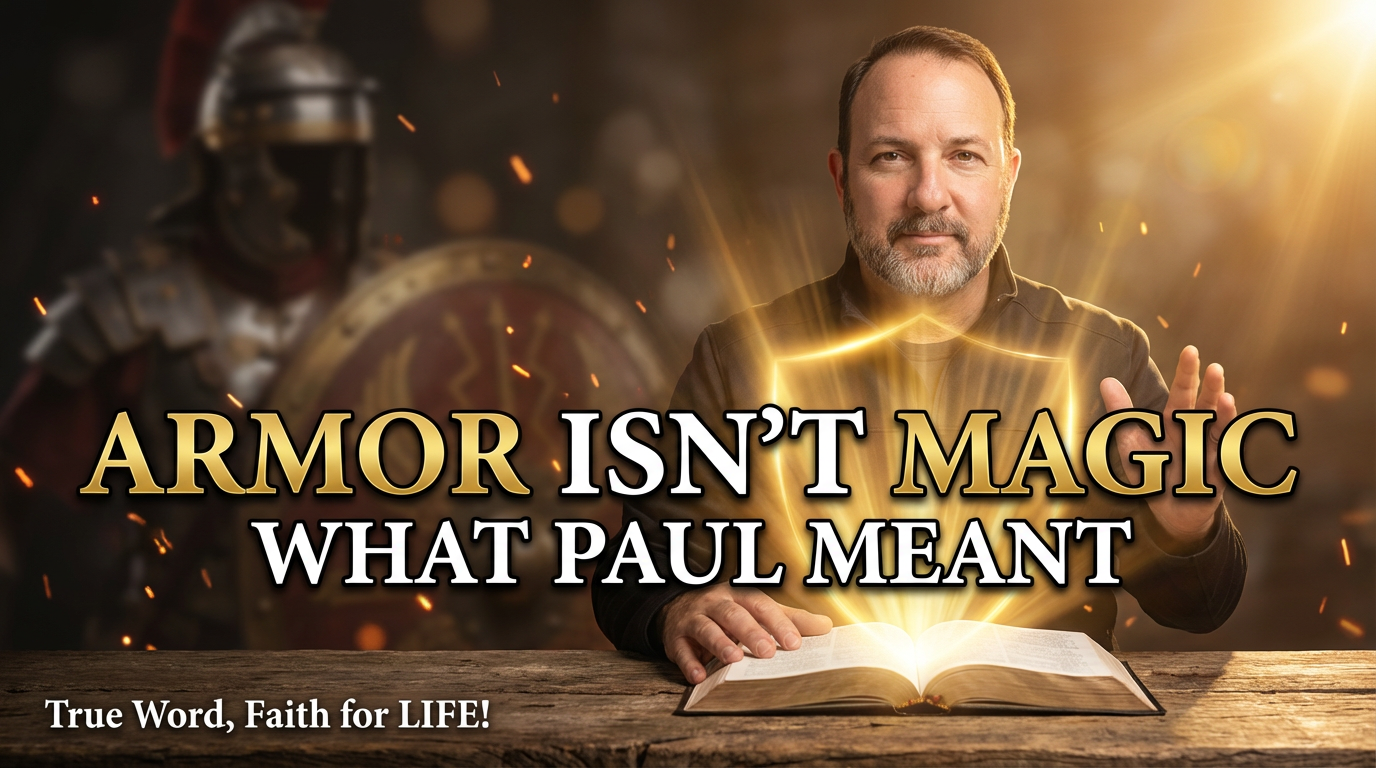
There’s a phrase I’ve heard my entire Christian life.
“I put on the armor of God this morning.”
Maybe you’ve said it too?
It usually sounds confident. Faith-filled. Responsible.
Helmet on. Breastplate on. Sword ready.
And yet, for many people, life still falls apart by lunchtime.
Relationships fracture. Anxiety spikes. Temptation wins. Fear creeps back in.
And then the quiet question follows.
Did I not pray hard enough?
Did I forget a piece?
Did God not protect me?
If you’ve ever felt that tension, you’re not weak. You’re honest.
Here’s the truth most of us were never taught.
Paul never described the armor of God as a ritual you recite.
He described it as a life you grow into.
Armor is not magic.
Armor is formation.
Paul wrote Ephesians to believers living in Ephesus, a city obsessed with power, magic, fear, and spiritual manipulation. They didn’t need more superstition baptized in Christian language. They needed stability. They needed faithfulness. They needed to learn how to stand when pressure hit.
That’s why the repeated command in Ephesians 6 isn’t fight, shout, or chase demons.
It’s stand.
Standing isn’t dramatic.
Standing is costly.
Standing requires character.
The armor Paul describes is not about avoiding hardship. It’s about remaining loyal in the middle of it. Truth when lies would be easier. Righteousness when compromise would be quicker. Shalom when panic would feel justified. Trust when fear is loud. Identity when shame whispers. God’s Word when your own thoughts are spiraling.
A uniform doesn’t make you a soldier.
It reveals who you already belong to.
In the same way, the armor of God doesn’t make you strong.
It reveals the strength God is already forming in you through covenant loyalty.
Jesus isn’t offering you a spell for your mornings.
He’s offering you a new life under a new King.
And that kind of armor doesn’t come from saying the right words.
It comes from becoming the right kind of person.
If you’re tired of formulas that don’t hold up under pressure, this teaching is for you.
If you’re curious about faith but wary of religious performance, this teaching is for you.
If you want something real, grounded, and honest, this teaching is for you.
Armor isn’t magic.
It’s who you’re becoming.
Shalom b’Shem Yeshua
© 2026 Dr. Shawn M. Greener. All Rights Reserved.
True Word, Faith for LIFE!
STUDY GUIDE
TRUE WORD, FAITH FOR LIFE!
SPIRITUAL WARFARE SERIES
EPISODE 4
ARMOR ISN’T MAGIC:
WHAT PAUL WAS REALLY TEACHING

SUMMARY
This teaching reframes the armor of God from ritual language into covenant identity formation. Paul was not giving believers a spoken protection formula. He was describing the lived moral and covenant character of those who belong to Messiah. In the Ancient Near Eastern and Second Temple Jewish worldview, spiritual warfare was primarily understood as loyalty to God under pressure, not ritual incantation or verbal protection practices.
This episode demonstrates how modern Western Christianity sometimes unintentionally reintroduced pagan style ritual thinking into armor teaching by turning it into something spoken rather than something lived. The armor is best understood as identity alignment with the character of God and covenant loyalty to the King.
PRIMARY BIBLE TEXTS
LEB Ephesians 6:13
Because of this, take up the full armor of God, in order that you may be able to resist in the evil day, and having done everything, to stand.CJSB Ephesians 6:13
So take up every piece of war equipment God provides; so that when the evil day comes, you will be able to resist; and when the battle is won, you will still be standing.LEB Isaiah 59:17
And he put on righteousness like a breastplate, and a helmet of salvation on his head.CJSB Isaiah 59:17
He put on righteousness as his breastplate, salvation as a helmet on his head.
ANE AND SECOND TEMPLE CONTEXT
In ANE covenant culture, clothing symbolized identity, allegiance, and function. Armor was not merely protection. It signaled who you served and how you were expected to live.
Second Temple Jewish spiritual warfare thinking centered on covenant loyalty. The defeat of evil was primarily framed as faithfulness to God, Torah obedience, and allegiance to His kingdom rather than ritual formulas or spoken spiritual techniques.
KEY TERMS
Emet
Truth, reliability, covenant faithfulness, stability of character.
Tzedakah
Right relationship expressed through faithful action.
Shalom
Covenant wholeness, restoration, alignment with God’s order.
Emunah
Steadfast trust rooted in proven covenant relationship.
THEOLOGICAL FRAMEWORK
Spiritual warfare is covenant loyalty lived under pressure.
Armor represents identity transformation, not ritual protection.
Victory is faithfulness, not circumstantial avoidance of suffering.
The Bible is applied first to personal obedience before public argument.
DISCUSSION QUESTIONS
Have I ever treated spiritual language as a substitute for spiritual obedience?
Which piece of armor reflects my strongest spiritual growth area right now?
Which piece of armor reveals my current vulnerability?
How does covenant loyalty change my understanding of spiritual warfare?
PRACTICAL APPLICATION
Daily Truth Practice
Refuse self deception and hidden compromise.
Daily Righteousness Practice
Choose relational integrity over image management.
Daily Shalom Practice
Respond from covenant security, not fear reaction.
Daily Faith Practice
Trust God’s character when outcomes are unclear.
Daily Salvation Identity Practice
Think like someone rescued, not abandoned.
Daily Bible Practice
Apply the Bible to yourself before applying it to others.
BIBLIOGRAPHY
The Complete Jewish Study Bible. Hendrickson Publishers.
Lexham English Bible. Lexham Press.
Heiser, Michael. The Unseen Realm.
Moen, Skip. Various Hebraic worldview teachings.
Shalom b’Shem Yeshua
© 2026 Dr. Shawn M. Greener. All Rights Reserved.
True Word, Faith for LIFE!
Armor of God meaning, Spiritual warfare Bible teaching, Ephesians 6 explained, Hebraic worldview, spiritual warfare, ANE Bible context, Covenant loyalty, Bible teaching

Author / Host / Theologian
I am just a beggar who found Bread, helping other hungry beggars to find Him too. My life has certainly been complex and I and my halo has many dents. Heschel said; "Something Sacred hangs in the balance of every moment." I live like it. I teach like it.
As a person who survived a fatal 92 mph vs 51 mph head on crash, after dying and re-animating, and surviving several other brushes with death, my perspective is, let's say, unique. I haven't always been a theologian and I'm living REAL life, just like you... I have my hurts, habits and hangups too.
I've learned a few very important things along the way that I'm confident you'll find useful... butter for the Gluten free Bread so to speak.. Oh, you may chuckle or full on snort along the way, but you might also shed a few tears... Faith for LIFE... That's how it happens.
Tucker and Candace Lie About Israel and God